Physicists found a hidden order in the zoo of strange paths that objects can trace in the curved space around a black hole, allowing them to create a "periodic table" of black hole orbits.
This knowledge could help scientists focus their search for gravitational waves, ripples in space triggered by the movements of massive objects, such as a pair of orbiting black holes.
Far from a black hole, an object will trace an ellipse as it orbits the massive object, as the planets in our solar system do when orbiting the Sun.
But very close to a black hole, the general theory of relativity predicts rare behavior, due to the way the ultra-powerful gravitational field of black holes warps the fabric of space. For example, an object could travel on an elongated path toward the black hole, then perform a tight loop around the hole one or more times before being thrown outward again.
Objects that make these close passages follow paths that essentially never repeat in exactly the same shape, their courses dictated by initial trajectories and velocities.
Discovering some hidden order in the bewildering variety of possible orbits might seem impossible, but physicists Janna Levin and Gabe Perez-Giz of Columbia University in New York did just that.
They used mathematical models in which the trajectory and initial velocity of an object are set in the right way to allow its orbit to repeat exactly - a "perfect" situation the authors say would never happen in the real world.
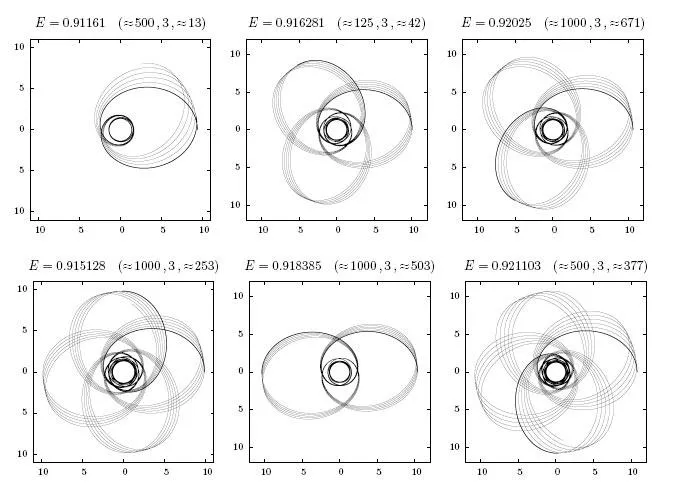
Clover design
An example of this is the clover design, where the object traces each leaf in the design, then repeats it all again when it returns to its starting point. "It's totally different from what we see in the behavior of planetary orbits," Levin told New Scientist.
The key, found by the researchers, was that for every non-repeating path that real-world objects are likely to follow, there is a corresponding repeating path that traces a very similar course. For example, an object traveling in an elliptical orbit where the orbit itself precesses around, or rotates, could be modeled by a flower-like structure with 10 million overlapping petals.
That discovery allowed the team to organize all possible paths into different groups, based on the repeating path they resemble. This could be useful for scientists searching for gravitational waves.
Deciphering signals
This is because the pattern of gravitational waves produced by two black holes orbiting each other before merging depends on the shape of their orbits.
A better understanding of these orbits could give physicists a better idea of what to look for in the data collected by observatories.
And since a pair of orbiting black holes is described by about 10 key numbers - including their mass, spin rate, spin direction - the new "periodic table" could help physicists determine those physical characteristics from any gravitational wave they observe from such pairs, says Levin.
"I think no one has tried to create a classification like this before," says Daniel Kennefick, a black hole expert at the University of Arkansas. "It could well be a fruitful idea." He added that there is a curious thing about classifications: "it's very hard to say until some time has passed how useful they might be."
Sources and related links
- New Scientist:'Periodic table' organises zoo of black hole orbits, by David Shiga
- A Periodic Table for Black Hole Orbits
Janna Levin, Gabe Perez-Giz - Janna Levin's site
About the images
An object orbiting near a black hole can trace a variety of intricate designs.
Illustration:Janna Levin/Gabe Perez-Giz/Columbia University.