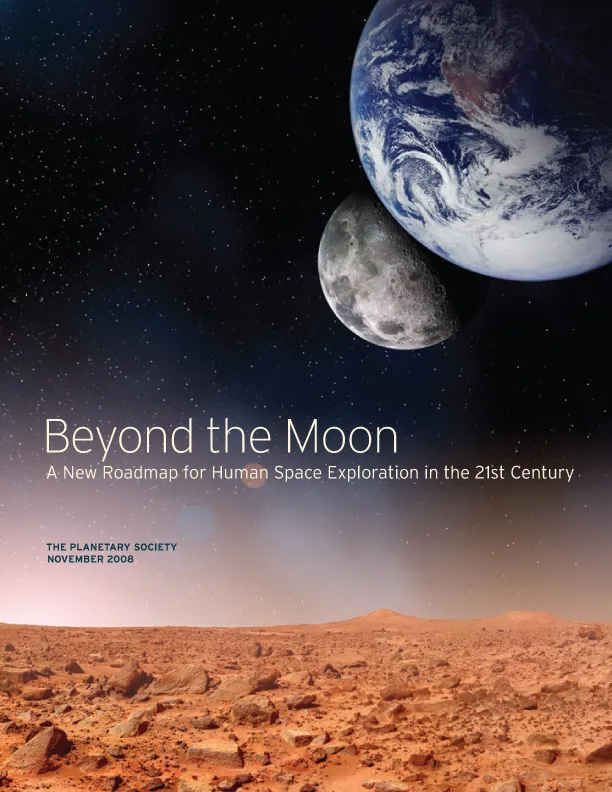
The Planetary Society strongly recommends a new approach to space exploration in "Beyond the Moon: A New Roadmap for Human Space Exploration in the 21st Century". The Society created this guide for the consideration of the U.S. Congress and the new administration.
The impetus for creating this "roadmap" came from a workshop by the Planetary Society and Stanford University, titled "Examining the Vision: Balancing Science and Exploration" [1]. Held at Stanford in February 2008, the workshop brought together about 50 experts from a diverse range of space-related disciplines to discuss the United States' Vision for Space Exploration.
The key elements in this roadmap include:
- Focusing on Mars as the goal for human spaceflight
- Deferring human lunar landings until the costs of the interplanetary transportation system and the shuttle replacement are largely paid for
- Accelerating climate change research through more detailed Earth observations
- Achieving a step-by-step approach to new goals in interplanetary flight, including a human mission to a near-Earth object.
The new guide calls for achieving a more flexible program, based on a series of new achievements and an international commitment to exploration and discovery.
Principles

Since President Bush proposed the Vision for Space Exploration in January 2004, NASA has sought an implementation plan heavily influenced by its roots in the Cold War era and by the success of the Apollo program four decades ago. Through a series of expert workshops, opinions in the press and before the U.S. Congress, the sentiment that the plan might not achieve its objectives. Moreover, concern is growing that the current strategy could result in something more than a costly and repeated extension of Apollo's achievements. That is why The Planetary Society opens the debate by articulating a series of guiding principles and their implementation for a new paradigm.
The human spaceflight program of nations is a symbol of global leadership as well as an engine for technology and innovation. It allows achieving national and international interests and should be planned and conducted as an international objective.
These objectives should be planned as a long-term program, with clear, strongly founded ultimate goals and a sustained national commitment. The current implementation of the program does not have adequate funding and focuses on short-term objectives.
The exploration of Mars should be the objective of spaceflights. Mars holds a special place in scientific and popular culture due to its connection with questions about life in the universe and its potential as a long-term home for humanity.
The most effective and achievable plan is one that includes important intermediate destinations, gradual development of new capabilities, and key robotic missions as foundation stones for human flights to Mars.
Science, exploration, and technology are inseparable.
Many of the great human explorations in the past were carried out primarily for cultural or political reasons but still resulted in revolutionary scientific advances and new capabilities.
A robust human spaceflight program will lead to unexpected and unique discoveries. Science provides a framework for the technology that enables all exploration; our technology, in turn, defines our culture, educates people, and drives the economy and national security.
Exploration and discovery represent a continuous and interactive process of science and adventure that is woven into humanity. The integration of human and robotic explorers working together in an integrated program will lead humanity toward its future in the solar system and will be a source of inspiration and education. The cultural and economic impact of expanding human horizons beyond our planet, beyond Earth orbit, beyond the moon will define not only the future of a single nation or people, but of the entire human race.
Recommendations
Based on these principles and the input from individuals and groups who participated in recent discussions, workshops, and debates, The Planetary Society makes a series of recommendations for the implementation of the space program.
- 1-Establish a global collaboration in space exploration.
The United States should capture the global community's attention in a long-term program, based on the free exchange of ideas and results, shared costs, and broad participation and inspiration of young people. Strategic international investment should be developed with synergy rather than duplication. - 2-Establish a program that takes humanity to the solar system.
The (U.S.) National Space Council should reexamine and develop an exploration architecture, whose ultimate goal is the establishment of human capabilities for the exploration of Mars. This architecture should incorporate new, culturally significant achievements as steps toward Mars, including:
The first human journeys beyond the Earth-Moon system
The first human journeys beyond Earth's gravitational influence
The first human exploration of near-Earth asteroids
The first human journeys to another planet, culminating in a landing on Mars and safe return to Earth
The first base on Mars with self-sustaining energy and resources - 3-Develop a national capability for interplanetary transportation and life support
The new systems being planned now, Ares and Orion, were designed primarily to meet the requirements for lunar and Earth orbit missions and their extension to interplanetary destinations should be studied and reviewed. Research will be necessary on the human ability to live and work for extended periods in deep space or at interplanetary destinations. This should include the use of resources for the production of water, oxygen, etc. - 4-Human missions to the Moon based on need and in concert with international partners
The current vision sets the goal of new lunar landings for 2020 and this led to a series of programmatic decisions that would delay the expansion of human activity beyond the Earth-Moon system. It has also led to budget conflicts between the human flight program and the highly successful robotic programs.
Lunar missions should be carried out if they are clearly beneficial and cost-effective for validating exploration techniques beyond Earth. And we should not compete against other space agencies whose priorities include lunar exploration. - 5-Ensure that robotic and scientific initiatives are protected and enhanced.
Ensure that initiatives take advantage of very important synergies. Emphasize the proper mix of human and robotic elements and understand the best role for human explorers in achieving scientific objectives.
The space shuttle
One of the elements of the Vision for Space Exploration is the decision to retire the Space Shuttle by 2010. This is a necessary step, consistent with the findings of the Columbia accident investigation.
The retirement of the shuttle allows nations to dedicate resources to developing the new Ares launch vehicle and the Orion exploration vehicle, which are critical for human exploration. In the interim, the United States and its international partners have a number of options to provide continued access to the International Space Station. Among others, the use of Russia's proven Soyuz flight system, development of new systems, or modification of existing ones (Atlas/Delta). While it is tempting to consider extending the shuttle beyond 2010, this would severely impact the ability of nations to extend human exploration beyond low Earth orbit. That measure should be taken only as a last resort to avoid the United States losing access to the ISS.
Summary
The Planetary Society indicates that the new U.S. administration has before it an opportunity to recapture the spirit of the Vision for Space Exploration. A new implementation plan is proposed, one that surpasses the achievements that could be obtained from the current vision, to achieve objectives beyond the Moon. This new implementation is proposed as a flexible series of steps that allow reaching new achievements and developing scientific and technical capabilities.
Continue the development of the Ares/Orion system and retire the Shuttle as soon as possible. Ensure access to the ISS.
Focus the early utilization of the new systems on the first human missions beyond the Moon.
Plan the first interplanetary trip. The target could be a Near-Earth Object, a class of object that represents an impact hazard, while also a new space potential.
Develop and validate new technologies to extend human presence in deep space. Use the ISS for space life research and plan missions to the moon if required by the emerging architecture.
Plan and conduct robotic scientific missions to increase our knowledge of the solar system and prepare for human exploration. Includes one or more Mars sample collection and return to Earth missions.
Establish a new emphasis on understanding Earth sciences and climate change.
Sources and related links
- Beyond the Moon
- [1]"Examining the Vision: Balancing Science and Exploration":
Examining the Vision: Balancing Science and Exploration - Planetary Society:The Planetary Society
- Beyond the Moon Roadmap
About the images
Cover of the new Planetary Society Roadmap.
Credit:The Planetary Society