The Cassini spacecraft sampled and collected organic material erupted from a geyser on Saturn's moon Enceladus during a flyby on March 12. Scientists are amazed that this small moon is so active, "hot" and brimming with water vapor and organic chemicals.
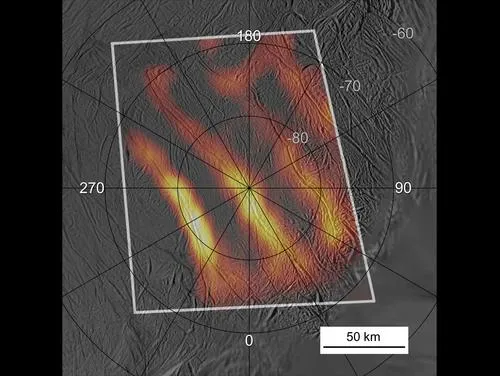
New surface temperature maps show higher temperatures than previously known in the south polar region, with hot trails running along large fissures. Additionally, scientists say the organics are similar to those found in a comet. The jets harmlessly splashed Cassini, exerting a torque on the spacecraft and providing an indirect measure of density.
"A completely unexpected surprise is that the chemistry of Enceladus, what comes from its interior, resembles a comet," says Hunter Waite, principal investigator of Cassini's ion spectrometer. "Having primordial material coming from the interior of a Saturnian moon raises many questions about the formation of the Saturn system."
"Enceladus is in no way a comet. Comets have tails and orbit the Sun and Enceladus's activity is generated by internal heat while a comet's activity is generated by sunlight," says Waite.
The ion spectrometer saw a higher density of volatile gases, water vapor, carbon dioxide and carbon monoxide, as well as organic materials, some 20 times denser than expected. This dramatic increase in density was evident as the spacecraft passed over the plume area.
New high-resolution heat maps of the south pole from Cassini's spectrometer show that the giant fissures that are the source of the geysers are hot along almost their entire length and reveal other warm fissures nearby. These new, more precise measurements reveal temperatures of at least -93º Celsius. That is 17ºC warmer than previously observed and 93º warmer than in other regions of the moon. The warmest regions correspond to the locations of the two jets seen in Cassini images.
"These spectacular new data will truly help us understand what generates the geysers. The surprisingly high temperatures make the existence of liquid water not far below the surface more likely," explains John Spencer, a Cassini scientist.
Previous ultraviolet observations showed four jet sources, matching the location of the water vapor plumes seen in earlier images. This indicates that the gas in the plumes exits from the surface into space, mixing to form a larger plume.
Images from other observations showed individual jets and marked the locations from which they emanate. New images show how the hot fractures are related to other surface features. In future observations, scientists hope to see the individual sources and investigate the differences between fractures.
"Enceladus has heat, water and organic chemicals, some of the essential building blocks needed for life," says Dennis Matson of JPL. "We have a recipe for life in our hands, but we still have to find the final ingredient, liquid water, but Enceladus is only whetting our appetites for more."
At its closest approach, Cassini was only 48 km from the Saturnian moon. During the flyby of the vapor plumes it was 193 km from the surface of Enceladus. The next flyby of this moon will be in August.
Sources and related links
Cassini-Huygens: Cassini Tastes Organic Material at Saturn's Geyser Moon
About the images
Heat radiating from the entire length of the 150 km long fractures is seen in this map of the active south polar region of Saturn's icy moon, Enceladus.
Credit: NASA/JPL/GSFC/SwRI/SSI