NASA's Cassini spacecraft has discovered evidence pointing to the existence of a subsurface ocean of water and ammonia on Saturn's moon Titan. The findings appear in the March 21 edition of Science.
Members of the mission's science team used Cassini's Synthetic Aperture Radar to collect data during 19 passes over Titan between October 2005 and May 2007. The radar can see through the moon's dense, methane-rich atmosphere, detailing never-before-seen features of its surface.
Using data from radar observations, the radar scientists and engineers established the location of 50 landmarks on Titan's surface. They then searched for the lakes, canyons, and mountains in the dataset returned by Cassini on its last flyby of the moon. They found that prominent surface features had shifted from their expected position by up to 30 kilometers. A systematic shift of surface features would be difficult to explain unless the icy crust were decoupled from its core by an internal ocean, making it easy for the crust to move.
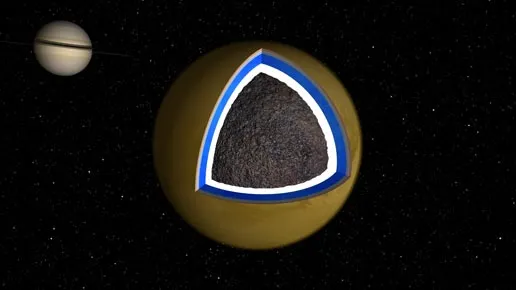
"We believe that about 100 kilometers beneath the icy and organically rich crust there is an internal ocean of liquid water mixed with ammonia," says Bryan Stiles of JPL.
"The combination of an organically rich environment and liquid water is very appealing to astrobiologists," says Ralph Lorenz, author of the paper and a Cassini radar scientist. "Further studies of Titan's rotation will allow us to better understand the watery interior and how the spin of the crust and the winds in the atmosphere are linked; we could see seasonal changes in the spin in the coming years."
Cassini scientists will not have to wait long to get more data from Titan. On March 25, just before its closest approach at an altitude of 1,000 kilometers, Cassini will use its spectrometer to examine the moon's upper atmosphere. Immediately after its closest approach, the visual and infrared mapping spectrometer will capture high-resolution images of Titan's southern quadrant.
Sources and related links
- NASA: Cassini Spacecraft Finds Ocean May Exist Beneath Titan's Crust
- Cassini site: Cassini Spacecraft Finds Ocean May Exist Beneath Titan's Crust
- Titan's Rotation Reveals an Internal Ocean and Changing Zonal Winds
Ralph D. Lorenz et al.
Science 21 March 2008:Vol. 319. no. 5870, pp. 1649 - 1651
DOI: 10.1126/science.1151639
About the images
Image: The image illustrates a cross-section of Saturn's moon Titan in which scientists speculate there is a layer of water and ammonia about 100 kilometers below the surface.
Credit: NASA/JPL