NASA's Mars Odyssey orbiter found evidence of salt deposits. These deposits point to places where water was abundant and where evidence of possible Martian life could exist in the red planet's past.
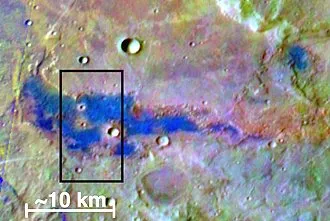
A team led by Mikki Osterloo of the University of Hawaii found approximately 200 places in southern Mars that show spectral characteristics consistent with chlorides. Chloride is part of many types of salt, such as sodium chloride.
"They could come from groundwater that reached the surface. The water would have evaporated and left mineral deposits. The sites are disconnected, so they are not likely to be remnants of a global ocean."
The scientists used the Thermal Emission Imaging System (THEMIS) camera, designed and operated by Arizona State University, to take images in a range of visible light and infrared wavelength. They think the deposits formed approximately between 3.5 and 3.9 billion years ago.
Whether life existed on Mars is the biggest scientific question driving research on that planet. On Earth, salt is good for preserving organic material. Bacteria have been revived in the laboratory after being preserved in salt deposits for millions of years.
"The discovery demonstrates the continuing value of the Odyssey mission, now entering its seventh year," says Jeffrey Plaut of JPL.
Sources and related links
- NASA:NASA Mission Finds New Clues to Guide Search for Life on Mars
- THEMIS:Mars salt deposit discovery points to a new place to hunt for life's ancient traces
About the images
The blue marks indicate chloride mineral (salt) deposits on Mars in this false-color image, which highlights differences in mineral composition.
Credit:NASA/JPL-Caltech/Arizona State University/University of Hawaii