By observing the remnant and the light echo of the initial burst, astronomers established the validity of a powerful new method for studying supernovas.
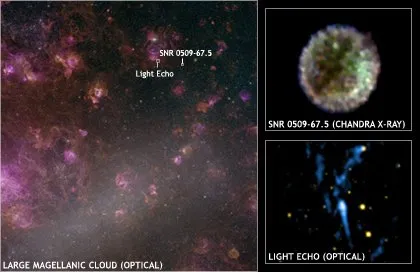
Using data from the Chandra X-ray Observatory, ESA's XMM-Newton Observatory, and the Gemini Observatory, two teams of researchers studied the supernova remnant and the light echo of the explosion that are located in the Large Magellanic Cloud (LMC), a small galaxy about 160,000 light-years from Earth. They concluded that the supernova occurred about 400 years ago and that it was unusually bright and energetic.
This result is the first to use two methods to estimate the energy of a supernova explosion: X-ray observations of the remnant and optical observations of the expansive light echoes of the explosion.
Until now, scientists made that estimate using the light seen shortly after the star's explosion or using remnants that are several hundred years old, but not both.
In 2004, scientists used Chandra to determine that a supernova remnant in the LMC, known as SNR 0509-67.5, was a Type Ia supernova, caused by a white dwarf in a binary system that reached critical mass and exploded.
In a new study, an estimate of the event's energy came from studying an echo of the original light from the explosion. Just as sound bounces off canyon walls, light waves create an echo by bouncing off dust clouds in space. The light from these echoes travels a longer path than the light traveling directly to us, so they can be seen hundreds of years after the supernova itself.
First seen by the Cerro Tololo Observatory in Chile, the light echoes were observed in great detail by the Gemini Observatory in Chile. The optical spectrum was used to confirm that the supernova was Type Ia and to unambiguously determine the particular class of explosion, and thus its energy.
The Chandra data, along with data obtained in 2000 by XMM, were then independently used to calculate the amount of energy involved in the original explosion, using an analysis of the supernova remnant and state-of-the-art explosion models. Their conclusion confirmed the results of the optical data, namely that the explosion was an especially energetic and bright Type Ia. This agreement provides strong evidence that the detailed models are accurate.
"Having these two methods agree gives us a sigh of relief," says Carlos Badenes of Princeton University, who led the Chandra and XMM study.
Both methods estimated a similar time since the explosion, about 400 years.
"We will be able to learn a lot about supernovas in our own galaxy by using this technique," says Armin Rest of Harvard University, who led the light echo observations using Gemini.
These results appear in two papers recently accepted to The Astrophysical Journal. The first discusses the spectrum obtained by Gemini. The second details the observations with Chandra and XMM.
Sources and related links
Chandra: Action Replay of Powerful Stellar Explosion
Papers accepted for publication in The Astrophysical Journal:
The Persistence of Memory, or How the X-Ray Spectrum of SNR 0509−67.5 Reveals the Brightness of Its Parent Type Ia Supernova
Carles Badenes, John P. Hughes, Gamil Cassam-Chenaï, and Eduardo Bravo
Spectral Identification of an Ancient Supernova Using Light Echoes in the LMC
A. Rest, et al.
About the images
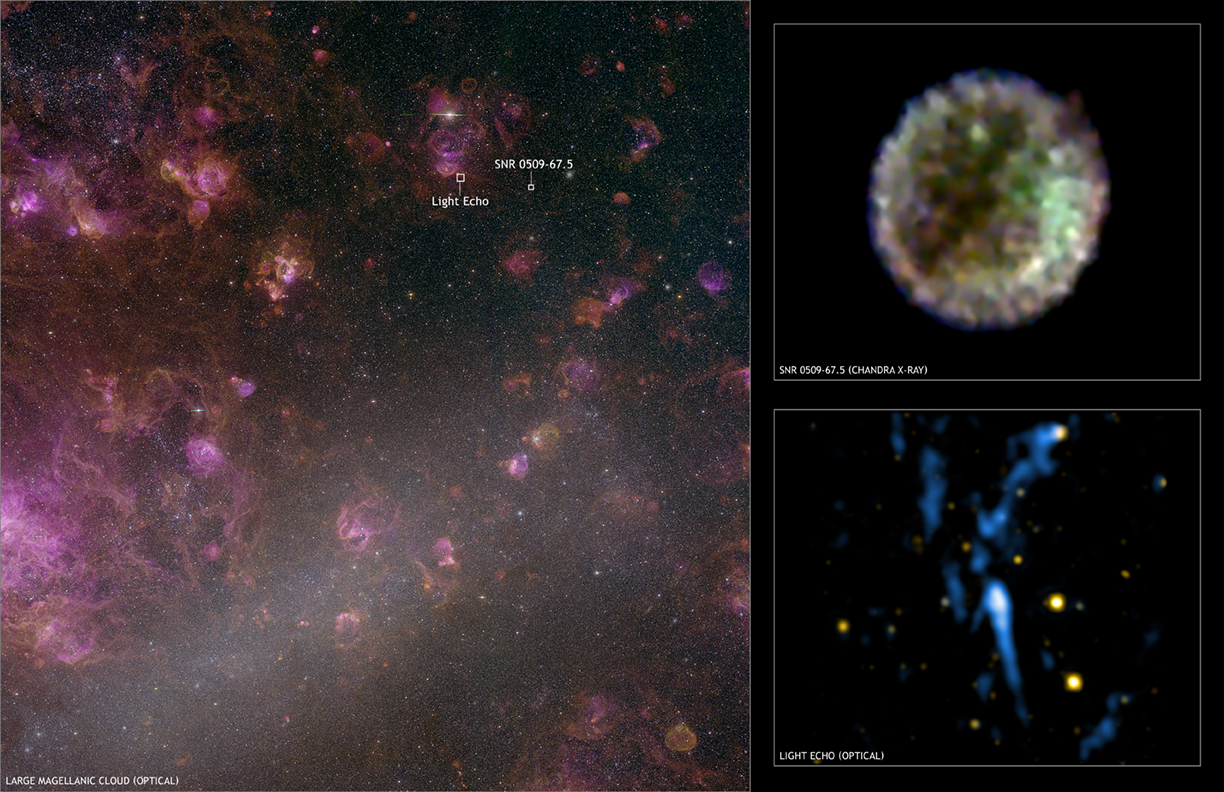
The remains of the supernova explosion, the remnant SNR 0509-67.5, are shown in the image from the Chandra X-ray Observatory, top right, where lower-energy X-rays are shown in red, intermediate in green, and high-energy in blue.
The light echo, in the lower inset, from the 4-meter Blanco Telescope at the Cerro Tololo Inter-American Observatory (CTIO), shows optical light from the original explosion that bounced off dust clouds in neighboring regions of the LMC. The light echoes are shown in blue and the stars in orange. The image is just one of a sequence of five images taken between 2001 and 2006 that are shown separately in an animation.
The larger, main inset is from the Magellanic Cloud Emission Line Survey (MCELS), obtained with the University of Michigan telescope at CTIO. Hydrogen emission lines (H-alpha) are shown in red, ionized sulfur in green, and doubly ionized oxygen in blue. The image highlights star-forming regions in the LMC, including supernova remnants and giant structures carved by multiple supernovas.
A higher resolution image can be obtained at http://chandra.harvard.edu/photo/2008/snr0509/snr0509.jpg
Credits: X-ray: NASA/CXC/Rutgers/J.Warren, J.Hughes; Optical (Light Echo): NOAO/AURA/NSF/Harvard/A.Rest et al.; Optical (LMC): NOAO/AURA/NSF/S.Points, C.Smith & MCELS team