Millions of faint galaxies loom near the edge of our Universe, too diffuse to be detected by most telescopes. But some enormous cosmic explosions and the supersensitive infrared eyes of the Spitzer space telescope are bringing many of them to light.
Located approximately 12.5 billion light-years away from Earth, the distant galaxies exist in an era when the Universe was only one billion years old.
"A few billion years after the big bang, 90% of the stars were being born in this type of faint galaxy. By identifying this population, we hope to gain insight into the environments where the universe's first stars formed," says Dr. Ranga Ram Chary, of the Spitzer Science Center.
The galaxies were found thanks to the glow of enormous explosions, the gamma-ray bursts or GRBs. These explosions, which are suspected to appear when a massive star dies and becomes a very dense object, can vary in their duration, from one second to a few minutes.
This is not enough time for astronomers to directly identify their source. However, as the light from the burst fades, a persistent glow can be seen at other wavelengths of light. In fact, Chary's team used ground-based telescopes to follow the infrared glow of several of these events to their faint host galaxies, months after the initial explosions were detected.
The glow occurs when energetic electrons spin around magnetic fields and release light. In this explosive death, material shot out from the massive star collides with the surrounding gas. This violent shock heats the gas and energizes its electrons.
Once the coordinates of these faint galaxies were determined, the team used Spitzer to photograph them and the amount of light from those galaxies allowed Chary to "weigh" them. They found that these distant galaxies are "lightweight" or not very massive compared to the mature galaxies we see in our neighborhood.
"Understanding the mass and chemistry of the first galaxies in the Universe and taking pictures of galaxies at different ages gives us a better idea of how gas, dust, and metals—the material that formed our Sun, the solar system, Earth—has changed throughout the history of the Universe," says Chary.
Unlike current ones, these pristine galaxies were composed primarily of hydrogen and helium and contained less than 10% of the heavy elements we see in the Local Universe and even on Earth. The stars that formed and lived in those galaxies ultimately formed heavy chemical elements in their cores and, upon dying, expelled them into space. Some of that material went on to form part of another generation of stars and finally planets in their galaxies.
Chary's paper was published in the December 10 issue of Astrophysical Journal.
Sources and related links
Spitzer: Cosmic Searchlights Reveal "Lost" Galaxies
About the images
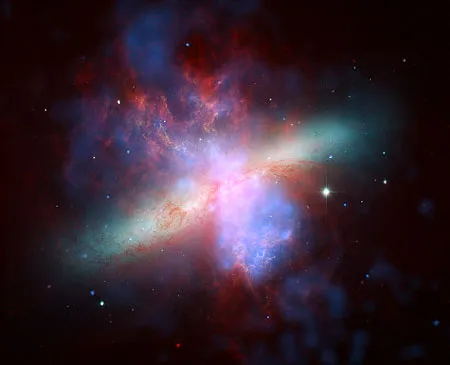
The distant, faint galaxies in the study were smaller and less massive than our galactic neighbor M82, shown in this image.
However, like M82 they are producing intense star formation and the explosions of dying massive stars are expelling gas and metals out of the galaxy, which can be seen as colorful clouds extending above and below the galaxy's central disk.
Credit: NASA/JPL-Caltech/STScI/CXC/UofA/ESA/AURA/JHU