Last week this ambitious project to study high-energy cosmic rays, located in the province of Mendoza, Argentina, was officially inaugurated.
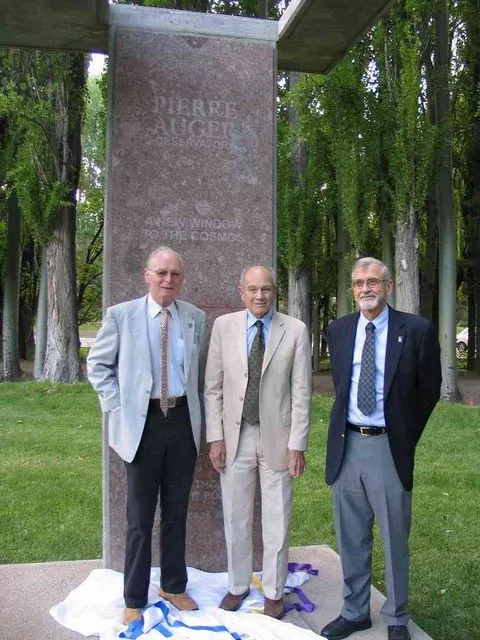
The Vice President of the Nation, Julio Cobos, stated that the inauguration of the works that complete the Pierre Auger project in Argentina is a very particular satisfaction for him, as he followed this undertaking from different positions, as dean of UTN, as minister and finally as governor.
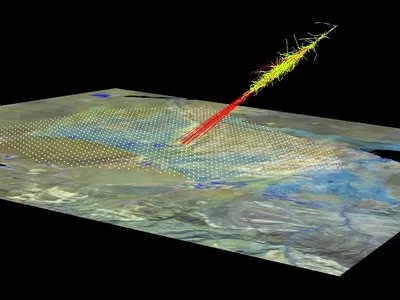
The Observatory explores the mysteries of high-energy cosmic rays: a shower of charged particles that reach Earth with energy 10 million times greater than the largest particle accelerator. So far, there is no consensus on the origin of these cosmic rays.
For his part, the general representative of the project in Argentina, Paul Mantsch, said: "Six years ago we inaugurated the first building, it was the cornerstone, the starting point to carry out such an enterprise. From those 6 telescopes and 42 tanks, 3 buildings, 18 telescopes and 1,000 more tanks were added. And as if that were not enough," added Mantsch, "the detectors worked much better than expected. It is my duty to thank the Government of Mendoza that even in times of crisis, it did not set aside this project of international scale."
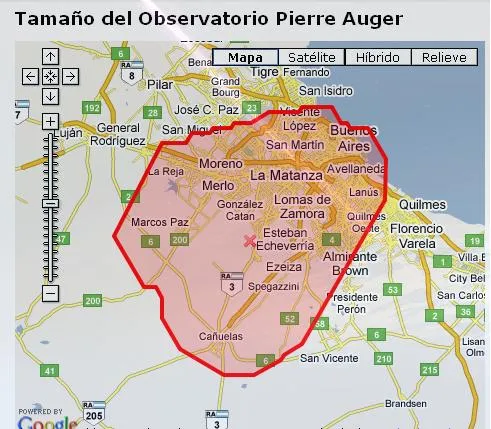
To achieve its objective, the Pierre Auger Collaboration began construction of its Southern Observatory in the year 2000. The project consists of a set of 1600 detectors scattered over 3000 square kilometers in Malargüe, Province of Mendoza. Around the set there are 24 fluorescence telescopes to detect the faint ultraviolet light emitted by the shower of particles as they reach the atmosphere. The collaboration includes more than 350 physicists from 70 institutions in 17 countries, who share the construction cost of approximately 53 million dollars.
Last year the collaboration published its first results revealing insights into the properties of high-energy particles. They found that the arrival directions of the highest-energy cosmic rays is anisotropic. The arrival directions correlate with nearby galaxies containing active nuclei. This is one of the most important scientific results of 2007. We reported it here in "Highest-energy cosmic rays linked to violent black holes"
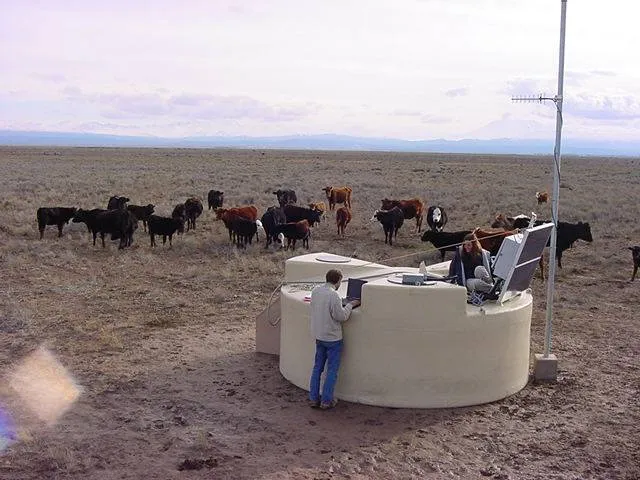
The Observatory in numbers
3000 square kilometers, is the area occupied by the detectors
30 times the city of Paris could fit in the area
1400 meters above sea level
1600 number of Cherenkov detector tanks
11000 liters of water per tank
1500 meters between tanks
20 years is the expected average life of the tanks
1500 events recorded per day
17 participating countries
1938 year in which Pierre Auger discovered cosmic ray showers
1992 year in which the observatory was first proposed by Jim Cronin and Alan Watson.
20,000 is the population of Malargüe
927 average human population per detector in the area
81 average llama population per detector, in the area.
Source: Symmetrybreaking
Argentine Collaboration
Centro Atómico Bariloche (CNEA); Instituto Balseiro (CNEA & UNCuyo); CONICET http://www.cab.cnea.gov.ar/
Instituto de Astronomía y Física del Espacio (CONICET)
Laboratorio Tandar (CNEA); CONICET; Univ. Tec. Nac. (Reg. Buenos Aires)
http://www.tandar.cnea.gov.ar/
Observatorio Pierre Auger Sur http://www.auger.org.ar/
Universidad Nacional de la Plata; IFLP/CONICET; Univ. Nac. de Buenos Aires http://www.fisica.unlp.edu.ar/auger/
Universidad Tecnológica Nacional - Regionales Mendoza y San Rafael http://www.frm.utn.edu.ar/
Sources and related links
- Scientists celebrate inauguration of Pierre Auger Observatory
- Particle physics gives boost to areas of Latin American
- Fermilab Newsletter
- Pierre Auger Public Event Explorer
- Scientists celebrate inauguration of Pierre Auger Observatory
- El Observatorio Pierre Auger en Google Earth
- Aerial views of the Pierre Auger Observatory
- Videos and interviews about the Pierre Auger Observatory
- A stamp for the Auger Observatory
About the images
Credit: Pierre Auger Observatory