A new experiment appears to have discovered surprising evidence that nature treats matter and antimatter differently.
The discoveries, detailed in the March 20 edition of Nature, suggest that a complete solution to the mystery of why the observable Universe is dominated by matter and not antimatter might have to await the discovery of new particles or the invention of a new physics.
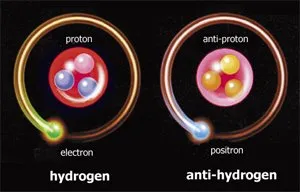
Antimatter is the strange twin of matter. For every particle of normal matter, there is a particle of equal mass but opposite electric charge. For every proton, with a positive charge, there is an antiproton which is a particle identical to the proton, with the same mass, but with a negative charge. The electron, which has a negative charge, has its antiparticle (called a positron), which has a positive charge. The neutron differs from the antineutron, not by its mass or its electric charge (which are equal) but by the type of quarks they are composed of.
When matter collides with antimatter they annihilate in an explosion of energy.
According to the standard model of physics, matter and antimatter were created in equal amounts after the Big Bang. If that were the case, they would have canceled each other out, leaving the Universe filled with energy.
But as our existence attests, that did not happen. Studies suggest the Universe is currently composed of 75% dark energy, 20% dark matter and only 5% matter.
A great mystery is why particles of normal matter seem to be the building blocks of the observable Universe.
Why aren't we made of antimatter?
For some reason, there was a greater amount of matter than antimatter (one particle for every billion antiparticles), and that difference is what endured.
In recent years, experts have tried to artificially recreate this primitive disproportion using high-energy particle colliders. In the latest study, a consortium of researchers called the Belle Collaboration, led by Paoti Chang of National Taiwan University, used the KEK-B accelerator in Japan to collide electrons and positrons.
When these particles collide, they create a burst of energy that quickly materializes into particles called B mesons. The experiment created four types of B mesons: neutral ones, their counterpart the neutral anti-Bs, positive ones and their counterpart, the negative ones.
A 2004 study showed that neutral B mesons decay into other particles faster than anti-Bs.
Scientists had assumed that the differences between these types of B mesons were minor. This led them to predict that positive B mesons should decay at the same rate as neutral B mesons (since both are normal matter particles) and that negative B mesons should decay at the same rate as anti-Bs (as both are antimatter particles).
The new study reveals that this is not the case. The team found that neutral B mesons decay faster than anti-Bs, but that positive B mesons decay more slowly than their antiparticles.
"This is not just that there is a particle-antiparticle asymmetry. It's that there are two asymmetries that are different from each other," commented Michael Peskin, a theorist at Stanford University who was not involved in the study.
The new results are similar to unpublished data recently gathered by another international team working at the Stanford Linear Accelerator (BaBar), of which Peskin is a member.
Considered together, the teams' findings cannot be easily explained by the standard model of physics and could be a clue to an entirely new mechanism for particle-antiparticle asymmetry, as Peskin explained.
Sources and related links
- Cosmos: New twist to matter-antimatter mystery
- Difference in direct charge-parity violation between charged and neutral B meson decays
Nature 452, 332-335 (20 March 2008) | doi:10.1038/nature06827;
Received 12 July 2007; Accepted 7 February 2008
The Belle Collaboration
About the images
Image: USAF