Today the autumnal equinox occurs in the southern hemisphere. Equinox means "equal night". It happens that day and night will have the same duration, 12 hours.
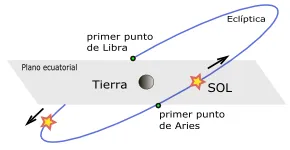
These moments, which we relate to the changes of seasons, are due to the Earth's tilt of just over 23º. Given the angle, we receive the Sun's rays more directly in summer and less in winter. If the Earth rotated on its axis perpendicularly to the plane of its orbit around the Sun, there would be no temperature variation throughout the year.
One way to experiment with the equinox is to stick a stick, stake or similar into the ground and periodically in the coming weeks measure the length of the shadow when the Sun is at the zenith and keep recording the measurements. It won't take long to show differences and thus notice how the Sun's position changes in the sky and with it, the plane of the ecliptic (the Earth's movement around the Sun takes place along a plane called the Ecliptic, which is also the plane along which the Sun apparently moves around the Earth).
In astronomical language, an equinox is either of the two points on the terrestrial sphere where the ecliptic and the celestial equator intersect.
In the northern hemisphere, the March equinox is called vernal, as it passes from winter to spring; in the southern hemisphere it is called autumnal, as it passes from summer to autumn.
The equinoxes are not fixed points on the celestial sphere but move westward along the ecliptic, passing through all the constellations of the zodiac in 26,000 years. That is what is called the precession of the equinoxes, a motion noted by Hipparchus. If you count the number of days from the autumnal equinox to the spring equinox you will get 186 days, that is, more than half a year. Conversely, the interval between the spring equinox and the autumnal equinox is shorter, about 176 days. Therefore, it is obvious that the Sun's apparent motion is not uniform. The difference is a result of the Earth's orbit being an elliptical path, as postulated by J. Kepler.
And why does precession occur?
It is caused by the gravitational attraction of the Sun and the Moon on the Earth's equatorial bulge. This is well explained in La precesión de los equinoccios.
The vernal equinox is also called the "first point of Aries" and the autumnal one the "first point of Libra", although -due to precession- the first is in Pisces and the second in Virgo.
When will autumn begin this year?
Expressed in Argentine Official Time, time zone 3 hours West of Greenwich, the March equinox will occur on March 20 at 05h 48min, meaning it has already begun.
Equinoxes and solstices mark the beginning of the astronomical seasons, whose dates do not coincide year after year. This is because the tropical year, the time interval between two successive passages of the Sun through the vernal equinox, equal to 365.2422 mean solar days, is not divisible by the Gregorian calendar year, of 365.2425 mean solar days. But only after a cycle of 400 years do the seasons begin again on the same days, approximately.
At the beginning of the year, we had already done some calculations about it.
And what about balancing an egg on this day?
Nothing. It's bad science. Bad astronomy. But if you are really interested, you can read the article I cite in the related links, a translation of an article by Phil Plait, author of Bad Astronomy Blog.
Sources and related links
- UniverseToday:Vernal Equinox Is Coming… Balance Eggs Or Believe In Science?
- Balancing an Egg during the Equinox: is this an example of good or bad Astronomy?
About the images
Image:
This view shows the two equinoxes as the intersection of the celestial equator and the ecliptic. The Sun, in its apparent motion along it, is North or South of the equatorial plane, causing the succession of seasons. Astronomically, the first point of Aries is a fundamental reference.
Image by Francisco Javier Blanco González on Wikipedia:Equinoccio