A new nano-electronic device is an important step that will help astronomers see the invisible light from the creation of the cosmos. The submillimeter region of the electromagnetic spectrum contains approximately half of the total luminosity of the Universe and 98% of all photons emitted since the Big Bang.
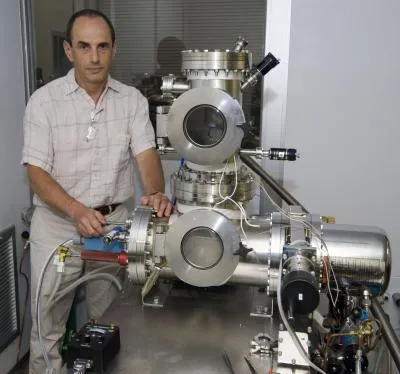
The very small circuit developed by physicists from Rutgers University, NASA's JPL, and the University at Buffalo, New York, is one hundred times smaller than the thickness of a human hair and is sensitive to far-infrared wavelengths.
"In the expanding universe, the earliest stars are moving away from us at a speed close to that of light. As a result, their light is strongly redshifted when it reaches us, appearing infrared," explains Michael Gershenson, a physics professor at Rutgers and one of the authors of the research.
Since Earth's atmosphere strongly absorbs far-infrared light, ground-based radio telescopes cannot detect the very faint light emitted by these stars. Therefore, scientists are proposing a new generation of space telescopes to collect this light. But to take advantage of those observatories, the detectors that capture the light must be much more sensitive than any that currently exist.
Infrared and submillimeter wave detectors, known as bolometers, measure the heat generated when they absorb photons or units of light. The current technology is mature and has reached the limit of its performance.
"The device we created, which we can call a nanobolometer, is potentially 100 times more sensitive than existing ones. It also reacts to light faster," says Gershenson.
The research team is publishing a description of the experimental device in the upcoming edition of Nature Nanotechnology.
Made of titanium and niobium, the new device is 500 nanometers long and 100 wide, operating at very low temperatures (-253ºC/-459ºF).
Photons that strike the nanodetector heat the electrons in the titanium section, which is thermally isolated from the environment by niobium superconductors. By detecting the infinitesimal amount of heat generated in the titanium, the energy of the light absorbed by the detector can be measured.
"The ultimate goal is to build and test a 100 x 100 photodetector array, which is a very difficult engineering task," adds Gershenson. The scientist hopes the technology will be useful for exploring the early universe with space telescopes in one or two decades. "That will make our new technology useful for examining stars and star clusters at the farthest limits of the universe."
Sources and related links
- Scientific Blogging:
How To See 'Invisible Light' From The Birth Of The Universe - Ultrasensitive hot-electron nanobolometers for terahertz astrophysics
Jian Wei, David Olaya et al.
Nature Nanotechnology - Published online: 6 July 2008
DOI:10.1038/nnano.2008.173 - Rutgers:
Nano-sized Electronic Circuit Promises Bright View of Early Universe
About the images
Professor Michael Gershenson with laboratory equipment used to fabricate the ultra-sensitive infrared light nanodetector.
Credit:Carl Blesch, Rutgers University.