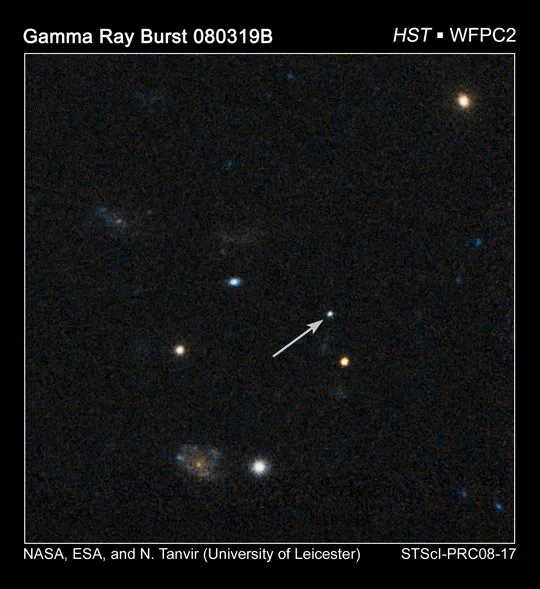
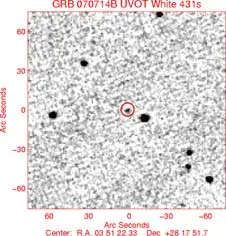
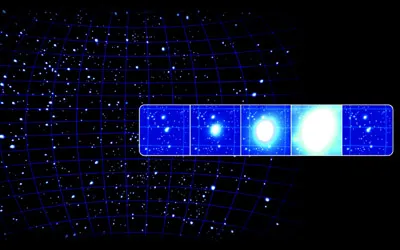
A powerful stellar explosion detected on March 19 by NASA's Swift satellite breaks the record for the most distant object that could be seen with the naked eye.
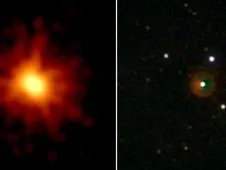
It was a gamma-ray burst. Most of these explosions occur when a massive star runs out of nuclear fuel and its core collapses to form black holes or neutron stars. In the process, an intense burst of high-energy gamma rays is released and jets of particles are ejected.
Swift's Burst Alert Telescope picked up the burst at 2:12 EDT on March 19 and determined its coordinates in the constellation Boötes, the herdsman. Telescopes in space and on the ground moved quickly to observe the afterglow. The burst was named GRB 080319B, a name that comes from the date and the B because it was the second burst detected that day.
Several telescopes saw the afterglow at a magnitude between 5 and 6, so -from a location with a good sky, like the countryside- it could be seen with the naked eye, faintly.
Later that evening, the VLT telescopes in Chile and the Hobby-Eberly in Texas measured the redshift at 0.94. Redshift is a measure of the distance to an object, which in this case, (0.94) converts to a distance of 7.5 billion light-years, so it occurred 7.5 billion years ago, when the Universe was less than half its current age and Earth had not yet formed.
"No other object or type of explosion could be seen with the naked eye at such a distance," says Stephen Holland of the science team.
The optical afterglow was 2.5 million times more luminous than the most luminous supernova ever detected, making the burst the most intrinsically bright ever observed by humans in the Universe. The previous most distant object that could have been seen with the naked eye is the nearby galaxy M33, at 2.9 million light-years from Earth.
Analyses of the burst are being conducted to find out why it was so bright. One possibility is that its energy was concentrated in a narrow jet pointed directly at our position on Earth.
GRB 080319B was one of four bursts detected by Swift on March 19.
"Coincidentally, the death of Arthur C. Clarke seems to have set the Universe ablaze with gamma-ray bursts," says Judith Racusin of Penn State University.
Sources and related links
- NASA SWIFT:NASA Satellite Detects Naked-Eye Explosion Halfway Across Universe
- An animation can be seen on the Pi in the sky group's site:
Pi of the sky frame view for GRB080319B (single frames)
About the images
GRB 080319B
Credit:NASA/Swift/Stefan Immler, et al.