All that Cassini Jazz: A musician used the sounds of the gas giant planet, collected by NASA's Cassini probe, to create a beautiful jazz song. Also, we review other sounds of the cosmos, including the sound of the Big Bang, the Great Explosion.
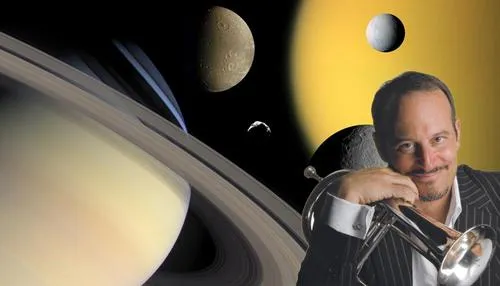
Imagine being able to listen to the music of the ringed planet Saturn. Well, nothing is stopping you!
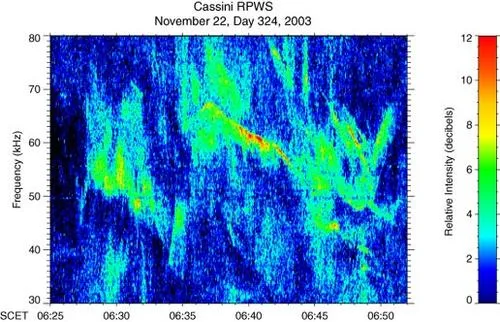
Like the other planets in our solar system, Saturn "sounds" with powerful radio signals. Scientists used that data collected by the Cassini-Huygens spacecraft to produce some of Saturn's sounds, so it is possible to appreciate the planet's "natural music" here on Earth.
When musician and space enthusiast Jeff Oster heard some of those sounds, he felt they corresponded with a piece he was working on at the time.
The first sounds heard on Oster's latest album called "True" are the sounds of Saturn's auroras. "When I say they are the actual sounds of the planet, it adds an incredibly new and important dimension to the music," explains the musician.
In April 2002, when the Cassini spacecraft was 2.5 astronomical units (374 million km) away from the Sun, the probe's radio plasma wave instrument (RPWS, Radio Plasma Wave Sound) began listening to the radio signals from Saturn's auroras. Scientists believe the complicated patterns (similar to those of Earth's auroras) are generated by many small radio sources dancing along the magnetic field lines in the areas where the auroras form. These radio signals sound like a strange wind.
Olster, 50, who has been playing the trumpet since he was 8, worked as a limousine driver and financial planner, but always kept his dream of becoming a professional musician. Oster says he is more of a musician than a financial consultant, but someone has to pay the bills...
Finally he was able to make enough money to dedicate himself to his passion full-time.
"Saturn calling" is a beautiful piece of new age jazz. The track won the 2008 independent music award for Best New Age Song and is part of his album "True".
On the track, Oster plays the flugelhorn (a kind of trumpet) because "its soul gravitates towards the warmer, darker sound". (I must say I had no idea an instrument with that name existed!).
The musician hopes that "Saturn Calling" will make his audience want to learn more about Saturn and the Cassini mission. "I am so happy to be at least a small part of this. The song is very majestic and so is the [Cassini] program. That's how space is. That's how the planets are. They complement each other in a very powerful and beautiful way."
Listen to "Saturn Calling" on the JPL/NASA Cassini site (MP3, 5 MB)
We recently wrote here about something similar in "The Musical Big Bang", about Darryl Kubian's 3-2-1 concerto.
The story of the sound of the Big Bang
The sound of the Universe is a previous post on this blog containing links to sites with sounds, particularly to "Sounds of the Universe" and "The Sound of the Big Bang".
I'll stop at this last one to tell a story that perhaps is not remembered or known:
It is a site by University of Washington in Seattle physics professor John G. Cramer. As he explains on that website, he does research in heavy ion physics in an experiment at Brookhaven Laboratory, colliding gold nuclei to produce systems that resemble the first microsecond of the Big Bang. He doesn't work much in cosmology and astrophysics, as he explains, although he published some papers in that area, but he writes a column for Analog Science Fiction & Fact Magazine. There he published an article called "BOOMERanG and the Sound of the Big Bang" where he explained, back in 2001, that a balloon had been sent in Antarctica to map the temperature variations of the cosmic microwave background radiation. He described those variations as a recording of the "sound of the Big Bang".
The professor relates that a month after the article appeared on the web, he received an email from a mother, who explained that she had an eleven-year-old son, Daniel, doing a school project on the Big Bang. They found the article online and she wondered if the sound of the Big Bang, mentioned there, was actually recorded somewhere so they could play it in class.
The professor's answer was "no," but -as the scientist relates- the question made him consider the problem. With the available data from BOOMERanG (the balloon experiment. It is named for "Balloon Observations Of Millimetric Extragalactic Radiation ANd Geophysics"), and more recently from WMAP, it wouldn't be very hard to simulate the sound, using a symbolic algebra program called Mathematica that includes a feature to interpret mathematical functions as sounds that can be captured as .wav files.
I suppose it goes without saying that Daniel finally received a copy of the sounds in his email and, according to his mother's report, his science project was a great success. According to the professor, the file was put on his sister's blog and from the mention in New Scientist a media explosion occurred about the file with the primordial sounds.
Initially the file was 100 seconds long, but later he made others of different durations, shorter and longer, although he still recommends the original. The files can be used for any purpose as long as his authorship is acknowledged.
The files are available on the page "The Sound of the Big Bang" (way down, see where it says 100 seconds, 200 seconds, 500 seconds, which are the wav files of those durations in seconds).
Right there, the author explains:
The sound in the simulation is derived from compression waves through the plasma/hydrogen medium of the early Universe, about 100 to 700 thousand years after the Big Bang. The density of the medium was changing as the Universe expanded, but it should have been considerably denser than the air on our small planet. Air is not needed to have sound, but some medium in which the compression/rarefaction of the waves can propagate is. The sound waves were very low in frequency and had wavelengths comparable to a fraction of the size of the Universe. For human convenience, as we cannot hear such low frequencies, they were increased so they can be heard.
John Cramer has a website, writes a column in Analog and is the author of two hard science fiction novels Twistor and Einstein's Bridge.
Sources and related links
- Cassini: All That Cassini Jazz: Musician Uses Saturn's True Voice to Make Beautiful Music
- Space sounds from the University of Iowa
- Sounds from Cassini
- Cassini RPWS
About the images
Jeff Oster
Credit: NASA/JPL/Space Science Institute/Jeff Oster
Strange sounds from Saturn's radio emissions
Credit: NASA/JPL/University of Iowa