There are those who do not give up. The issue was settled two years ago, when the International Astronomical Union (IAU) downgraded Pluto to dwarf planet status. But some researchers plan to reignite the debate at an upcoming meeting.
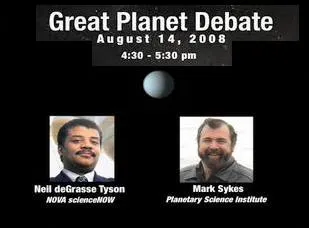
Researchers for and against will meet in August at the Applied Physics Laboratory of Johns Hopkins University in what has been called "The Great Planet Debate: Science as Process".
The goal, according to Mark Sykes, co-organizer of the conference and director of the Planetary Science Institute in Arizona, is to teach the public that science is a process of constant revision and refinement.
"People should be aware of that process. The IAU process gave the impression that science is done by a group of scientists voting behind closed doors."
The conference will last three days. In the first two, what has been learned about planetary bodies over more than 40 years of robotic exploration of the Solar System and what we are learning about planets around other stars will be presented.
The dynamic definition of the IAU of a planet will be presented, as well as an alternative geophysical definition. The usefulness of each will be debated, along with other potential definitions.
The third day will be a workshop for educators on how the issue should be addressed in class and how the debate could be used as a springboard to discuss science as a process.
There are, at least, two problems related to teaching the planets of our solar system. On one hand, much literature still characterizes Pluto as a planet. And this is exactly what the students' parents learned and is, therefore, what they tell their children.
Pluto, the odd one
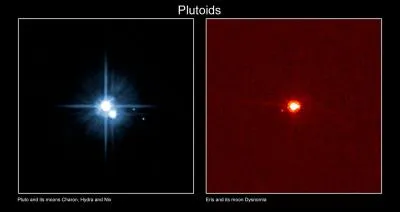
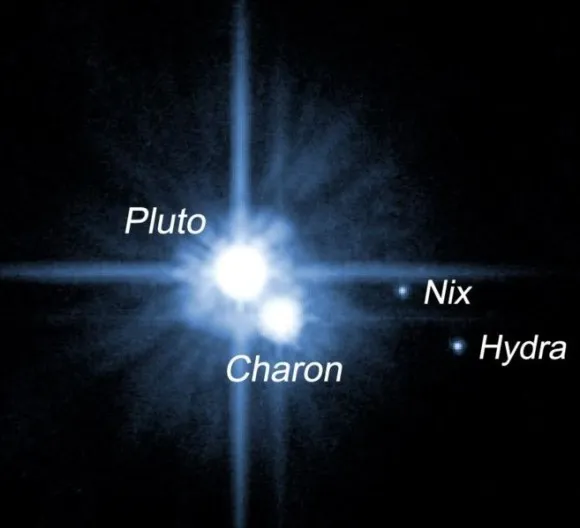
In 1930 Clyde W. Tombaugh at Lowell Observatory discovered Pluto. But several decades passed until its mass could be calculated. Thanks to the discovery of Charon in 1978, it was known to have a mass of 0.0021 Earths and its size could be estimated at 2400 km. Mercury, the small planet closest to the Sun, is 4880 km. However, Pluto was the largest object that had been found, beyond the orbit of Neptune.
Pluto is different from the other planets. With almost one-fifth the mass of our Moon, it is one of the largest icy bodies that make up the Kuiper belt, beyond Neptune. Unlike the four inner planets, its atmosphere is very tenuous. The other four planets, the outer ones, are massive and gaseous.
As if that weren't enough, the former ninth planet has an eccentric orbit that crosses that of Neptune.
Ever larger objects
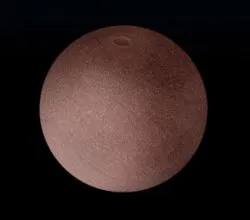
But these differences began to weigh heavily with the various discoveries of objects in the Kuiper belt, each larger than the last. It was only a matter of time until one larger than Pluto was discovered. In 2003 the "tenth planet" appeared. It was Eris, an object larger than Pluto, since it is 2600 km. From then on, the issue exploded, given that many other objects could also be considered planets. Two years later, the IAU convened a meeting in Prague to decide the formal definition of a planet.
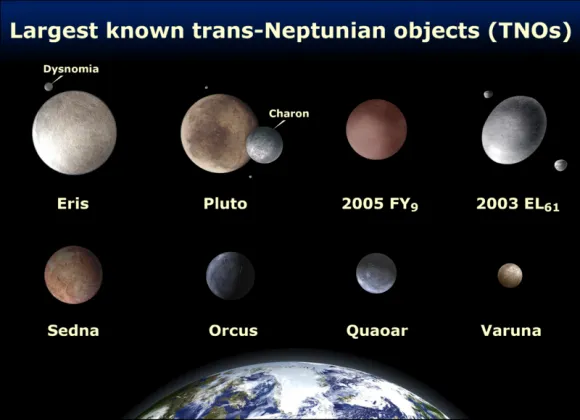
An initial proposal was the definition of a planet based on its roundness. But that would include not only Pluto, but its moon Charon and Ceres, the largest asteroid in the belt between Mars and Jupiter.
After a highly publicized debate, it was decided to modify the definition so that the body, besides being round, had its orbit cleared of competitors. This removed Pluto, reclassified as a dwarf planet.
For an object to be considered a planet, it needs to qualify in three categories:
It needs to be in orbit around the Sun
It needs to have enough gravity to be spherical
It needs to have its orbit free of neighbors
Pluto qualifies in the first two, but not in the last.
What does it mean to be free of neighbors?
When forming, planets become the gravitationally dominant object in their orbit in the Solar System. When interacting with other smaller objects, they either consume them or remove them from there with their gravity. Without enough gravity, this does not happen. And that is the case of our friend Pluto, as well as Eris.
This could change if Pluto collided with other objects and gained mass. Meanwhile, the Solar System would have only 8 planets. If a new object that qualifies in all three categories were to be discovered, they could be nine again, but it seems very unlikely that this will happen.
Scientists in disagreement
Not everyone agreed. In particular the researchers of the New Horizons mission to Pluto and the Kuiper belt, launched in 2006. About 300 planetary scientists then signed a petition protesting the definition and asking for a new one.
Those who reject the definition say that it requires scientific expertise to interpret it. For example, Neptune does not prevent Pluto from crossing its orbit and Jupiter's orbit is not "clear": it contains hundreds of rocks, called Trojan asteroids.
Jack Lissauer, author of Planetary Sciences, counts Pluto among the planets in the 2001 edition of his book, but will exclude it in the second edition to be released next year. However, he limited the use of the term dwarf planet "because we suspect that if an object with the mass of Mercury were discovered at 100 AU (astronomical units) it would be accepted as a planet even if it did not have its zone cleared".
In a recent edition of Science, Mark Sykes argues the case for the definition of a round body. A sufficiently massive object settles into the shape of a ball under its own gravity. When that happens, the denser material occupies the core and geological processes occur, including volcanism, plate tectonics, and erosion.
That definition provides planetary scientists with a useful guide for selecting objects in the solar system that could shed light on processes here on Earth, says Sykes, who is part of the science team for the Dawn mission to Ceres and Vesta, the two largest members of the asteroid belt.
On the other hand, the roundness argument does not automatically allow distinguishing between moons and planets.
But, aside from the concerns of one side or the other regarding the definition itself, there is another debate. It is the scientific debate, about science and its method. And its relationship with outreach.
Is science a crystalline process, without stumbling blocks and mistakes? Is science responsible for bringing "truths" to the masses? How are scientific decisions made? Do definitions form part of a rigorous process or are they related to personal feelings and historical conventions?
Questions to think about
How to communicate a dynamic process?
New discoveries, largely generated thanks to technological innovations, put science outreach and teaching before a dilemma. Teach the "safe" knowledge, that which seems solid and consolidated, or disseminate based on new theories. When can a new theory, different from the previous one, be considered valid to be taught?
We probably have to be sufficiently cautious, but also prepared. If today the definition is such, in any order and on any topic, not only in this particular planetary debate, then that definition should be taught.
However, we must always emphasize that science is a dynamic process, under constant review, and that definition can change.
In fact, it is not enough to observe the objects around our Sun. Many exoplanets have already been discovered, most of them large, around other stars.
Despite many advances in this regard, the level of detail is still very low. In the systems found outside our own, there are surely many other planets that cannot be observed, because they are smaller, for example.
And it is clear that a good definition should not be limited to the objects in our neighborhood.
As the sample of planets grows and becomes more and more detailed, perhaps the definition of planet will have to be reconsidered again.
Sources and related links
- Is Rekindling the Pluto Planet Debate a Good Idea? by JR Minkel
- The Great Planet Debate: Science as Process
- UniverseToday:Why Pluto is No Longer a Planet
- PLANETARY SCIENCE: The Planet Debate Continues
Mark V. Sykes
Science 28 March 2008:
Vol. 319. no. 5871, p. 1765
DOI: 10.1126/science.1155743
About the images
Credit:NASA