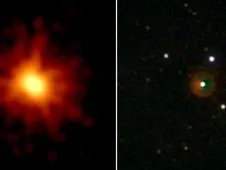
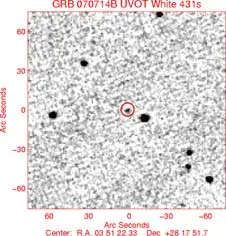
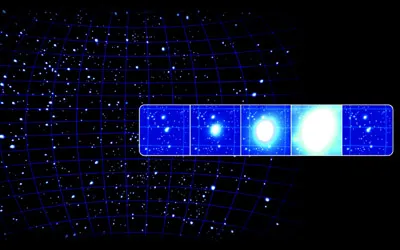
The intrinsically brightest gamma-ray burst visible to the naked eye was detected on March 19. Since Arthur C. Clarke died that day, it is known as the "Clarke Event".
Three weeks later, the Hubble Space Telescope can still detect the glow of this titanic explosion.
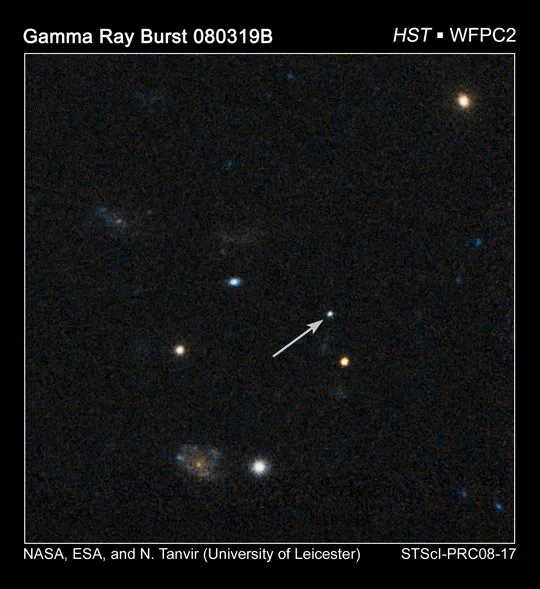
At 7,500 million light-years away, halfway to the Big Bang, the Swift satellite detected on March 19 what became known as the brightest naked-eye burst in the Universe, a gamma-ray burst or GRB, as we reported here the next day.
For almost a minute, the star shone as brightly as 10 galaxies and then its glow faded to that of a fifth-magnitude star and continued to dim ever since.
Astronomers have been waiting to see the host galaxy where the burst presumably occurred, but the light from this GRB 080319B still does not allow the galaxy's light to be seen even though three weeks have already passed. This is particularly surprising because it was initially a very powerful burst.
Long-duration GRB bursts are theorized to be caused by the death of a very massive star, perhaps up to 50 times the mass of the Sun. Those explosions, sometimes called hypernovas, are more powerful than supernovas and much more luminous, partly because their energy seems to be concentrated as a beam, which in this case, would have pointed directly at Earth.
Sources and related links
- NASA:Hubble Pinpoints Record-Breaking Explosion
- HubbleSite
About the images