By listening to the particular "ring" of a star that hosts a planet, a team of astronomers from ESO showed that it must have belonged to the Hyades cluster. The discovery has implications for theories of star and planet formation and for the dynamics of our galaxy.
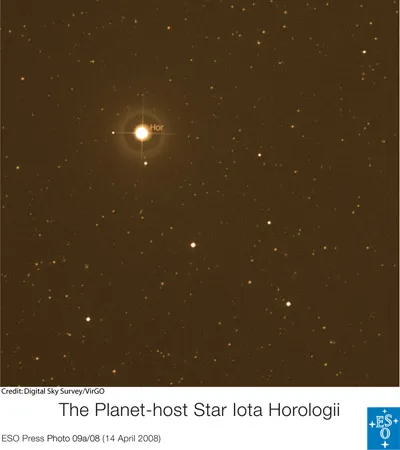
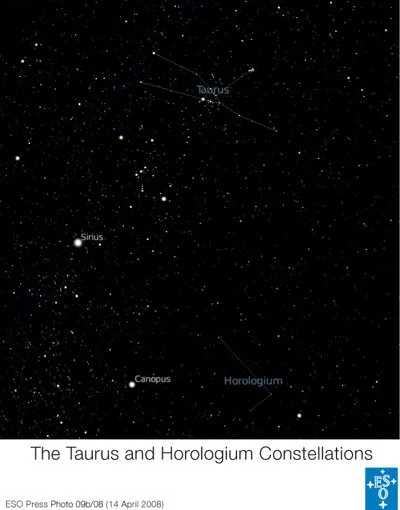
The yellow-orange star Iota Horologii, located 56 light-years away in the constellation Horologium ("The Clock"), belongs to the so-called "Hyades Stream", a large number of stars moving in the same direction.
Previously, astronomers used an ESO telescope and showed that the star hosts a planet, more than twice as large as Jupiter and orbiting in 320 days.
But until now, all studies were unable to determine the star's characteristics and understand its origin. A team of astronomers, led by Sylvie Vauclair from the University of Toulouse, France, decided to use the technique of "stellar seismology" to unravel the star's secrets.
"In the same way that geologists monitor how seismic waves generated by earthquakes propagate through the Earth and thus learn about the internal structure of our planet, it is possible to study sound waves running through a star, which form a kind of large, spherical bell," says Vauclair.
The observations were conducted in November 2006 over 8 consecutive nights with the advanced HARPS spectrograph mounted on ESO's 3.6 m telescope at La Silla.
Up to 25 "notes" were identified in the data, most corresponding to waves with a period of 6.5 minutes.
These observations allowed the astronomers to obtain a very precise portrait of Iota Horologii: its temperature is 6150K, its mass is 1.25 times that of the Sun, and its age is 625 million years. Furthermore, the star appears to be 50% richer in metals than the Sun.
"These results show the power of asteroseismology when using a very precise instrument like HARPS," says Vauclair. "They also show that Iota Horologii has the same metal abundance and age as the Hyades cluster and this cannot be a coincidence."
The Hyades are a group of stars in the constellation Taurus that form an open cluster, located 151 light-years away and containing stars that formed together 625 million years ago.
The star Iota Horologii would have then formed with the stars of that cluster but must have slowly drifted away, currently being over 130 light-years from its original birthplace. This is an important result for understanding how stars move on the galactic highways of the Milky Way.
It also means that the amount of metals present in the star is due to the original cloud from which it formed and not because it devoured planetary material. "The chicken-and-egg question of whether the star has planets because it is metal-rich or if it is metal-rich because it formed planets that were devoured, is at least answered in one case," says the scientist.
The study will be published as a letter to the editor in Astronomy and Astrophysics.
Sources and related links
ESO: The Drifting Star
The exoplanet-host star iota Horologii: a member of the Hyades cluster wandering around in the south hemisphere
S. Vauclair, M. Laymand, F. Bouchy, G. Vauclair, A. Hui Bon Hoa, S. Charpinet, and M. Bazot
Astronomy and Astrophysics
Accepted: 04 March 2008
DOI: 10.1051/0004-6361:20079342
About the images
Credit: Digital Sky Survey/VirGO.