At the annual meeting of the American Physical Society, there is a rumor that a group of scientists will announce the detection of a dark matter particle, after repeating a controversial experiment they had already performed in the year 2000.
It is the experiment of the DAMA collaboration (acronym for "DArk MAtter", that is, "dark matter"), now under the name DAMA/LIBRA (LIBRA for Large sodium Iodide Bulk for RAre processes), an underground particle detector at the Gran Sasso Laboratory in Italy.
The controversy dates back to 1998 when this group said they had found evidence of dark matter particles passing through their detector.
Their approach, in itself, was not to everyone's liking. They assume that the amount of dark matter flowing through our planet depends on the direction of Earth's motion, so it varies with the seasons. So they look for seasonal variations in their set of sodium iodide detectors. And back then, they found a variation that, although small, matched the prediction.
But the experiment seemed to suffer from a lot of background noise: many scientists said the experiment had impurities that produced perfectly ordinary particles. It was said that the detection could have been due to a slight fluctuation in the laboratory temperature or the decay of radioisotopes in the groundwater.
As Carl Sagan would say: "Extraordinary claims require extraordinary evidence"
We are talking about those particles that, although scientists cannot see, they do know are there and that make up no less than 23% of our Universe. In contrast, ordinary particles, which we are made of, contribute a mere 5% of the Cosmos.
Returning to the present, in the hunt for dark matter there are already many experiments around the world looking for what are known as WIMPs: weakly interacting massive particles. A potential source for these particles is a hypothetical proposal called supersymmetry.
The problem seems to be that, although in this new DAMA/LIBRA experiment improved technology was used, the experiment itself is the same. Therefore, if the announcement is indeed made, scheduled for April 16 at the “Neutrino Oscillations workshop, in Venice, Italy, caution will reign.
By the way, the collaboration has nothing to do with the DHARMA Initiative!
Sources and related links
- Scientific American: Dark matter particle discovered?
- NewScientist: Dark matter mystery 'solved' - again
- Symmetry Breaking:
Dark matter discovered? (APS April 2008)
About the images
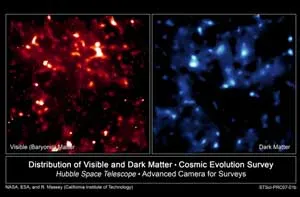
Two false-color images comparing the distribution of normal matter (red, left) with dark matter (blue, right). The brightness of the clumps corresponds to the mass density. Image from Hubble, mapping the Universe's dark matter in 3D
Credit: NASA, ESA, CalTech