Using observations from the Rossi X-ray Timing Explorer (RXTE), an international team of astronomers discovered a mechanism that allows them to predict when an overdense star will release very powerful explosions.
"We found a clock that ticks slower and slower and when it slows down too much, boom!, the bomb explodes," says Diego Altamirano, an Argentine astronomer graduated from the Universidad de La Plata, who works at the University of Amsterdam in the Netherlands.
We had mentioned him in a previous note about the "export" of astronomers trained in La Plata.
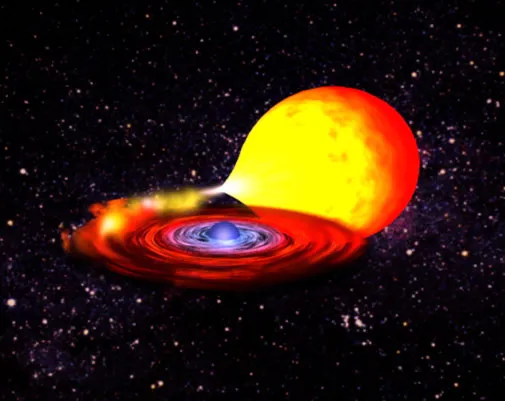
The outburst occurs in a neutron star, which is the remnant of a massive star that exploded in a supernova. The neutron star belongs to a binary system that can be described as a time bomb. The hydrogen and helium from a companion star is absorbed by the neutron star, slowly accumulating it on its surface until reaching a critical temperature. Suddenly, the hydrogen and helium begin to fuse uncontrollably into heavier elements, igniting the thermonuclear combustion that quickly spreads around the entire star. The resulting explosion appears as a bright flash of X-rays.
These outbursts, which can occur several times a day on the same star, release more energy in just 10 to 100 seconds than our Sun does in an entire week. Or, to put it another way, the energy is equivalent to 100 hydrogen bombs of 15 megatons exploding simultaneously.
Scientists have observed hundreds of these outbursts in about 80 neutron stars. But until now, they had no way to predict when they would occur.
The key to the discovery is RXTE, which makes extremely precise measurements of rapid X-ray emissions. As gas gradually accumulates on the surface of the neutron star, the hydrogen and helium sometimes fuse into heavier elements in a stable and almost perfectly repetitive form. This fusion mode produces an almost regular signal known as a quasi-periodic oscillation (QPO). Theory predicts that the frequency of the cycle should be 0.009 cycles per second (9 Millihertz or one cycle every two minutes). This is very close to the QPO frequency measured by Altamirano in the system 4U 1636-53.
But the team also found that the QPO frequency decreases over time from about 12 to 8 Millihertz. In a paper recently published in Astrophysical Journal Letters, the authors demonstrate that each time the QPO frequency decreases to about 8 Millihertz (one cycle per 125 seconds), the neutron star in the system 4U 1636-53 releases a powerful X-ray outburst.
"We still don't know if this sequence of events means that the oscillations cause the explosion or if they are only telling us that the time for an outburst has come. Additional observations with RXTE will be essential to decipher it," says coauthor Michiel van der Klis.
The same group is studying more than 50 neutron stars to see if they can identify similar behavior. The system 4U 1636-53 is located 20,000 light-years away, near the border between the constellations Ara and Norma.
Sources and related links
- NASA: Stellar Ticking Time Bomb Explodes on Cue
- EurekAlert: NASA satellite pins down timer in stellar ticking time bomb
- Intermittent Millisecond X-Ray Pulsations from the Neutron Star X-Ray Transient SAX J1748.9−2021 in the Globular Cluster NGC 6440
D. Altamirano, P. Casella, A. Patruno, R. Wijnands, and M. van der Klis
The Astrophysical Journal, 674:L45–L48, 2008 February 10
DOI: 10.1086/528983 - Diego Altamirano's page
- Astrocosmo: Neutron stars and X-rays
About the images
Illustration. Credit: NASA