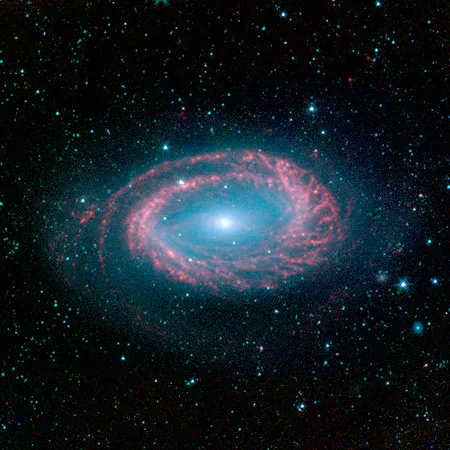
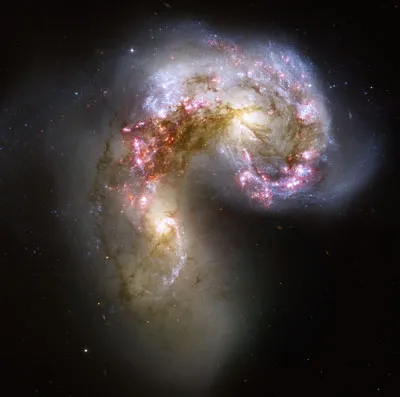
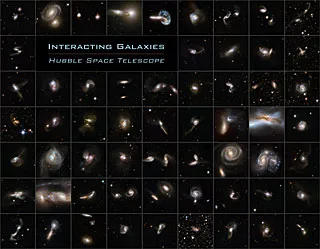
The largest collection of Hubble Space Telescope images ever released to the public at once: 59 new images of galaxy collisions.
An incredible atlas of galactic interactions that produce a remarkable variety of intricate structures.
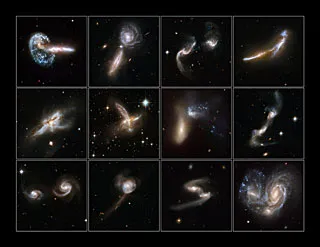
Galactic interactions are found throughout the Universe, sometimes as dramatic collisions that trigger star formation, and on other occasions they are stealthy mergers that result in new galaxies.
A series of 59 new images of galactic collisions have been released from the several terabytes of archive images from the Hubble Space Telescope as a way to commemorate the 18th anniversary of the telescope's launch. This is the largest collection of Hubble images released to the public simultaneously.
They can be seen in the Hubble Galaxy Merger Image Gallery
Galaxy mergers, which were more common in the early Universe than today, are thought to be the main source of cosmic evolution, igniting quasars, awakening frantic stellar births and explosive star deaths. Even seemingly isolated galaxies show signs in their internal structure of having experienced one or more mergers in their past. Each of the various mergers in this series of images is a snapshot of a different instant in the long process of interaction.
Our own Milky Way contains remnants of many smaller galaxies it has encountered and devoured in its past, and is currently absorbing the dwarf elliptical galaxy Sagittarius. In turn, it seems that the Milky Way will become part of our giant neighbor, the Andromeda galaxy, resulting in an elliptical galaxy.
The Moon's pull that produces the rise and fall of the oceans illustrates the nature of tidal force. This force between galaxies is much more disruptive for two main reasons. First, the stars in galaxies are held together only by the force of gravity. Second, because galaxies can pass much closer to each other, relative to their size, than Earth and the Moon. The billions of stars in each galactic interaction move individually, following the gravitational pull of all the other stars, so tidal forces can produce the most intricate effects.
The first sign of interaction will be a bridge of matter when the first gravitational pull removes gas and dust from the approaching galaxies. An example is galaxy IC 2810. As the outer boundaries of the galaxies begin to intermingle, long streams of gas and dust, the tidal tails, are stretched and coiled around the nuclei, as in galaxies NGC 6786, UGC 335, NGC 6050.
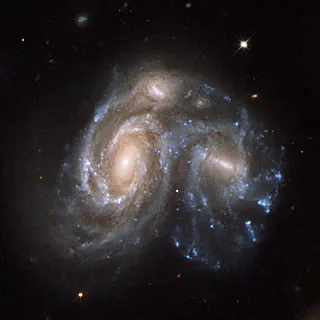
These spectacular tails are the signature of an interaction and can persist long after the main action has ended. As the nuclei of the galaxies approach, their gas and dust clouds are struck and accelerated dramatically by the pull of matter in all directions (NGC 6621, NGC 5256).
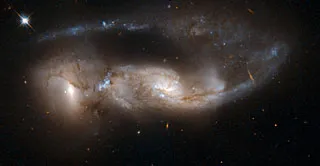
These forces can result in shock waves through interstellar clouds (ARP 148). Gas and dust are funneled into the active central regions, generating an impressive star formation that appears as characteristic blue knots of young stars (NGC 454). As the dust clouds heat up they become bright infrared objects in the sky (APG 220).
These objects emit up to several trillion times the luminosity of our Sun. They are the fastest star-forming galaxies in the present Universe and are related to quasars. Unlike standard spiral galaxies, like our galaxy, which radiate from stars and hot gas distributed throughout their extent, perhaps 100,000 light-years, the energy in ultraluminous infrared galaxies is mainly generated in the central portion, extending only between 1,000 and 10,000 light-years. This energy emanates from the vigorous process of star formation and from massive black holes.
Intense star-forming regions and high levels of infrared radiation are typical of the most active periods of interaction and are seen in many objects in these new images.
Other visible signs of interaction are disturbances of the galactic nucleus (NGC 3256, NGC 17).
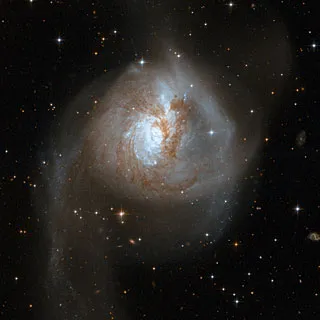
Most of the new Hubble images are part of a long investigation of luminous and ultraluminous infrared galaxies called the GOALS Project (Great Observatories All-sky LIRG Survey). This survey combines observations from Hubble, the Spitzer telescope, the Chandra X-ray Observatory and the Galaxy Explorer. The Hubble observations are led by Professor Aaron S. Evans of the University of Virginia at the U.S. National Radio Astronomy Observatory.
A number of interacting galaxies seen in this collection are included in the Atlas of Peculiar Galaxies, a remarkable catalog produced by astronomer Halton Arp in the mid-1960s. Arp compiled the catalog in a pioneering attempt to solve the mystery of rare galaxy shapes observed by ground-based observatories. Today, the peculiar structures seen by Arp and others are well understood as results of complex galactic interactions.
Sources and related links
- SpaceTelescope:heic0810: Galaxies gone wild!
- Hubblesite has a video with this release.
- Hubble interacting galaxy image gallery
About the images
Credit: NASA, ESA, the Hubble Heritage Team (STScI/AURA)-ESA/Hubble Collaboration and A. Evans (University of Virginia, Charlottesville/NRAO/Stony Brook University), K. Noll (STScI), and J. Westphal (Caltech)