In the nucleus of many galaxies, supermassive black holes expel powerful jets of particles. The most accepted theory says that the particles are accelerated by magnetic fields close to the black hole, but confirming the idea requires a difficult close look. Now, using the resolution of the NRAO's VLBA array of radio telescopes, astronomers have seen material behaving as predicted.
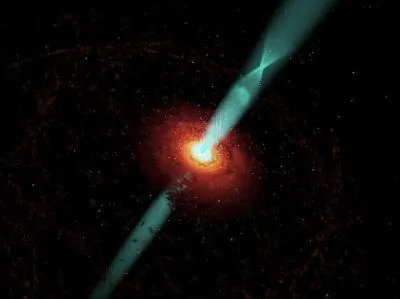
"We have obtained the clearest look at the innermost portion of the jet, where particles are accelerated, and everything we see supports the idea that twisted, spiral magnetic fields are expelling material," says Alan Marscher of Boston University, leader of an international research team. "This is an important advance in our understanding of a remarkable process that occurs throughout the Universe," he added.
The team studied the galaxy BL Lacertae (BL Lac), about 950 million light-years from Earth. BL Lac is a blazar, the most energetic type of black hole. A black hole is a concentration of mass so dense that not even light can escape its gravitational pull. Supermassive black holes in galactic centers generate jets of particles and intense radiation.
Material pushed toward the interior of a black hole forms a rotating disk called an accretion disk. As the material moves from the outer edge of the disk inward, the magnetic field lines perpendicular to the disk are twisted, forming a tight spiral bundle that, astronomers believe, propels the ejected particles. Closer to the black hole, space itself is twisted by the powerful gravitational pull of the black hole.
Theorists predict that material moving in this region would follow a spiral path, with a corkscrew shape inside the bundle of twisted magnetic fields. They also predict that the light and other radiation emitted by the moving material would shine when its path pointed directly toward Earth.
Marscher and his colleagues predict that there would also be a flare when the material hits a stationary shock wave called a "core," some time after having emerged from the acceleration region.
"That behavior is exactly what we saw," says Marscher. In late 2005 and early 2006, astronomers observed BL Lac with an international collection of telescopes, as a knot of ejected material passed through the jet. As the material moved away from the vicinity of the black hole, the VLBA could determine its location, while other telescopes measured the radiation properties emitted by that knot.
Bright bursts of light, X-rays and gamma rays were detected at the locations the theory predicts. Furthermore, the alignment of the radio and light waves - a property called polarization - rotated as the knot wound along its spiral path.
"We have an unprecedented view of the innermost portion of one of these jets and have acquired information that is very important for understanding how these tremendous particle accelerators work," says the scientist.
The astronomers reported their findings in the April 24 edition of the journal Nature.
Sources and related links
The inner jet of an active galactic nucleus as revealed by a radio-to-big gamma-ray outburst
Alan P. Marscher et al.
Nature 452, 966-969 (24 April 2008)
doi:10.1038/nature06895;
Received 17 January 2008; Accepted 6 March 2008 http://www.nature.com/nature/journal/v452/n7190/abs/nature06895.html
EurekAlert:Radio telescope reveals secrets of massive black hole
NRAO:Radio Telescope Reveals Secrets of Massive Black Hole
VLBA:http://www.vlba.nrao.edu/
Animation of the black hole jet
About the images
Credit: Marscher et al., Wolfgang Steffen, Cosmovision, NRAO/AUI/NSF
Artistic conception of a region near a supermassive black hole where twisted magnetic fields propel and shape jets of particles.