The same team of astrophysicists that had simulated the collision and merger of two of these monstrous objects has now performed the collision of three black holes.
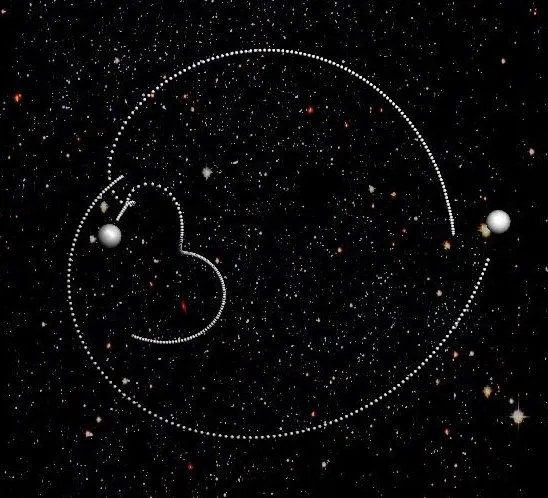
They are the scientists Manuela Campanelli, Carlos Lousto and Yosef Zlochower, from the Center for Computational Relativity at the Rochester Institute of Technology (RIT), who, as we reported here, had already performed simulations of collisions between two black holes.
The new simulation of multiple black holes evolving, orbiting and finally colliding confirmed the robustness of their code. The May edition of Physical Review D will publish the team's latest findings in an article titled "Close Encounters of Three Black Holes".
"We discovered complicated dynamic orbits, simultaneous triple mergers and complex gravitational waves that could be observed by detectors like LIGO and LISA," explained Lousto. "These simulations are timely because a triple quasar was recently discovered by a team led by Caltech astronomer George Djorgovski. This presumably represents the first triple supermassive black hole."
The team simulated the simplest case with equal masses and no spin, a prerequisite for more complex simulations. The center's "newHorizons" supercomputer cluster processed the simulations and performed evolutions of up to 22 black holes to verify the results.
"Twenty-two is not going to happen in reality, but three or four can happen," notes Zlochower. "We realized that the code itself doesn't care how many black holes there are. As long as we can specify where they were located -and there is enough computing power- we can track them."
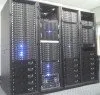
For scientists like Campanelli, who specialize in computational astrophysics and numerical relativity, tools like these high-performance computers are essential. Coincidentally, we had talked here about SUGAR, a supercomputer to listen to black holes.
Scientists hope to measure gravitational waves for the first time in the next decade using the detector known as LIGO (Laser Interferometer Gravitational Wave Observatory) and the future NASA and ESA space mission called LISA (Laser Interferometer Space Antenna).
"To be able to confirm the detection of gravitational waves, scientists need models. They need to know what to look for in the data they acquire, otherwise they would see only noise. If you know what to look for you can confirm the existence of gravitational waves. That's why they need all these theoretical predictions," explains Campanelli.
"Gravitational waves can confirm the existence of black holes directly because they have a special signature. That's what we are simulating. We are predicting a very specific signature for black hole encounters."
Sources and related links
EurekAlert:RIT team simulates first merger of 3 black holes on a supercomputer
About the images
Image credit:CCRG