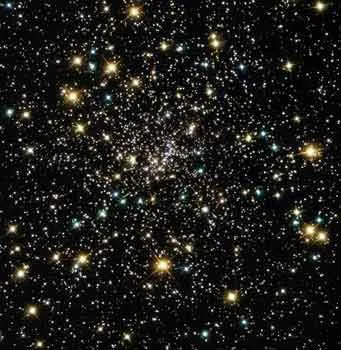
Images from the Hubble Space Telescope and data obtained with the spectrograph of the Gemini South telescope in Chile show that Omega Centauri, the largest and brightest globular cluster in the sky, appears to host an intermediate-mass black hole at its center. Is Omega Centauri a globular cluster or a dwarf galaxy? Are intermediate-mass black holes the precursors of the supermassive black holes in the centers of galaxies?
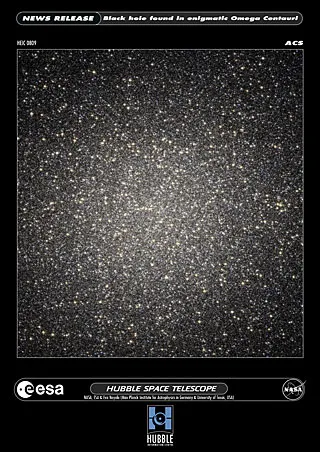
Omega Centauri is visible to the naked eye from Earth. Although it is located 17,000 light-years away, situated just above the plane of the Milky Way, it appears almost as large as the full Moon when seen from the dark rural sky, free of pollution.
What is Omega Centauri?
It was first classified as a star in Ptolemy's catalog, almost 2000 years ago. Edmond Halley reported it as a nebula in 1677. John Herschel, around the 1830s, was the first to recognize it as a globular cluster. Now, more than a century later, this new result suggests it is not a cluster but a dwarf galaxy. We had already commented here on a previous study on the matter, in "Multiple stellar births in a globular cluster".
Globular clusters consist of hundreds of thousands of old stars grouped together by their gravity. They are found in the outskirts of many galaxies including our own. Omega Centauri has several characteristics that distinguish it from other globular clusters: it rotates faster, has a rather flattened shape and consists of several generations of stars, while typical globular clusters usually consist of stars from the same generation.
Furthermore, Omega Centauri is about 10 times more massive than other large globular clusters, almost as massive as a small galaxy. These peculiarities have led astronomers to suggest that Omega Centauri may not be a globular cluster but a dwarf galaxy that had its outer stars stripped away, perhaps by a previous encounter with the Milky Way.
"Finding a black hole at the heart of Omega Centauri could have profound implications for our understanding of its past interaction with the Milky Way," says Eva Noyola, an astronomer at the Max-Planck Institute and leader of the team that made the discovery.
Noyola and her colleagues measured the motions and brightness of the stars at the center of Omega Centauri. The measured velocities of the stars at the center are related to the total mass of the cluster and were much higher than expected for a mass deduced from the number and type of stars seen. So there must be something extraordinarily massive (and invisible) at the center of the cluster, responsible for the rapid stellar dance, probably a black hole of about 40,000 solar masses.
"Before this observation, we had only one example of an intermediate-mass black hole- in the globular cluster G1, in the neighboring Andromeda galaxy," says astronomer Karl Gebhardt of the University of Texas and a team member.
Although the presence of an intermediate-mass black hole is the most likely reason for the velocity of the stars near the center of the cluster, astronomers analyzed a couple of other possible causes: a collection of unseen stars, such as white dwarfs or neutron stars or a group of stars with elongated orbits that could make the stars closest to the center appear to gain speed.
According to Noyola these scenarios are unlikely: "The normal evolution of a star cluster like Omega Centauri should not end with stars behaving in those ways. Even if we assume that one of those scenarios occurred in some way, both configurations are expected to be short-lived. A group of stars that have exhausted their fuel is expected to move out of the center of the cluster quickly. For stars with elongated orbits, the orbits are expected to become circular quickly."
According to the scientists, these intermediate-mass black holes could be the predecessors of supermassive black holes. "We are on the frontier of discovering a possible mechanism for the formation of supermassive black holes. Intermediate-mass black holes like this could be the seeds of the supermassive ones."
Astronomers have debated the existence of intermediate-mass black holes because they do not have strong evidence for them and there is no widely accepted mechanism for how they form. They do have ample evidence that stellar-mass black holes are produced when a massive star dies. There is similar evidence that supermassive black holes weighing the equivalent of trillions of solar masses reside in the centers of many galaxies, including the Milky Way.
Intermediate-mass black holes may be rare and exist only in dwarf galaxies, but they could also be more common than expected, existing in the centers of globular clusters as well. A previous survey of supermassive black holes and their host galaxies showed a correlation between the mass of a black hole and its host. Astronomers estimate that the mass of a dwarf galaxy that could have been the precursor to Omega Centauri was about 10 million solar masses.
If the rule of supermassive black hole masses and their massive host galaxies were also valid for smaller galaxies and black holes, then the mass of Omega Centauri does not match its black hole.
The team will use ESO's VLT at Paranal, Chile, to conduct follow-up observations of the velocity of stars near the center of the cluster to confirm their discovery.
Sources and related links
- EurekAlert:Black hole found in enigmatic Omega Centauri
- SpaceTelescope:Black hole found in enigmatic Omega Centauri
- Gemini and Hubble Space Telescope Evidence for an Intermediate Mass Black Hole in Omega Centauri
Eva Noyola (Max Planck Institute for Astrophysics in Germany & University of Texas, USA), Karl Gebhardt (University of Texas) and Marcel Bergmann (Gemini Observatory).
The Astrophysical Journal, 676:1008–1015, 2008 April 1
DOI: 10.1086/529002
About the images
Credit:NASA, ESA and the Hubble Heritage Team (STScI/AURA)
Acknowlegement: A. Cool (San Francisco State Univ.) and J. Anderson (STScI)