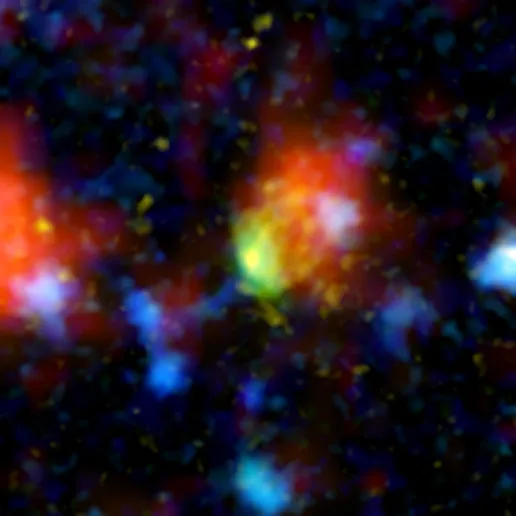
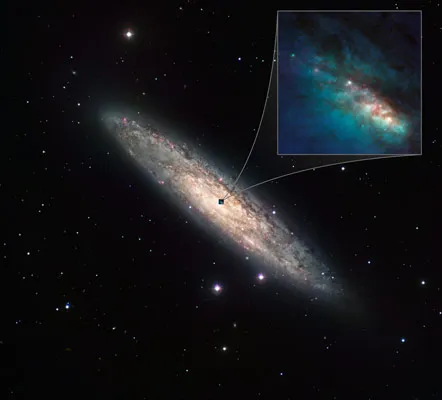
Observations with the Spitzer Space Telescope show that old galaxies were the greatest producers of stars when our Universe was half its current age.
"The idea that galaxies would form their stars in different generations at different times is not new...What our work proves is that this is the 'typical' behavior of most of the luminous infrared galaxies between 5 and 8 billion years old," says Dr. Karina Caputi, of the Institute of Astronomy ETH Hoenggerberg in Zurich.
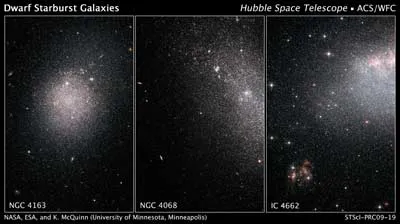
Infrared galaxies are extremely dusty, and most are furiously forming new stars. Recently, we commented here, a fabulous collection of new images from the Hubble Telescope with wonderful interacting galaxies, many of which are luminous infrared galaxies.
Astronomers suspect that the source of the brightness of infrared galaxies comes from the hot dust around newly born stars. Using data from Spitzer, Caputi and her colleagues identified approximately 600 of the brightest infrared galaxies 8 billion light-years from Earth.
"Spitzer's data allow us to estimate how luminous those galaxies were at infrared wavelengths and how many stars they were forming per unit of time. The most luminous ones were forming stars at a rate equivalent to a few tens up to several hundred Suns per year," says Caputi.
Once the team members identified the galaxies, they used data from ESO's VLT in Chile to learn more about the stellar population in those galaxies.
"For most of the galaxies in our study, the VLT data revealed an old population of stars mixing with newly born stars. This indicates that the galaxies are 'old' and are producing a new 'burst' of star formation," explains Caputi.
The team members suspect that the older population of stars was responsible for filling the infrared galaxies with dust. This dust eventually absorbed ultraviolet light from the new generation of stars and re-emitted the energy in the infrared, giving the galaxies their particular brightness.
Furthermore, the scientists found an interval of 10 to 100 million years between the beginning of stellar births and when the galaxy obtained its bright infrared glow.
"We suspect that it must take time for the dust to absorb the ultraviolet light that is emitted by young stars and re-emit it in the infrared," explains Caputi, who notes that this research can help astronomers better understand how galaxies develop over time.
Sources and related links
- Spitzer: The Second Stellar Baby Boom
- The optical spectra of 24 micron galaxies in the COSMOS field: I. Spitzer/MIPS bright sources in the zCOSMOS-bright 10k catalogue
K. I. Caputi et al.
arXiv:0803.1002v1 - The Infrared Luminosity Function of Galaxies at Redshifts z = 1 and z 2 in the GOODS Fields
K. I. Caputi, et al.
The Astrophysical Journal, 660:97–116, 2007 May 1
DOI: 10.1086/512667 - The Nature of Star Formation in Distant Ultraluminous Infrared Galaxies Selected in a Remarkably Narrow Redshift Range
D. Farrah
The Astrophysical Journal, 677:957–969, 2008 April 20
DOI: 10.1086/529485
About the images
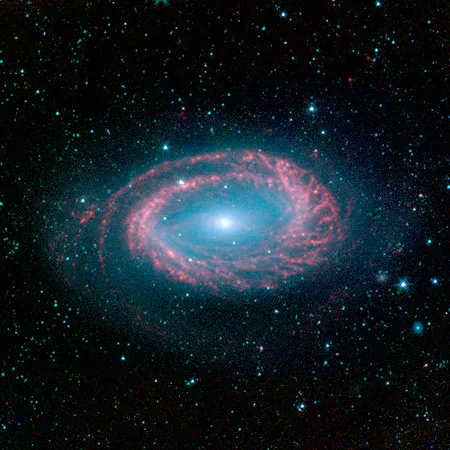
The galaxy NGC 4725 is peculiar because it is thought to have a single spiral arm. Most spirals have two or more arms. It would then be a barred ring galaxy because a prominent ring of stars surrounds a bar of stars at the center.
In this false-color image from Spitzer, the galaxy's arm is highlighted in red, with its center and its peripheral halo in blue. The red represents clouds of hot dust illuminated by the newborn stars, while blue indicates populations of older and cooler stars.
NGC 4725 is located 41 million light-years away in the constellation Coma Berenices.
Credit: NASA/JPL-Caltech/R. Kennicutt (University of Arizona) and the SINGS Team