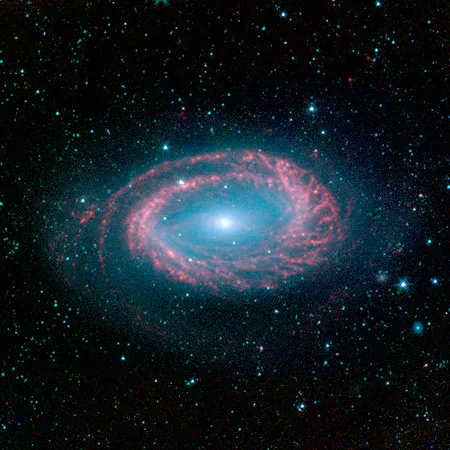
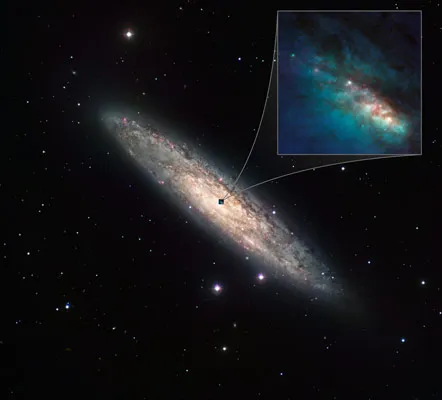
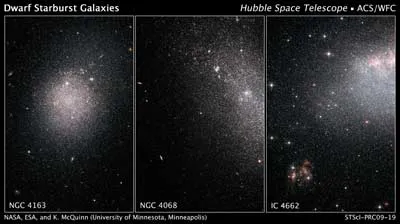
Astronomers discovered a galaxy in the distant universe generating stars at a surprising rate, up to 4,000 per year. In comparison, our Milky Way generates only 10 stars per year.
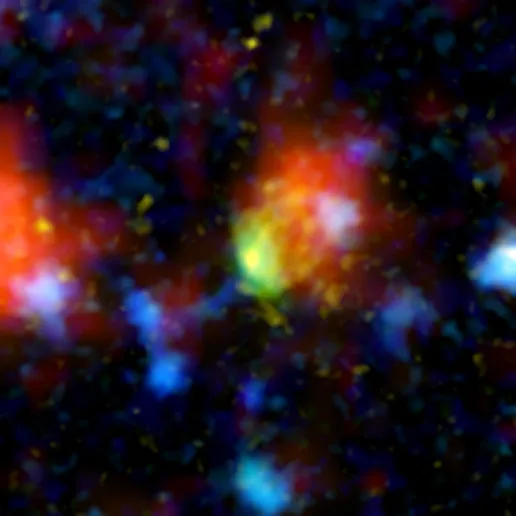
The discovery, made thanks to several telescopes, goes against the grain of the most common theories of galactic formation. According to the theory, called the Hierarchical Model, galaxies slowly increase their stars over time by absorbing small parts of galaxies and not in a great burst as observed in this case.
"This galaxy is undergoing an enormous generation of stars, producing the majority of its stars at the same time," says Peter Capak of the Spitzer Science Center. "If our human population were produced in a similar birth, almost all people alive today would be the same age." Capak is the lead author of a new report detailing the discovery in the July 10 edition of Astrophysical Journal Letters.
This type of galaxy, with high rates of star formation, is called "starbursts." In this case, it is the brightest starburst galaxy in the distant universe. It was found and observed by a set of telescopes operating at different wavelengths. Hubble and Subaru first observed the galaxy in visible light.
However, it was only when the Spitzer and James Clerk Maxwell telescopes observed in infrared and submillimeter wavelengths, respectively, that the galaxy gained significant details. Due to its large amount of star formation, it was named "Baby Boom."
To learn more, Capak and his team followed up with a number of telescopes. They used optical measurements from Keck to determine the distance: 12.3 billion light-years!!
The astronomers also measured at radio wavelengths with the Very Large Array in New Mexico. Together with the measurements from Spitzer and J.C. Maxwell, they allowed the astronomers to calculate a star formation rate of between 1,000 and 4,000 per year. At those rates, the galaxy needs only 50 million years (not much on cosmic scales) to grow into a galaxy equivalent to the most massive ones seen today.
While there are galaxies in our neighborhood that can produce stars at similar rates, the most distant one known until now is at 11.7 billion years.
"The incredible star-forming activity we have observed suggests we might be witnessing for the first time the formation of one of the most massive elliptical galaxies in the universe," adds co-author Nick Scoville.
"Until now, we had seen galaxies forming stars in this way when the universe was a teenager, but this galaxy is from when the universe was just a child. The question now is whether most of the very massive galaxies formed in the early universe like this galaxy or if it is an exceptional case," explains Capak.
Sources and related links
- Rare 'Star-Making Machine' Found In Distant Universe
- JPL:Rare 'Star-Making Machine' Found in Distant Universe
- Spectroscopic Confirmation of an Extreme Starburst at Redshift 4.547
Peter Capak et al.
The Astrophysical Journal Letters, 681:L53–L56, 2008 July 10
About the images
What is seen in green and red in the image is the galaxy called "Baby Boom"
credit: NASA/JPL-Caltech/Subaru