Two astronomers discovered asteroids similar to ordinary chondrites, the most common meteorites found on Earth.
Most of the meteorites we find on our planet come from the main belt located between Mars and Venus. There are only a few exceptions, like the meteorites that come from Mars.
Meteorites are a very important tool for learning about the history of the solar system, since their composition is a record of past geological processes.
One difficulty is that astronomers do not know from which asteroids most of the meteorites in the asteroid belt originate. To find the source, astronomers must compare the spectrum of a meteorite with those of asteroids. This is a difficult task because meteorites and the asteroids they come from undergo different processes since the meteorite's ejection. In particular, the erosion caused by micrometeorites and the solar wind, which progressively transforms the surface of asteroids.
Thus, the spectral properties of asteroids differ from their associated meteorites, making their identification difficult.
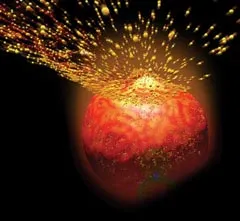
Collisions are the main cause affecting asteroids. They cause asteroids to fragment, giving rise to what are called "asteroid families". Most of these known families are very old (they formed 100 million or more years ago). However, young families are more difficult to detect because their fragments are closer together.
After the main asteroid breaks up, the fragments separate. The older the collision, the greater the distance between the fragments.
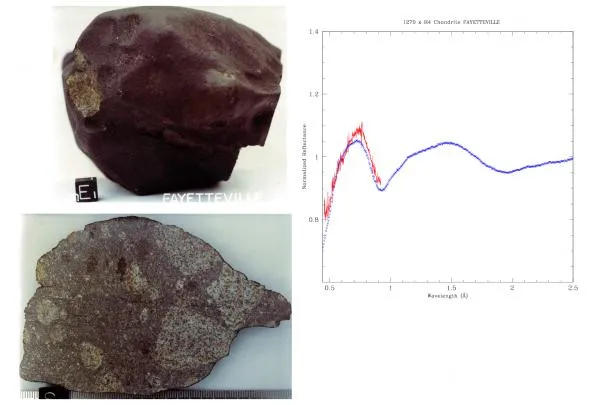
In 2006, four new very young asteroid families were identified, with ages between 50,000 and 600,000 years. These fragments should have been less affected than older families by erosion. Astronomers Mothé-Diniz (Observatório Nacional, Brazil) and Nesvorný (Southwest Research Institute, USA) observed these asteroids with the Gemini telescopes (in Hawaii and Chile) and obtained their spectrum. Comparing it with an ordinary chondrite (the Fayetteville meteorite) they found great agreement.
This discovery is the first in which there is agreement between the most common meteorites and asteroids in the main belt. It also confirms the role of space erosion in altering the surface of asteroids.
Identifying the source asteroids of meteorites is a unique tool for studying the history of our solar system because one can infer the timing of geological events (from the meteorite which can be analyzed by dating techniques) and their location in the solar system (from the location of the source asteroid).
The study was published by Astronomy & Astrophysics Vol. 486 No. 2 (August 2008)
Sources and related links
Astronomy & Astrophysics (2008, July 10). Source Of The Most Common Meteorites Discovered. ScienceDaily. Retrieved July 12, 2008, from http://www.sciencedaily.com /releases/2008/07/080710103903.htm
Visible spectroscopy of extremely young asteroid families
T. Mothé-Diniz and D. Nesvorný
A&A 486, L9-L12 (2008)
DOI:10.1051/0004-6361:200809934
About the images
Comparison of the spectrum of asteroid (1270) Datura with the spectrum of the Fayetteville meteorite (right).
Images of the Fayetteville meteorite (left)
Credit:Copyright Arkansas Center for Space and Planetary Sciences, University of Arkansas