For the first time, an international team of researchers found a way to see accretion disks around black holes.
A black hole and its bright accretion disk form a quasar, the powerful source of light at the center of some galaxies. Using a polarized filter, the team isolated the light emitted by the accretion disk from the light produced by other matter in the vicinity of the black hole.
According to Robert Antonucci, the physical process that astronomers find most attractive to explain the energy source of quasars involves matter falling toward a supermassive black hole, spiraling into a disk as it approaches the event horizon, the surface that marks the boundary of black holes. In the process, friction causes the matter to heat up and produce light at all wavelengths of the spectrum, including infrared, visible and ultraviolet. Finally, the matter falls into the black hole, increasing its mass.
"If it's true, we can predict from the laws of physics what the electromagnetic spectrum of a quasar should look like," says Antonucci. But testing this prediction has been impossible until now because astronomers have not been able to distinguish between the light emanating from the accretion disk and the clouds of ionized gas in the area of the black hole.
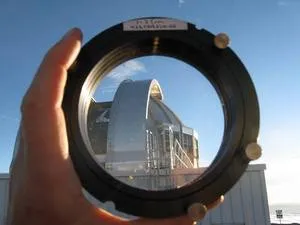
By adding a polarized filter to the United Kingdom Infrared Telescope (UKIRT) on Mauna Kea, Hawaii, the team led by Makoto Kishimoto, an astronomer at the Max Planck Institute in Germany, was able to eliminate the unwanted light and measure the spectrum of the accretion disk. In doing so, they demonstrated that the spectrum matches what was previously predicted. The researchers also used data collected from the polarization analyzer of the Very Large Telescope in Chile.
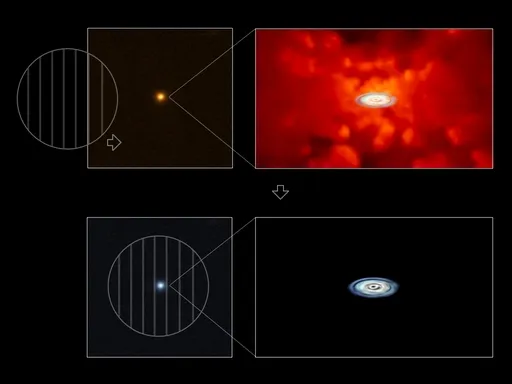
What makes it possible for the filter to work is that direct light is not polarized - that is, it has no preference regarding the directional alignment of its electric field. The accretion disk emits direct light, as do dust particles and ionized gas. However, a small amount of light from the accretion disk, which is the light the researchers want to study, reflects off gas located very close to the black hole. This light is polarized.
This is possible thanks to the IRPOL (infrared polarimeter) instrument built by the University of Hertfordshire, on the UKIRT.
"Studying the spectrum of an object like a quasar provides astronomers with an incredible amount of valuable information about its properties and processes. Our understanding of the physical processes in the disk is still poor, but now at least we are confident in the big picture," added Antonucci.
The finding is published in the July 24 edition of Nature.
Sources and related links
- Polarizing filter allows astronomers to see disks surrounding black holes
- New "Sunglasses" Help Astronomers See Light Near Black Holes
- Infrared Sunglasses See Black Hole Disks
- The characteristic blue spectra of accretion disks in quasars as uncovered in the infrared
Makoto Kishimoto et al.
Nature 454, 492-494 (24 July 2008)
DOI:10.1038/nature07114
About the images
Diagram: M. Kishimoto and Schartmann