No object in space is more mysterious—and psychologically threatening—than a black hole. It has been said that the Large Hadron Collider (LHC) could generate mini black holes that could destroy our planet. Here, an explanation of why we can rest easy.
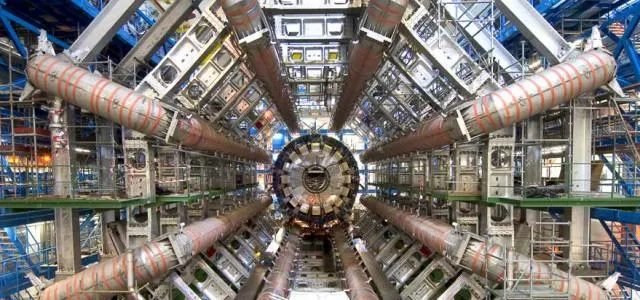
The LHC has a circular tunnel 17 miles (27,358.85 meters or about 27 km) long where particles will travel at a speed close to that of light to collide with each other, producing temperatures 100,000 times hotter than in the Sun's core. Physicists will observe the collisions in search of clues about the fundamental constituents of matter, hidden dimensions, and the elusive Higgs boson.
The magnitude of the machinery caused worldwide concern about the consequences this could generate. And I'm not referring to the usual doomsayers with their signs and blog comments, but to the establishment of lawsuits in the Honolulu district seeking to halt the start of the accelerator's operations. A similar lawsuit was filed in 2000 against the Brookhaven Laboratory's Ion Collider. The charges, then and now, are that the microscopic black holes that could be produced in the collider could swallow the Earth.
Discover asked Brown University physicist Greg Landsberg, who is involved in experiments at the LHC, if we should lose sleep over this issue.
First, how could microscopic black holes be produced at the LHC?
When a lot of matter is put into a very small space, it collapses under its own gravity and forms a black hole. That's what happens when an astronomical black hole forms. Now, the LHC doesn't create a lot of matter, but it does put a lot of energy into a very small volume. Black holes could be created at the LHC when two particles pass very close to each other, if the gravitational interaction between them is strong enough. But this is only possible in certain models that predict the existence of extra dimensions.
What is the connection between extra dimensions and black holes?
The production of black holes requires a strong gravitational attraction. But gravity is much weaker than other forces, such as electromagnetism. One way to remedy the problem is to assume the existence of extra dimensions in space that allow the transport of the gravitational force—the so-called graviton—but that are not accessible to other particles, such as quarks, electrons, and photons. If that were the case, gravity could be fundamentally strong but appear weak to us, since gravitons would spend most of their time in the extra space.
Imagine a long, thin stick. If you look at it from afar, you don't realize it has a second dimension rolled up, its circumference. It looks like a line to you, that is, one-dimensional. However, if you bring the stick close to a distance comparable to its radius, you will begin to realize its second dimension. Similarly, when two particles approach each other, they begin to feel the gravity of extra dimensions. That is basically the theoretical framework in which the production of black holes at the LHC is a possibility. But it must be understood that this is only a model. It is not known if it is true.
How could microscopic black holes be observed?
They would emit light that would be much hotter than the light from stars or the Sun, because their temperature is many orders of magnitude higher. They would emit high-energy gamma rays and could emit all kinds of particles, such as electrons and muons, which could be detected.
Can we be sure that a black hole created at the LHC will not expand and swallow the Earth?
I think the most honest answer to the question is yes. The black holes that could be produced at the LHC should be produced by the hundreds every day due to the energetic cosmic rays that bombard the Earth. When cosmic rays collide with particles, it's the same type of collision that occurs at the LHC. So the fact that we exist here and are talking about these things tells us that even if black holes are produced, it seems to be safe. If black holes are not produced, or if they decay very, very quickly due to Hawking radiation or an equivalent mechanism.
What exactly is Hawking radiation?
Stephen Hawking showed in the 1970s that black holes are not completely black. They have a small gray tint, so to speak. This means that black holes not only swallow everything—or accrete, as it is said scientifically—but they must also radiate some energy. This process is known as Hawking radiation.
The intensity of that radiation is determined by the black hole's temperature. The larger the black hole, the greater its radiation, just as a hot metal bar emits much more heat than a cold one. Now, the temperature of a black hole is inversely proportional to its mass. The more massive a black hole is, the colder it will be. Thus, small black holes are very hot and emit a lot of radiation, while large, astronomical black holes are extremely cold and emit almost no energy. The black holes found in the universe are so cold that it will take them a very, very long time—forever—to evaporate, many orders of magnitude longer than the age of the universe.
In contrast, black holes at the LHC would live only a fraction of a second before evaporating. This is not long enough for them to accrete anything before disappearing in a burst of radiation. These black holes would evaporate almost instantaneously, without moving more than the size of an atomic nucleus.
Is it possible to quantify the possibility of a catastrophe at the LHC?
The probability is never equal to zero in quantum mechanics, but you don't worry if the probability is very small. There is a small probability that all the air molecules in your room will cluster in one half of the room and you can't breathe. But we are talking about risk management here, and I think people should worry about probabilities that are large.
If black holes were detected at the LHC, what would it mean for physicists?
First of all, it would probably help us build a theory of quantum gravity, the only force that was not really explained by quantum mechanics. We have very little knowledge about what a quantum gravity theory is like, and producing these black holes at the LHC would be as close as you can get to an answer to this question.
Safety Statement
A summary from the LHC Safety Assessment Group (LSAG):
The safety of the LHC
The Large Hadron Collider can reach an energy that no other particle accelerator has reached before, but nature produces higher energies daily in cosmic ray collisions. Concerns about the safety of what can be created in high-energy particle collisions have been taken into account for many years. In light of new experimental data and theoretical knowledge, the LHC safety consultation group (LSAG) has updated the study of the analysis done in 2003 by the LHC safety group, composed of independent scientists. The LSAG group reaffirms and extends the conclusions of the 2003 study, stating that LHC collisions pose no danger and there is no reason for concern. Everything the LHC can do, nature has already done many times over the average lifetime of Earth and other celestial bodies. The study prepared by the LSAG group has been reviewed and approved by CERN's scientific policy committee, a group of external scientists that advises CERN's governing body, the CERN Council. The main arguments presented in the study by the LSAG group are summarized below. For more details, this report can be consulted directly, as well as the scientific articles it references.
Cosmic rays
The LHC, like other particle accelerators, recreates the natural phenomenon of cosmic rays under controlled laboratory conditions, allowing them to be studied in more detail. Cosmic rays are particles produced in outer space, with the energy of some of them being much greater than those that will be produced at the LHC. The energy and frequency at which they reach Earth's atmosphere have been measured in experiments for over 70 years. For billions of years, nature has generated on Earth as many collisions as a million experiments equivalent to the LHC, and planet Earth still exists.
Astronomers observe a large number of celestial bodies throughout the universe, which are constantly being traversed by cosmic rays. The entire universe produces more than 10 million million experiments like the LHC per second. The possibility of dangerous consequences contradicts what astronomers observe: stars and galaxies still exist.
Nature forms black holes when some stars, much larger than the sun, collapse on themselves at the end of their life. They concentrate a large amount of matter in a very small space. Speculations about microscopic black holes at the LHC refer to particles produced in collisions of proton pairs, each of which has an energy comparable to that of a flying mosquito. Astronomical black holes are objects much heavier than anything that could be produced at the LHC. According to the well-known properties of gravity, described by Einstein's theory of relativity, it is impossible for microscopic black holes to be produced at the LHC. There are, however, some speculative theories that predict the production of such particles at the LHC. These theories predict that such particles would disintegrate immediately. Therefore, black holes would not have time to absorb enough matter to cause macroscopic effects. Although stable microscopic black holes are not theoretically expected, the study of the consequences of their production by cosmic rays demonstrates that they are harmless. Collisions at the LHC and collisions of cosmic rays with celestial bodies like Earth differ in that the new particles produced in LHC collisions move more slowly than those produced by cosmic rays. Stable black holes could have an electric charge or be neutral. If they had an electric charge, they would interact with ordinary matter and stop when traversing Earth, whether produced in cosmic rays or at the LHC. The fact that Earth still exists rules out the possibility that cosmic rays or the LHC could produce charged and dangerous microscopic black holes. If stable microscopic black holes had no electric charge, their interaction with Earth would be very weak. Those produced by cosmic rays would pass harmlessly through Earth into space, while those produced at the LHC could remain on Earth. However, there are celestial bodies much larger and denser than Earth in the universe. Black holes produced in collisions of cosmic rays with other bodies like neutron stars or white dwarfs would stop. The existence of such dense celestial bodies today, in addition to the existence of Earth, eliminates the possibility that the LHC produces dangerous black holes.
Strangelets
Strangelet is the term used to denote a hypothetical microscopic piece of "strange matter" containing the same number of particles, quarks, of the up, down and strange types. According to the most recent theoretical studies, strangelets would transform into ordinary matter in one thousandth of a millionth of a second. But could strangelets fuse with ordinary matter and change it into "strange matter"? This question was first raised in the year 2000 when the Relativistic Heavy Ion Collider (RHIC) in the United States began operation. A study from that time showed there was no reason to worry, and the RHIC accelerator has operated for eight years searching for strangelets without finding them. During some periods, the LHC will operate with beams of heavy nuclei, like RHIC. The LHC beams will have a higher energy than RHIC, which makes it even less likely that strangelets could form. It is difficult for "strange matter" to clump together at the high temperatures produced in such colliders, in the same way that ice does not form in hot water. Furthermore, the constituents will be more diluted in the LHC than in RHIC, making it harder for "strange matter" to clump together. The production of strangelets at the LHC is less probable than at RHIC, and the experience at this accelerator has validated the argument that strangelets cannot be produced.
Vacuum bubbles
There are speculations that the universe is not in its most stable configuration, and that the disturbances caused by the LHC could lead it to a more stable state, called a vacuum bubble, in which we could not exist. If the LHC could do this, cosmic ray collisions could also do it. Since vacuum bubbles have never been produced in the visible universe, they cannot be produced at the LHC.
Magnetic monopoles
Magnetic monopoles are hypothetical particles with a single magnetic charge, either a north pole or a south pole. Some speculative theories suggest that, if they exist, magnetic monopoles could cause proton decay. These theories also predict that such monopoles would be too heavy to be produced at the LHC. On the other hand, if magnetic monopoles were light enough to be produced at the LHC, cosmic rays hitting Earth's atmosphere would have already produced them, and Earth would have stopped and trapped them. The fact that Earth and other celestial bodies continue to exist eliminates the possibility that the dangerous magnetic monopoles that would eat protons are light enough to be produced at the LHC.
LHC Concerns
There is a group that discusses, in a forum, their concerns about the operation of the LHC: LHC Concerns
Sources and related links
- Discover: The Extremely Long Odds Against the Destruction of Earth
- Astroseti: El gran colisionador de hadrones (LHC) (I)
It is a series of 11 articles, highly recommended reading. - What can we expect from the LHC?
- Stephen Hawking and black holes
About the images
Credit: CERN