How to weigh the largest black holes in the universe? One answer comes from a new technique that astronomers have developed using data from the Chandra X-ray Observatory.
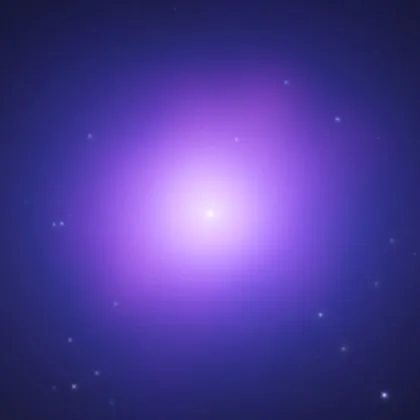
By measuring a peak in the temperature of the gas at the center of a giant elliptical galaxy, NGC 4649, scientists have determined the mass of the galaxy's supermassive black hole. The method, applied for the first time, yields results consistent with a traditional technique.
Astronomers have sought different and independent ways to accurately weigh supermassive black holes, those that are billions of times more massive than our Sun. Until now, methods based on observations of the motions of stars or gas in a disk near the black holes have been used.
"This is tremendously important work given that black holes can be elusive and there are only a couple of ways to weigh them accurately," says Philip Humphrey of the University of California, Irvine, leader of the study. "It is reassuring that two different ways of measuring the mass of a large black hole provide similar results."
NGC 4649, 51 million light-years from Earth, is now one of the few galaxies for which the mass of the supermassive black hole has been measured with two different methods. Furthermore, this new X-ray technique confirms that the black hole in that galaxy is one of the largest in the local universe with a mass of 3.4 billion times that of the Sun, and thousands of times larger than the black hole at the center of our galaxy.
The new technique makes use of the gravitational influence that the black hole has on the hot gas near the galactic center. As the gas falls toward the black hole, it is compressed and heated. This causes a peak in the temperature of the gas very close to the center of the galaxy. The larger the black hole, the larger the temperature peak.
This effect was predicted by two co-authors—Fabrizio Brighenti of the University of Bologna, Italy and William Mathews of the University of California, Santa Cruz—almost a decade ago, but this is the first time it has been used.
The black hole in NGC 4649 is in a state where it does not appear to be rapidly pulling material toward its event horizon or generating copious light as it grows. Therefore, the presence and mass of the central black hole must be studied more indirectly by tracing the effects on surrounding stars and gas.
The results will appear in an upcoming edition of The Astrophysical Journal.
Sources and related links
A New Way To Weigh Giant Black Holes
Weighing the Quiescent Central Black Hole in an Elliptical Galaxy with X-Ray-Emitting Gas
Philip J. Humphrey, David A. Buote, Fabrizio Brighenti, Karl Gebhardt, and William G. Mathews
Received: 2008 January 22 Accepted: 2008 April 21
The Astrophysical Journal
About the images
Credit: X-ray (NASA/CXC/Univ. of California Irvine/P.Humphrey et al.); Optical (NASA/STScI)