New analyses of the Martian terrain using observations from NASA spacecraft reveal what appears to be by far the largest impact ever found in the solar system and thus explain the dichotomy of the two faces of Mars.
The Mars Reconnaissance Orbiter (MRO) and Mars Global Surveyor (MGS) spacecraft provided detailed information about the elevations and gravity of the northern and southern hemispheres of the red planet. A new study, using that data, could solve one of the greatest mysteries about Mars: Why does the planet have two types of terrain in its hemispheres?
The mystery of the two faces of Mars has perplexed scientists since images of the surface were obtained in the 1970s. The main hypotheses pointed to an ancient impact or internal processes of the planet's inner layers.
The impact idea, proposed in 1984 by Steven Squyres, was not widely accepted because the shape of the crater did not seem to fit the expected rounded shape. The new data are convincing experts who doubted this scenario.
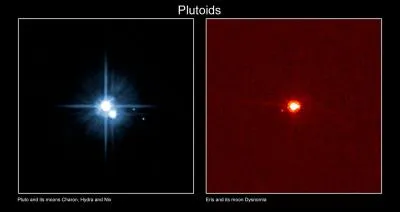
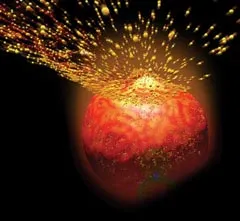
A giant crater covers about 40% of the surface of Mars: the Borealis crater, in the northern hemisphere. According to the new analysis, it is the remains of a colossal impact in the early solar system. At 8,500 kilometers in diameter, it is four times larger than the next largest known crater, the Hellas crater in southern Mars. The report calculates that the object that produced the Borealis crater must have been 2,000 kilometers in diameter. That is larger than Pluto.
This crater in the northern hemisphere is one of the smoothest surfaces found in the solar system. The southern hemisphere is high, rough, and heavily cratered. This is called the Martian surface dichotomy. These two faces of the planet now seem to have a favored explanation, in the impact scenario.
The analysis of the data was produced by running computational simulations through the CITerra computer cluster, in the Division of Geological and Planetary Sciences at Caltech, the California Institute of Technology.
A special edition of Nature, from June 26, covers the topic of cosmic cataclysms, and the Martian dichotomy, with the publication of three letters.
Sources and related links
- NASA Spacecraft Reveal Largest Crater in Solar System
- EurekAlert: Giant impact explains Mars dichotomy
- The Borealis basin and the origin of the martian crustal dichotomy
Jeffrey C. Andrews-Hanna et al.
Nature 453, 1212-1215 (26 June 2008)
doi:10.1038/nature07011 - Mega-impact formation of the Mars hemispheric dichotomy p1216
Margarita M. Marinova, Oded Aharonson & Erik Asphaug
doi:10.1038/nature07070 - Implications of an impact origin for the martian hemispheric dichotomy p1220
F. Nimmo, S. D. Hart, D. G. Korycansky & C. B. Agnor
doi:10.1038/nature07025 - Planetary science: Forming the martian great divide p1191
Walter S. Kiefer
doi:10.1038/4531191a
About the images
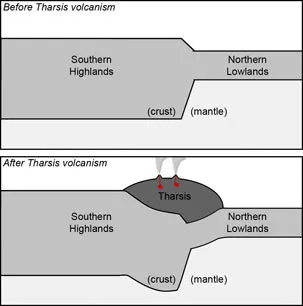
The dividing line between the Borealis crater and the southern highlands was difficult to discern due to the later arrival of a volcanic bulge called Tharsis, which was removed in a computational model by using analyses of topography and gravity, allowing the original shape of the crater to be seen.
Credit: Jeffrey C. Andrews-Hanna