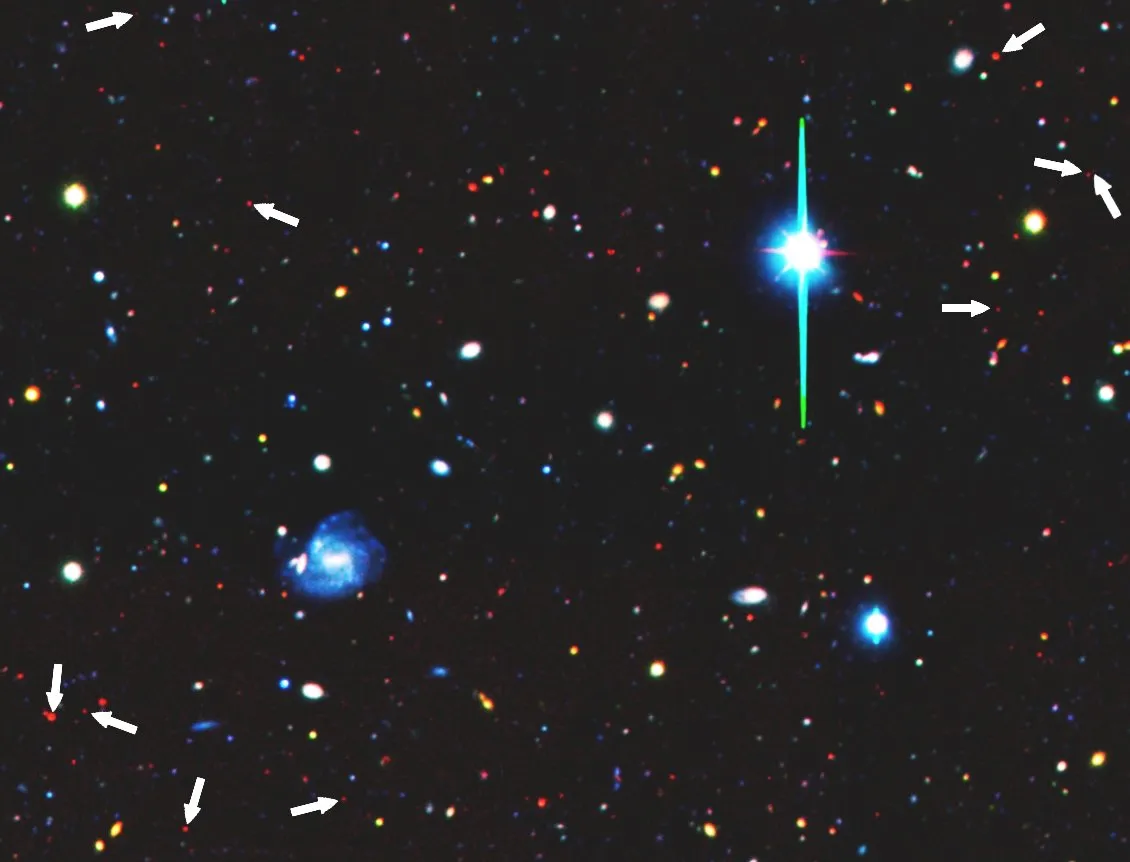
New observations from the Hubble Space Telescope of six spectacular galaxy clusters acting as gravitational lenses allow finding the largest sample of very distant galaxies seen to date: ten promising candidates that are thought to lie at a distance of 13 billion light-years!!!
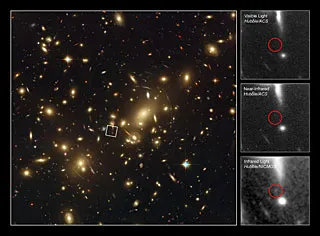
By using the gravitational magnification provided by six massive galaxy clusters, Hubble provided scientists with the largest sample of very distant galaxies seen until today.
Some of the amplified objects are fainter than the faintest ones seen by the legendary Hubble Ultra Deep Field, which is usually considered the deepest image of the Universe.
By combining visible and near-infrared observations with the Advanced Camera for Surveys (ACS) and the Near Infrared Camera and Multi-Object Spectrometer (NICMOS), scientists searched for galaxies that are only visible in near-infrared light. They discovered 10 candidates with a redshift of 7.5, which means the collected light was emitted by the stars when the Universe was still very young, only 700 million years old.
"These candidates could explain one of the biggest problems in current astronomy. We know that the Universe was reionized in the first 600 million years after the Big Bang, but we don't know if the energy came from a smaller number of large galaxies or a larger population of small ones," says Johan Richard, from Caltech. The relatively high number of galaxies with a redshift of 7.5, according to this research, suggests that most of the reionization energy was produced by faint and abundant galaxies rather than a few large ones.
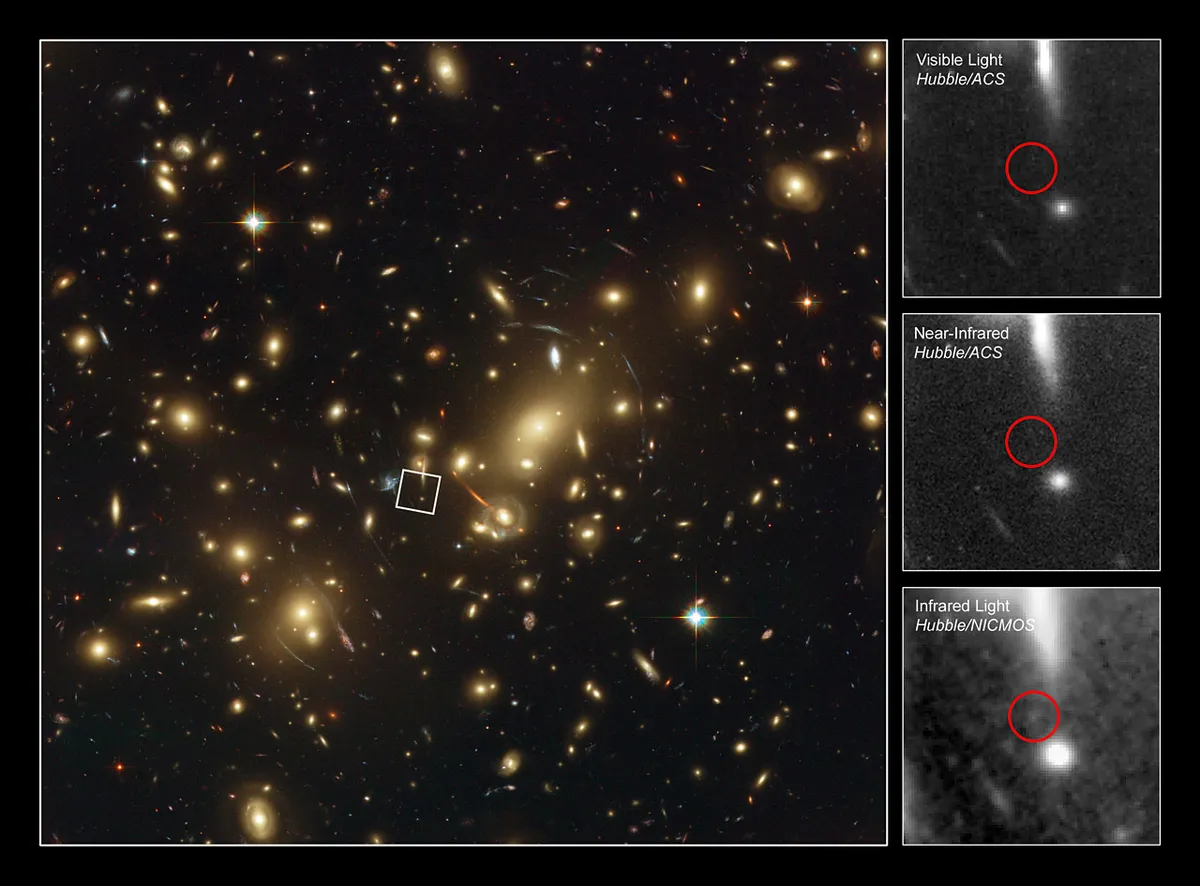
Several arcs in the image can be studied in detail. The images on the left show the view of a galaxy with an approximate redshift of 7.5 with the help of gravitational lenses. The galaxy cannot be seen in the top image, which was taken in the visual range by ACS. In the middle image, taken in the near-infrared by ACS, the galaxy becomes barely visible in the region marked with a circle. Finally, the galaxy becomes fully visible in the bottom image, taken by NICMOS in the infrared.
The galaxy is visible in the near-infrared region of the electromagnetic spectrum instead of the visible part because during the 13 billion years that the light took to travel to Earth, the Universe expanded enough to stretch the wavelength from visible to near-infrared.
"The challenge for astronomers is that galaxies beyond 13 million light-years (a redshift greater than 7) are exceedingly faint and are only visible in the near-infrared - right at the limit of what Hubble can observe," explained Jean-Paul Kneib from the Laboratoire d'Astrophysique de Marseille. This new result was only possible with the cosmic assistance of gravitational lenses that magnified the light of distant galaxies enough for Hubble to detect them. A firm confirmation of their distance is beyond the capabilities of the 10m Keck telescope and must wait for powerful future telescopes.
Confirmed in 1979, gravitational lenses were predicted by Albert Einstein in his General Theory of Relativity. According to the theory, the bending of light is due to the presence of matter in the Universe that causes the fabric of space-time to warp and curve.
Gravitational lenses are the result of this curvature of space-time and are mainly detected around very massive galaxy clusters. Due to the gravitational effect of the cluster's observable matter and hidden dark matter, light is bent around the cluster. This bending of light allows clusters in certain locations to act as a natural telescope that boosts the light from faint, more distant objects. They are the cosmos's great magnifying glass.
When ground-based telescopes fail to detect such faint and distant objects due to the effects of Earth's atmosphere, the combination of using the Hubble Space Telescope and the gravitational magnification of these lenses provides astronomers with a view of these elusive objects.
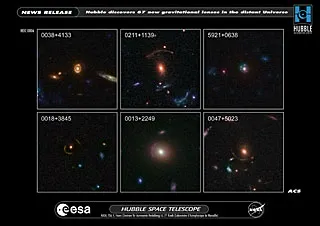
This technique has been used numerous times by Hubble and has helped astronomers find and study many of the most distant galaxies known. For example, when we reported the discovery of 67 galaxies with gravitational lenses.
Sources and related links
- SpaceTelescope:Lenses galore - Hubble finds large sample of very distant galaxies
- Hubble and Spitzer find tiny galaxies in the distant Universe
- Astroenlazador:Looking into the most remote past: Hubble Ultra Deep Field
About the images
Credit:NASA, ESA and Johan Richard (Caltech, USA)
Davide de Martin & James Long (ESA/Hubble)