A frequent sign of maturity in a spiral galaxy is the formation of a loop of stars and gas that crosses the nucleus.
In a new study of more than 2,000 spiral galaxies conducted with the Hubble Space Telescope, astronomers found that so-called barred spiral galaxies were much less abundant 7 billion years ago than they are now, in the local universe.
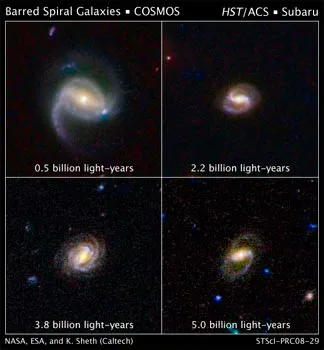
The results confirm the idea that bars are a sign that galaxies reach maturity. The observations are part of the COSMOS survey (Cosmic Evolution Survey). COSMOS covers an area of the sky nine times larger than the full Moon, studying 10 times more spiral galaxies than previous observations.
The team led by Kartik Sheth of the Spitzer Science Center at Caltech discovered that only 20% of spiral galaxies in the distant past possessed bars, compared to nearly 70% of modern ones.
Bars have been forming uniformly over the last 7 billion years, tripling their number. "The recently forming bars are not uniformly distributed across galaxy masses, however, and this is a key finding in our research," explained Sheth. "They are forming mainly in smaller, low-mass galaxies, while among the more massive galaxies, the fraction of bars was the same in the past as it is now."
The discoveries have important ramifications for galactic evolution. "We know that evolution is generally faster for more massive galaxies: these form their stars earlier and faster. Lower-mass galaxies form their stars more slowly, but now we see that they also create their bars more slowly over time."
Bars form when stellar orbits in a spiral galaxy become unstable and drift into a circular path. "Small elongations in the orbits of stars grow and become locked in place, creating the bar. It becomes stronger by locking in more and more of these elongated orbits. Finally, a large fraction of stars in the inner region of the galaxy join the bar," explains Bruce Elmegreen of IBM's research division in New York.
Lia Athanassoula of the Astrophysics Laboratory of Marseille in France, adds: "The new observations suggest that the instability is faster in more massive galaxies, perhaps because their inner disks are denser and their gravity is stronger."
Bars are, perhaps, one of the greatest catalysts for changing a galaxy. They force a large amount of gas toward the galactic center, generating new star formation, creating central bulges of stars and feeding massive black holes.
"The formation of a bar could be the last major act in the evolution of a spiral galaxy. Galaxies are thought to form through mergers with other galaxies. After settling down, the only dramatic way to evolve is through the action of bars," comments Sheth.
Our Milky Way, a barred spiral galaxy, has a central bar that probably formed early, like other bars in large galaxies in the Hubble study. Understanding how bars form in more distant galaxies could help understand how it happens here, in our neighborhood.
Sources and related links
- Barred Spiral Galaxies Are Latecomers to the Universe
- Evolution of the Bar Fraction in COSMOS: Quantifying the Assembly of the Hubble Sequence
The Astrophysical Journal, 675:1141Y1155, 2008 March 10
Kartik Sheth et al.
DOI:10.1086/524980
About the images
The images show four spiral galaxies with bars of stars and gas crossing them. They are at various distances from Earth. The galaxy in the upper left corner is 2.1 billion light-years away; the upper right one at 3.8 billion light-years; lower left at 5.3 billion light-years and the lower right one at 6.4 billion light-years.
The observations were made between 2003 and 2005 and astronomers combined these images with observations from the Hubble and Subaru telescopes on Mauna Kea.
Credit: NASA, ESA, K. Sheth (Spitzer Science Center, California Institute of Technology, Pasadena, Calif.), and P. Capak and N. Scoville (California Institute of Technology)