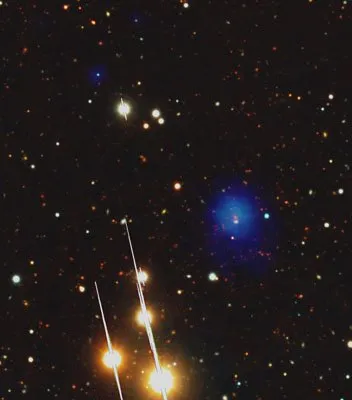
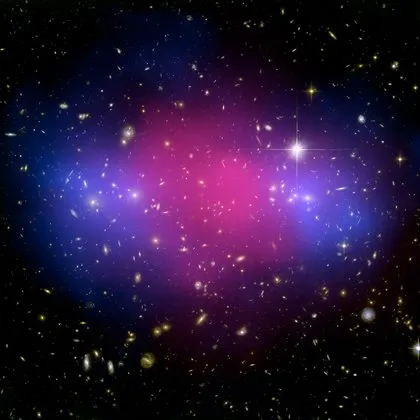
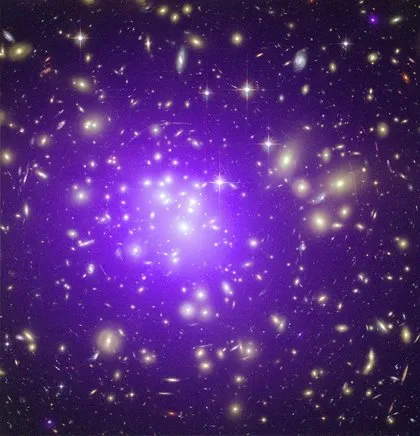
The Hubble Space Telescope identified hundreds of globular clusters over 5 billion years old in the Virgo cluster. One of the results of this discovery is a greater understanding about the life, evolution and interaction of galaxies.
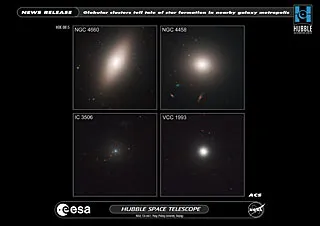
Globular clusters, dense groups of hundreds of thousands of stars that usually orbit galaxies, contain some of the oldest stars in the universe. A new international study found evidence that they are more likely to form in dense areas, where stellar births occur at a faster rate, rather than uniformly.
Astronomers used the Hubble Space Telescope to identify over 11,000 globular clusters in the Virgo cluster, most of which are over 5 billion years old. Composed of over 2,000 galaxies, the Virgo cluster is located 54 million light-years away and is the nearest large galaxy cluster to Earth. Along with Virgo, Hubble's sharp vision from the Advanced Camera for Surveys detected the star clusters in 100 galaxies of various sizes, shapes, and brightness, including diffuse dwarf galaxies.
"It is difficult to distinguish globular clusters from stars and galaxies using ground-based telescopes," explained Eric Peng of Peking University in Beijing and author of the study.
Hubble's "eye" is so sharp that it was able to distinguish the fuzzy globular clusters from stars in our galaxy and in more distant background galaxies.
The team found globular clusters, from a few dozen to several of them, in most of the dwarf galaxies within 3 million light-years of the center of the Virgo cluster. This is the same region where the giant elliptical galaxy Messier 87 resides.
These numbers are surprisingly high considering that dwarf galaxies are of low mass. In contrast, dwarf galaxies on the outskirts of the cluster have fewer globular clusters.
"Our study shows that the efficiency in the formation of star clusters depends on their environment," says Patrick Cote of the Herzberg Institute of Astrophysics in Canada. "Dwarf galaxies near the crowded center of the Virgo cluster contain more globular clusters than those farther away."
Astronomers have long known that the giant elliptical galaxy at the center of Virgo, Messier 87, also hosts a larger than predicted population of globular clusters. However, the origin of there being so many has been a mystery. It has been theorized that many of the clusters have been snatched from smaller galaxies that passed too close to Virgo.
"We found few or no globular clusters in galaxies within 130,000 light-years of Messier 87, suggesting that the giant galaxy stripped the smaller galaxies of their clusters. These smaller galaxies are contributing to building Messier 87," says Peng.
Evidence of Messier 87's "cannibalism" comes from an analysis of the composition of the globular clusters. "In Messier 87 there is a three times greater deficiency of heavy elements, such as iron, than in clusters rich in them. This suggests that many of the metal-poor star clusters have been stolen from neighboring dwarf galaxies, which also contain a deficiency in heavy elements."
Studying globular clusters is crucial for understanding the early stages of the star formation episodes that mark galaxy formation.
"Star formation near the core of Virgo is very intense and occurs in a small volume over a short amount of time. It would be faster and more efficient than star formation on the outskirts. The high star formation rate could be generated by the gravitational collapse of dark matter, an invisible form of matter, which is denser and collapses earlier near the center of the cluster. Messier 87 resides at the center of a large concentration of dark matter and all these globular clusters near the center probably formed in the early history of the Virgo cluster."
The smaller number of globular clusters in dwarf galaxies farther from the center could be due to the masses in question: "Star formation farther from the central region was not as robust, which would have produced only less massive clusters that dissipated over time," explained Peng.
Astronomers also obtained precise distances to 84 of the 100 galaxies in the study.
The results appear in the July 1, 2008 edition of The Astrophysical Journal.
Sources and related links
- Space Telescope:Globular clusters tell tale of star formation in nearby galaxy metropolis
- HubbleSite:Globular Clusters Tell Tale of Star Formation in Nearby Galaxy Metropolis
- The ACS Virgo Cluster Survey. XV. The Formation Efficiencies of Globular Clusters in Early-Type Galaxies: The Effects of Mass and Environment
Eric W. Peng
The Astrophysical Journal, 681:197–224, July 1, 2008
DOI:10.1086/587951
About the images