The Chandra X-ray Observatory reveals a new image of Abell 1689, a massive galaxy cluster located 2.3 billion light-years away, which shows signs of merger activity.
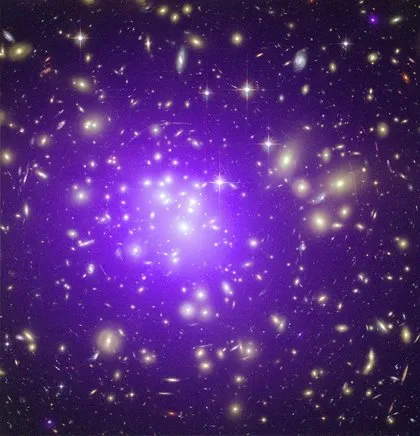
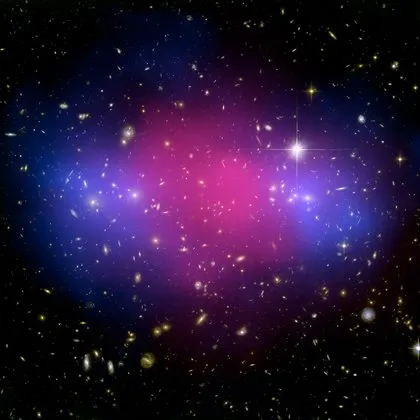
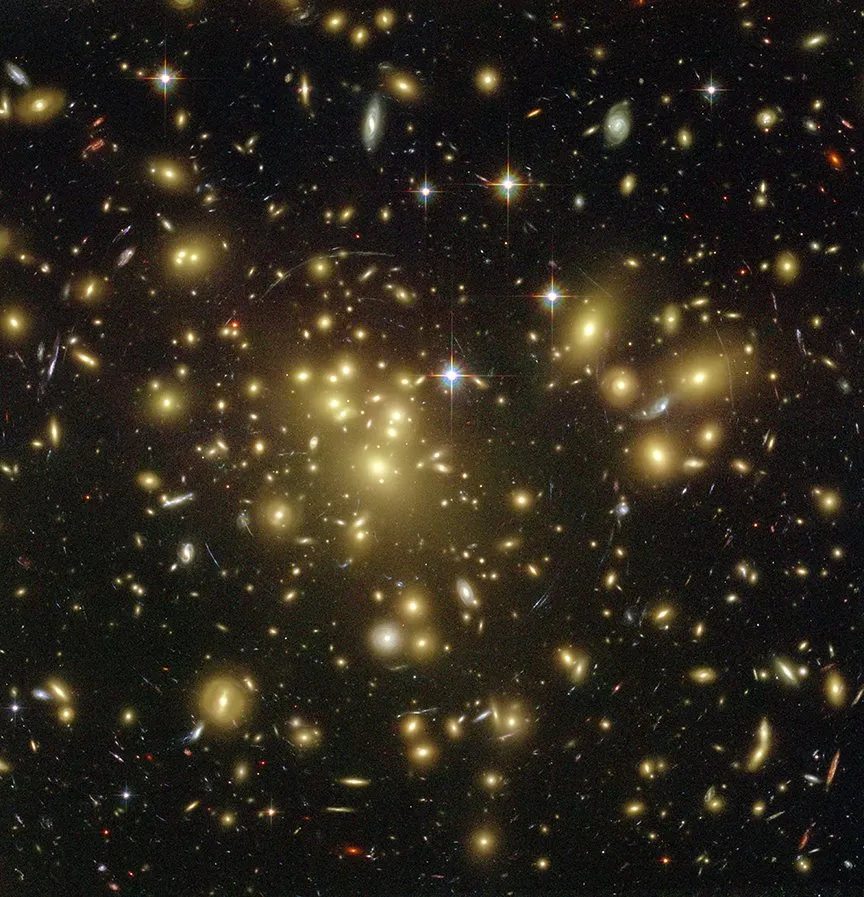
In violet, the super-hot gas detected by Chandra is shown, while the galaxies observed by the Hubble Space Telescope are colored yellow. The X-ray emission has a smooth appearance, unlike other merging systems like the Bullet Cluster or MACS J0025.4-1222, as we recounted in "Cluster collision provides clues about dark matter".
The long arcs in the optical image are caused by gravitational lensing of background galaxies by the matter in the cluster's galaxies, the largest system with such arcs.
Further studies are needed to explain the lack of agreement between the mass estimated based on X-ray data and gravitational lenses. Previous work suggests that filament-like structures of galaxies are located near the cluster along our line of sight to the cluster, which could bias mass estimates using gravitational lenses.
Sources and related links
About the images
Image composition
Credit: NASA/CXC/MIT/E.-H Peng et al; Optical: NASA/STScI
Optical image: Hubble
Credit: NASA/STScI