Astronomers and other people interested in having night skies free from the glare of artificial lights like to tell this story: When the Northridge earthquake occurred in Los Angeles in 1994, the city was left without power. Many calls were then received at emergency centers and the Griffith Observatory from people who went out into the streets in the hours before dawn. And they said they saw in the night sky, with concern, what they described as "a giant silver cloud" over the shaken city.
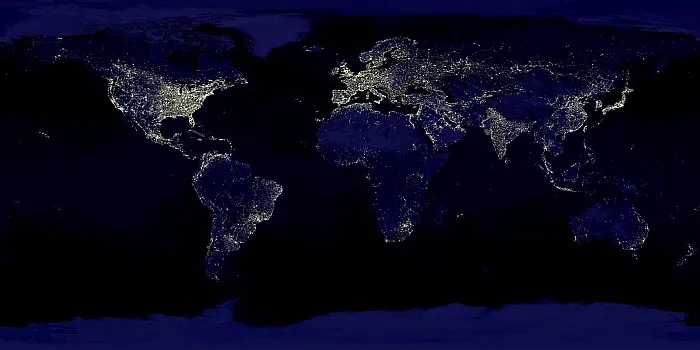
It was nothing to worry about. It was, simply, the Milky Way, the vast galaxy that humans used to know so well, until the brightness of electric lights erased its traces from urban skies.
It is easy to forget, 130 years after electric lights first shone in the streets, that the sky is full of stars. But, to a large extent, thanks to a remarkable collaboration between science and business, which began in Tucson during the 1970s, an idea is gaining acceptance: dark skies can be achieved with new products and technologies. Nighttime darkness can generate real benefits, not only for astronomers, but also for businesses from gas stations and parking lots to Nascar racetracks.
This is narrated by Joe Sharkey in the New York Times of August 30 in an article titled "Helping the Stars Take Back the Night".
The journalist continues saying that during the 1950s, a time when the United States decided to take the lead in space exploration, a conglomerate of observatories was founded on the summit of Kitt Peak, in the Sonoran Desert. It's that Arizona is a quasi-desert area, with only two large urban centers: Phoenix and Tucson.
There, a pro-dark skies movement began to take shape, giving rise to the International Dark-Sky Association, whose main objective is to raise awareness about light pollution and promote the design and marketing of outdoor lights that have a minimal impact on night skies.
Of course, this went against the interests of a part of society: car sellers, engineers in the sector, police officers, and owners of hamburger stands, shopping malls, and security companies.
Perception began to change with the development of fixtures with shields that put the light on the ground, where one really wanted it. Businessmen and politicians began to pay attention when it was demonstrated that bright lights create unnecessary glare that, in some cases, makes it harder to see clearly.
The police noticed this, as well-designed lighting devices focus exactly what one wants and provide a low-glare environment that is better for the task of viewing, whether on highways, sports fields, or parking lots.
The Dark Skies group estimates that poorly designed outdoor lights waste $10 billion in energy in one year.
Other companies began to develop more efficient lighting devices for sports fields and racetracks that allow the audience to see better and illuminate better for television broadcasts, in addition to generating less nuisance for neighbors and the surroundings of these outdoor entertainment centers.
And what is being done in Argentina about this?
Little to nothing. But the little can grow. Our country has two representatives in the "Dark Skies Awareness" group, which is a fundamental global project of the International Astronomical Union that attempts to spread the importance of night skies as a cultural heritage of humanity, as we already told in "Argentina en Dark Skies Awareness".
We have organizations that have been working on the issue for a long time, such as the Asociación Argentina de Luminotecnia, for example. But evidently, legislation is needed on the matter.
In the department of Malargüe, on April 14, 2005, a municipal ordinance was passed which regulates aspects related to permitted urban light intensities, the design and installation of lighting fixtures and devices, and their seasonal and hourly usage regime. This ordinance falls within the commitment to healthy policies assumed by the department of Malargüe and in accordance with the UNESCO Universal Declaration on the Rights of Future Generations: "Persons belonging to future generations have the right to an uncontaminated and undamaged Earth, including the right to a pure sky" (IAU/ICSU/UNESCO, 1992).
In "La Justa", the newspaper of the Defensoría del Pueblo de la Ciudad Autónoma de Buenos Aires, the topic is addressed in its issue 3 in the article titled "Sombras y resplandores". There it says, for example:
As established by research conducted by expert Mabel Santoro -author of a bill on the subject- this form of pollution implies a waste of electrical energy that has two negative consequences: the economic one, because more than necessary is spent when the crisis the country is going through imposes the adoption of emergency measures aimed at reducing consumption, and the environmental one, because in this way non-renewable natural resources are being wasted and the emission of gases is facilitated. Furthermore, light trespass increases road insecurity due to the glare suffered by drivers, prevents the good rest of neighbors, and invades private life by penetrating homes through windows. In addition, artificial light alters the activity of other living beings such as birds and unbalances the photosynthesis and growth of plants, producing the premature aging of some species.
Evidently, there is much to do. The dry areas, where observatories are usually installed, are the ones that generate legislative and awareness initiatives in this matter. But evidently, the biggest problem is found in the largest urban centers, where it seems more important to illuminate (and poorly) an advertising billboard than to look at the stars.
Sources and related links
- New York Times:Helping the Stars Take Back the Night by JOE SHARKEY
- International Dark-Sky Association
- ¿Puede Contaminar la Luz? Un Inmenso Despilfarro de Energía, by Mabel B. Santoro Licenciada en Geografía
About the images
Credit:Craig Mayhew and Robert Simmon, NASA GSFC, based on DMSP data.