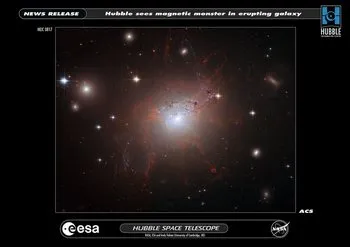
The Chandra X-ray Observatory presents us with an image composite of the active galaxy NGC 1275. It is also known as a radio source (Perseus A) and a strong X-ray emitter due to the presence of a black hole at the galaxy's center.
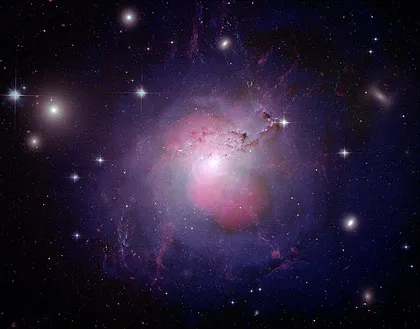
The galaxy lies at the center of a galaxy cluster known as Perseus. We recently talked about this galaxy due to a new study on its gas filaments conducted with the Hubble Space Telescope. (See "The gigantic filaments of NGC 1275") By combining images from several wavelengths into a composite, the galaxy's dynamics are more easily visible. Data in X-ray, optical, and radio wavelengths are combined into an aesthetically pleasing image, but one that also describes the violence of the events at the galaxy's heart.
Data from the Chandra X-ray Observatory (X-ray energies from 0.3-7keV, in violet) were used; data from the Hubble Space Telescope, from its Advanced Camera for Surveys (covering optical wavelengths in green, red, and blue); and radio data, from NRAO's Very Large Array, at 328 Mhz, colored pink in the image.
In the composite, the X-ray data contribute to the lilac bubbles around the outskirts of the center. The pink lobes toward the center of the galaxy are from radio frequencies. The radio emission, which follows the black hole's jets, fills the X-ray cavities. Dust lanes, star-forming regions, hydrogen filaments, stars, and background galaxies are contributions from Hubble's optical data.
NGC 1275 is actually two galaxies, one of which is in the background (the elliptical galaxy) and in front of it there is a spiral galaxy. They lie about 235 million light-years away (72 Mpc).
Sources and related links
- Chandra:Perseus A:A Monster Galaxy at the Heart of Perseus Cluster
- Observatory:The active galaxy NGC 1275
- The Hubble Heritage Project:Active Galaxy NGC 1275
About the images
Credit: X-ray: NASA/CXC/IoA/A.Fabian et al.; Radio: NRAO/VLA/G. Taylor; Optical: NASA/ESA/Hubble Heritage (STScI/AURA) & Univ. of Cambridge/IoA/A. Fabian