A gigantic ring of debris around a nearby star appears to be a much larger version than the Kuiper Belt of our Solar System, the region of icy objects beyond Neptune thought to be a source of comets.
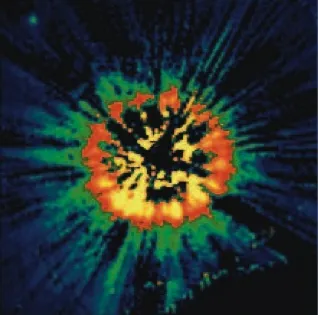
A team led by Christine Chen of the Space Telescope Science Institute in Baltimore, used the Spitzer Space Telescope and the Gemini South Telescope in Chile to study the infrared light from the disk around the star HD 181327, which lies 150 light-years from Earth. They detected a peak in brightness at a wavelength of 63 micrometers, characteristic, according to the scientists, of water ice. "We now have evidence that the composition is similar to our Kuiper Belt," Chen told NewScientist.
The disk has a radius of 12 billion kilometers, almost twice the size of the Kuiper Belt. It is also very bright, suggesting it hosts a lot of material, so the system could be a swarm of comets.
The star belongs to the Beta Pictoris Moving Group, close to Earth. These groups are stars that share a common motion through space and would also have a common origin. The Beta Pictoris Moving Group consists of 17 stellar systems, comprising a total of 28 individual stars. The core of the group lies 115 light-years from Earth and has an estimated average age between 10 and 30 million years.
The northern arm of the disk is 1.4 times brighter than the southern arm, suggesting that the density and/or temperature of the grains in that region is greater than in the southern arm of the disk.
The observed properties agree with the existence of water ice grains located at a distance of 86.3 Astronomical Units from the central star. The data suggest, according to the authors, that it is a debris disk that must be constantly replenished by collisions between the objects in the belt in a new planetary system in formation.
Sources and related links
- NewScientist:Nearby star may be swarming with comets
- A Possible Icy Kuiper Belt around HD 181327
Christine H. Chen, Michael P. Fitzgerald, Paul S. Smith
arXiv:0808.2273v1 - Studies of HD 181327
- HubbleSite:Beta Pictoris Disk Hides Giant Elliptical Ring System
- ESO:New Detailed Image of the Disk around Beta Pictoris
- Gallery of images of circumstellar disks
About the images
HD 181327
Credit:Schneider, G., et al. 2006