A rare event, and perhaps the last time it will occur. Two space shuttles are on two launch pads at NASA's Kennedy Space Center. Endeavour is on pad 39B as the rescue vehicle. Atlantis, on pad 39A, is being prepared for the Hubble Space Telescope servicing mission, scheduled for October 10.
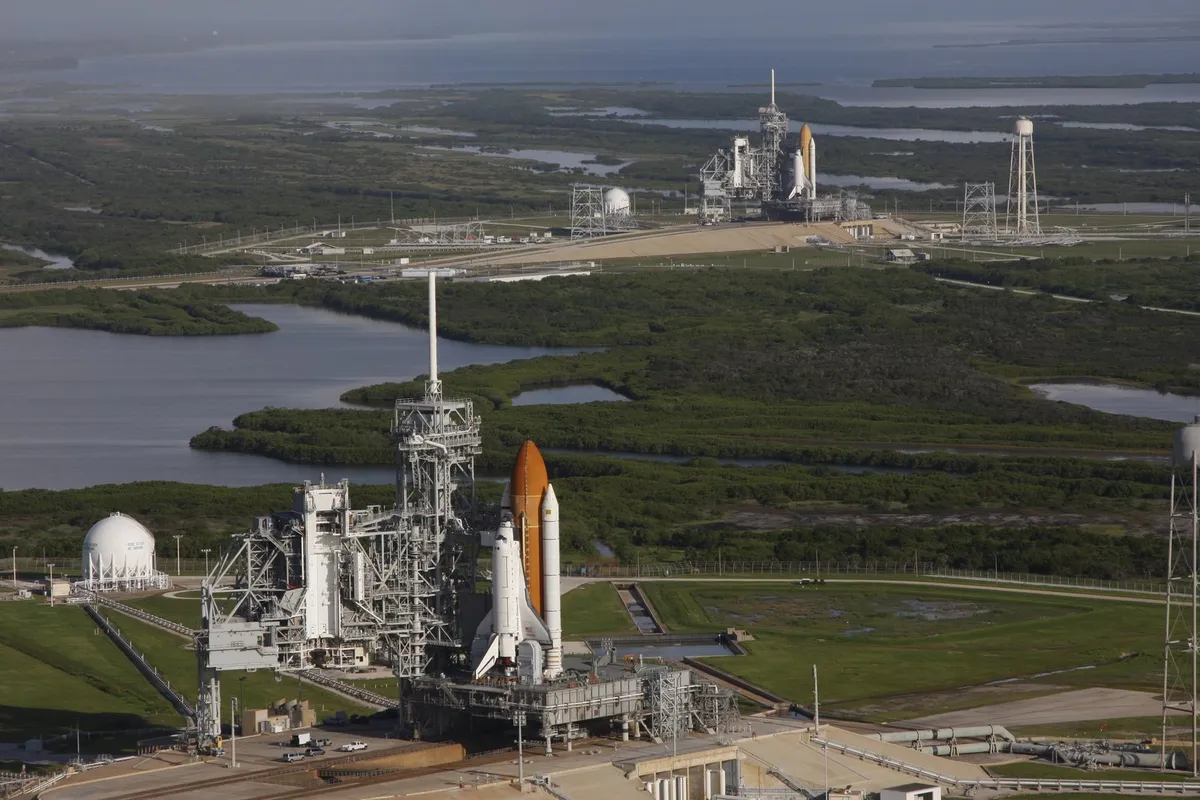
If it is not needed, as expected, to use Endeavour as a rescue vehicle, it will be moved to the other pad for the next mission, STS-126 to the International Space Station, scheduled for November 12. The move is because pad 39B is being prepared to be capable of launching Ares rockets, in preparation for the Constellation Program.
It is not the first time that two shuttles have been on the launch pads. At CollectSPACE.com, Robert Pearlman details about 17 times in history when it happened previously, and with some very good photos.
Damaris Sarria, on her blog "How I Am Becoming An Astronaut", also posted some very good photos from today of the two shuttles, like the incredible shot I am using in the post.
Failure of the NICMOS instrument on Hubble
Regarding the Hubble servicing mission, NASA reported on September 16 that a cooling system associated with the NICMOS (Near Infrared Camera and Multi-Object Spectrometer) scientific instrument aboard Hubble experienced an anomaly during a restart.
As part of the preparations for the new instruments to be installed during Servicing Mission 4, a software update was performed on the computer that controls the five instruments. This installation requires putting the instruments into a safe mode configuration for a short period of time. On September 11, the anomaly in NICMOS was detected. This was about six hours after the system was reactivated. The cooling system automatically went into safe mode. After studying the data, flight controllers modified the protection parameters and attempted to restart the system on Sunday the 14th. The anomaly was detected again, related to a high speed in the system's circulation pump, and it went back into safe mode.
Telemetry analyses indicate an erratic increase in the circulation rotor speed during startup. The data are consistent with rotor disturbance by ice particles (smaller than a millimeter in size). Engineers believe they understand the reason and assume that, after some adjustments to the startup procedures, the cooling system can be successfully reactivated. There was another failed restart attempt on Monday the 15th, so the plan is not to attempt again and for engineers to study the anomaly while waiting for the cooling system to warm up a bit, which may take a few weeks.
If the problem cannot be fixed from the ground, it is not known how it might affect Servicing Mission 4, for which there would be less than a month left, as planned.
Sources and related links
- UniverseToday:Two Shuttles on the Pad — The Last Time
- UniverseToday:Hubble NICMOS Instrument Experiences Anomaly
- NASA:Hubble Telescope Science Instrument Experiences Anomaly During Restart
- How I Am Becoming An Astronaut:Space Shuttle Atlantis and Endeavour at the pads
About the images
Credit:Damaris B. Sarria http://damarisbsarria.blogspot.com/