The U.S. space agency landed on Mars, photographed distant worlds, continued construction of the International Space Station and took part in a lunar mission with India. Here, on Earth, researchers studied the Arctic Ocean, broke aviation records, discovered the cause of the storms that make Auroras glow and even helped create advanced swimsuits for the Olympic Games. The agency's achievements on its golden anniversary, listed here.
The International Space Station (ISS) nearing completion on its 10th Anniversary
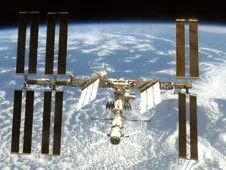
NASA completed four space missions in 2008 to bring modules and equipment to the ISS. The activation this year of the European Space Agency's (ESA) Columbus module and the Jules Verne Transfer Vehicle, as well as the Japanese agency's Kibo laboratory, marked the beginning of new space flight control centers in Germany, France and Japan working alongside existing ones in the U.S., Russia and Canada.
November 20 was the 10th anniversary of the launch of Zarya, a Russian control module that was the first component of the Station. Since then, the ISS has grown in mass (more than 300 tons) and volume (more than 700,000 cubic meters). The Station now houses 19 research facilities (9 from NASA, 8 from ESA and 2 from Japan).
ISS: 10 years
Endeavour launched successfully
Phoenix achieves a successful mission to Mars
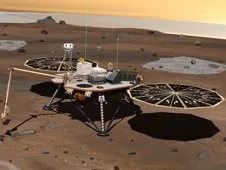
The Phoenix Mars Lander probe ceased communications on November 2 after successfully sending unprecedented scientific data to Earth. Launched on August 4, 2007, it managed to land on the red planet on May 25, 2008. Scientific achievements include more than 25,000 images sent to Earth and preliminary studies allowed investigation of whether the arctic environment has been favorable for microbial life, performed studies of the alkaline soil, discovered salt concentrations and documented the history of water on Mars. Analysis of its data continues.
NASA Phoenix
First images from Phoenix
The Ares I rocket passed an important test
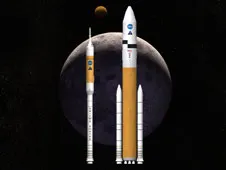
NASA successfully completed the preliminary design review of the rocket in 2008. It is expected that by 2015 the rocket will be able to launch the Orion exploration vehicle. The agency plans to test the rocket in 2009.
NASA Ares
Arctic ice decline continues

In September, Arctic sea ice coverage reached its second lowest level recorded since the birth of the satellite era, according to NASA observations. Arctic ice reflects sunlight, keeping polar regions cool and moderating the global climate. According to measurements from the National Snow and Ice Data Center (NSIDC), the ice has decreased dramatically.
Lighting up the night

Researchers using a fleet of five NASA satellites (Themis) discovered this year that the explosions of magnetic energy that occur at one-third the distance to the Moon generate the storms (substorms) that cause the sudden lights of the aurora borealis. The cause is magnetic reconnection, a process that occurs in the universe when magnetic field lines change shape, like a rubber band that has been stretched too far.
NASA Themis
Auroras around the clock
Hubble finds planet orbiting distant star
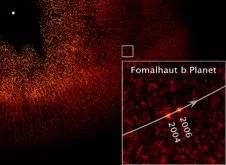
Astronomers announced in 2008 that the Hubble Space Telescope took the first visible-light image of a planet orbiting another star. It is an object orbiting the star Fomalhaut.
Hubble observes planet orbiting Fomalhaut
First tests of next-generation engine
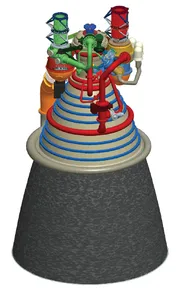
NASA engineers completed the first series of tests in the development of the J-2X engine that will be used to power the Ares I and Ares V rockets. Ares I will launch the Orion spacecraft that will carry astronauts to the ISS and there is the intention to use it to send astronauts to the Moon by 2020. The agency conducted nine tests of the J-2 engine heritage between December and May.
NASA: J-2 Tests
The Collier Trophy
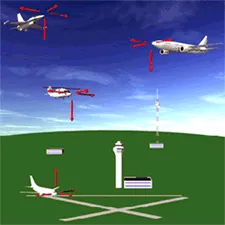
NASA was part of a team that received one of the most prestigious awards in aviation, in June. The award was due to ADS-B, Automatic Dependent Surveillance-Broadcast, an airspace surveillance system. This very sophisticated system has been put into operation around the world. The company UPS installed it in its entire fleet, for example.
Testing new technologies to control air traffic
NASA: Collier Trophy
FAA: ADS-B
NASA returns to the Moon with instruments on the Indian spacecraft

The U.S. agency partnered with India by providing two science instruments aboard the lunar explorer Chandrayaan-1. The Indian spacecraft was launched on October 22 and entered lunar orbit on November 8. The Moon Mineralogy Mapper (M3) instrument studies the mineral resources of the natural satellite and the Miniature Synthetic Aperture Radar maps the polar regions in search of ice deposits in the craters.
Moon Mineralogy Mapper (mM3)
Mini-RF http://m3.cofc.edu/
NASA helps Beijing swimmers

The agency's knowledge helped designers create state-of-the-art suits, which led the athletes who used Speedo's LZR Racer to win medals, including Michael Phelps.
Speedo: LZR-Racer/
NASA: Swimsuits