A bit of chance has favored astronomers in obtaining a surprising view of an event never before observed in a quasar, which could be the birth of a galaxy.
Astronomers from the University of Florida and the University of California, Santa Cruz, are the first to discover the beginning of an enormous flow of gas from a quasar, that is, the super bright nucleus of an extremely remote galaxy still in formation. The gas was expelled from the quasar and its enormous black hole at some point 10 billion years ago, an incredibly fleeting event noticed only by the sharp eye of a university student and the formidable convergence of two separate observations.
"It was completely by chance. In fact, the only way it could have happened is through luck," says Fred Hamann, a professor at Florida.
Quasars are extremely bright nuclei of very distant galaxies that are thought to contain supermassive black holes. The quasar in question -designated J105400.40+034801.2- is from 10.3 billion years ago (Redshift of z ~ 2.1)
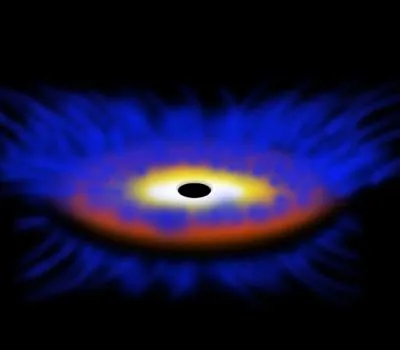
The black holes in quasars are invisible, of course, but the material that is drawn toward them forms an accretion disk, the source of the intense light of quasars. Some of the material falling toward the black hole can be expelled to form enormous clouds of gas, flowing at a speed close to that of light. The gas from the quasar, in this case, flows at 93 million kilometers per hour, according to Hamann.
While astronomers have observed the presence of those gas clouds in other quasars, they had not witnessed one forming, until now.
Hamann indicated that the discovery was initiated by Kyle Kaplan, a student at Santa Cruz who noticed peculiarities in the spectrum that had been recorded of the quasar. The spectrum was collected in 2006 as part of an effort to study the galaxies between the quasar and Earth.
When Hamann and other astronomers compared that spectrum against another from the same region recorded in a different survey conducted in 2002, they were surprised to discover that there were no indications of the gas cloud.
"That's how we know this appeared between 2002 and 2006," he explains.
Daniel Pogra, a physics professor in Nevada and an expert on gas flows from astronomical objects, indicated that the discovery was very fortunate.
"Humans cannot directly monitor changes in quasars since they take many years. So, a discovery of a change in a few years is very interesting. It is not unexpected, but the odds are very small."
"The fact of having seen one appear in such a short period of time means it is a volatile type of structure. It could be an evolutionary phase or perhaps a transitional stage from one phase to another," says Hamann about the discovery of the quasar's gas flow.
The finding opens new possibilities for knowledge about these very distant, very bright objects.
"An interesting question in astronomy is how the evolution of quasars is related to the evolution of galaxies. The matter ejected by quasars could be the key to this relationship because it can alter or regulate galaxy formation around quasars. This finding is a small piece of a story we see happening in real time and what we are going to do now is continue observing."
Sources and related links
- EurekAlert:Serendipitous observations reveal rare event in life of distant quasar
- University of Florida:Serendipitous observations reveal rare event in life of distant quasar
- Emergence of a Quasar Outflow
F. Hamann, K. F. Kaplan, P. Rodriguez Hidalgo, J. X. Prochaska and S. Herbert-Fort
Letters of the Monthly Notices of the Royal Astronomical Society
DOI10.1111/j.1745-3933.2008.00554.x
About the images
Illustration of the gas flows (in blue) surrounding a black hole of a quasar.
Credit:University of Florida/Myda Iamiceli