The physical properties of most galaxies in the universe can be explained in terms of just one parameter. That is the controversial conclusion of a team of astronomers who studied 195 galaxies. The scientists think their discovery could mean that cold dark matter does not exist.
One of the most important questions in cosmology is how galaxies formed from a primordial fireball after the Big Bang. Physicists believe that ordinary matter—the kind that forms stars, planets, and humans—would have been distributed evenly throughout the universe by the intense radiation present after the Big Bang. But that makes it quite unlikely that dense clumps of matter would form and grow rapidly into galaxies, which is what seems to have happened less than a billion years after the Big Bang.
The solution could lie in cold dark matter (CDM), an invisible form of matter that would interact with gravity but not with electromagnetic radiation. According to astrophysicists, cold dark matter would not have been evenly distributed by radiation, but would have clumped together due to gravity. These denser regions of dark matter would have later evolved into galaxies with normal and dark matter. This view is supported by indirect observations that suggest this still-unknown kind of matter makes up most of the mass of a typical galaxy.
Many astrophysicists believe this process can be described by the theory of hierarchical galaxy formation, in which progressively larger clumps of matter attract each other, merging in violent collisions. Through this chaotic formation process, there should then be a wide variety of galaxy types in the Universe. This view seems supported by the observation that galaxies have various properties, such as radius, mass, rotation rate, and luminosity, for example.
Six in one
However, in the last decade, astronomers have found that correlations exist between some properties of galaxies. The radius of a galaxy, for example, can be predicted by measuring its luminosity. Now, Mike Disney of Cardiff University and colleagues say they have shown that six important properties of galaxies are controlled by a single parameter. Although the team has not yet identified that parameter, they believe it is related to the mass of the galaxies.
According to Disney, the discovery makes it very unlikely that galaxies formed according to the hierarchical theory. And he goes further by indicating that the team's results cast doubt on the existence of cold dark matter.
The team used observational data from the Parkes radio telescope in Australia to identify about 300 candidate galaxy objects from the radio waves of neutral hydrogen. Then, Julianne Dalcanton and colleagues at the University of Washington searched the optical data from the Sloan Digital Sky Survey (SDSS) for the same objects and found that 200 of them were, indeed, galaxies.
Single parameter
Using these data, the team classified the galaxies in terms of six independent properties. These were two optical radii (which define the sizes of the regions of a galaxy that emit 50% and 90% of the object's light); luminosity; the mass of neutral hydrogen in the galaxy; the dynamic mass (which includes dark matter); and the color of the galaxy. Then the team performed statistical analyses of the data and found five correlations between these six properties, leading them to think that the structure of these galaxies is controlled by a single parameter. Although the team was not able to conclude exactly what that parameter is, according to Disney, it seems to have a strong relationship with the mass of the galaxies.
Disney argues that the finding is strange for the hierarchical formation theory, according to which a galaxy's structure would be strongly influenced by the nature of the collisions that formed it. "If that were the case we would expect to see 4-5 independent parameters," he explains.
And since the hierarchical theory has cold dark matter at its roots, Disney believes the study provides evidence that this type of matter simply does not exist. "Perhaps our observations can be explained by cold dark matter, but I wouldn't bet on it," he challenges.
Not everyone is convinced
Richard Bower of Durham University explained to physicsworld.com that proponents of CDM are aware of the correlations between galaxy properties and are trying to explain them. "The theory has been successfully tested against a number of individual correlations," he said, but admitted that proponents of cold dark matter must demonstrate that the theory can deal with this method of analysis.
Bower also indicated that galaxy mergers do not now seem as important as in earlier versions of the hierarchical theory. As a result, he says he is confident that galaxy formation can be explained using CDM. Furthermore, the scientist questioned the significance of the mass parameter's dominance over the others, noting that the mass of galaxies varies over a wider dynamic range than the other parameters, so it is not surprising that the mass correlation is the strongest.
Disney is now exploring galaxy formation theories that do not involve dark matter, but rather conventional matter.
An alternative to the cold dark matter model is the gravitational hierarchy model, for which small density fluctuations (regions where the density is slightly higher than average) are necessary. Those denser regions, consequently, with greater gravity, attract surrounding matter. Of course, one would have to know how to explain how and why denser inhomogeneity regions are created...
And the Russian model, known as the Pancake Model, developed by Yakov Borisovich Zel'dovich, has also been postulated. It is based on hot dark matter (that is, particles moving at high speeds) that would develop large structures from which fragments would be produced. It is, therefore, a "top-down" theory as opposed to theories that first form small structures that grow through mergers and collisions.
Sources and related links
- Galaxy survey casts doubt on cold dark matter
- , by Hamish Johnston, editor of physicsworld.com
- Correlations among the properties of galaxies found in a blind HI survey, which also have SDSS optical data
Diego A. Garcia-Appadoo, Andrew A. West, Julianne J. Dalcanton, Luca Cortese, Michael J. Disney
arXiv:0809.1434v1
Submitted to Monthly Notices of the Royal Astronomical Society - The origin of galaxies
About the images
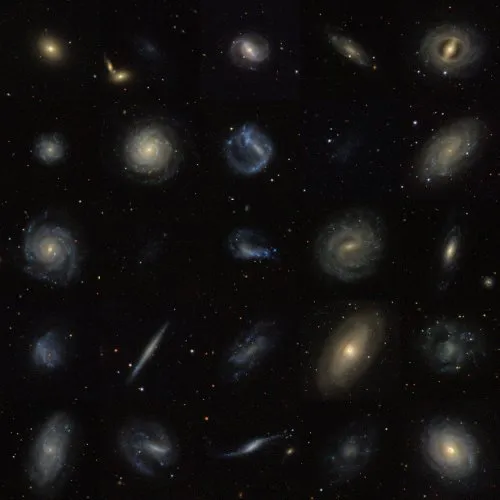
A selection of galaxies from the study.
Credit: Andrew West