Astronomers used the Very Large Array (VLA) radio telescope to observe a galaxy more than 12 billion light-years from Earth, seen as it was when the Universe was just 15% of its current age. Between this galaxy and Earth lies another galaxy, so perfectly aligned along the line of sight that its intense gravity curves the light and radio waves from the more distant object into what is called an "Einstein Ring."
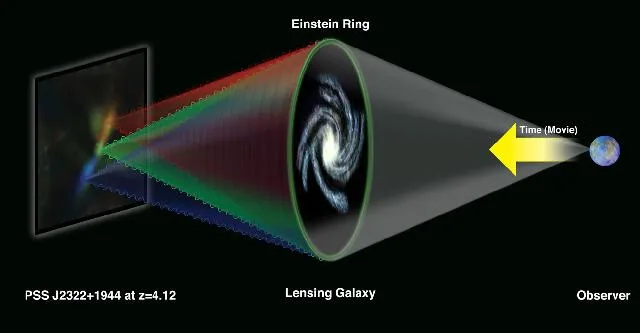
A gravitational lens forms when light from distant objects curves around a massive object located between the emitting object and the receiver.
This gravitational lens makes it possible for scientists to learn details of the young and distant galaxy that they otherwise would not have been able to.
"Nature provides us with a magnifying glass to spy on the workings of a galaxy in birth, giving us an exciting glimpse into the violent process of galaxy creation in the early history of the Universe," says Dominik Riechers, who led the project at the Max Planck Institute for Astronomy in Germany and now at Caltech.
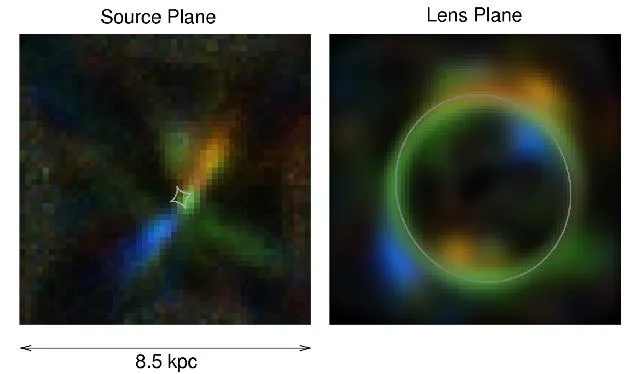
The new image of the distant galaxy, named PSS J2322+1944, shows a massive reservoir of gas, 16,000 light-years in diameter, containing the material to form new stars. A supermassive black hole is voraciously swallowing material and new stars are forming at a rate of nearly 700 stars per year. In comparison, our Milky Way produces the equivalent of 3 to 4 stars per year.
The black hole appears to be near the edge, rather than in the center, of this gigantic gas reservoir, indicating, as the astronomers explain, that the galaxy merged with another.
"This overall picture, of massive galaxies and supermassive black holes forming through galaxy mergers so early in the Universe, is a new paradigm in galaxy formation. This system allows us to see this process with unprecedented detail," adds Chris Carilli, of the National Radio Astronomy Observatory (NRAO).
In 2003, astronomers studied this system, finding the Einstein Ring by observing radio waves emitted by carbon monoxide (CO) molecules. When astronomers notice large amounts of CO in a galaxy, they conclude that there is also a large amount of molecular hydrogen present and thus a large reservoir of fuel for star formation.
In the latest study, the scientists produced a physical model of the intervening galaxy. By knowing the mass, structure and orientation of this galaxy, they were able to deduce the details of how it curves the light and radio waves from the more distant galaxy. This allowed them to reconstruct the image of the distant galaxy, with multiple VLA images at different radio frequencies and thus measure the motions of the gas in the distant galaxy.
PSS J2322+1944 is a system discovered by George Djorgovski of Caltech, using the Palomar Observatory. Subsequent radio and optical studies showed that it had an enormous reservoir of dust and molecular gas.
Gravitational lenses were predicted by Albert Einstein in his General Theory of Relativity in 1919. The scientist himself showed in 1936 that a perfectly aligned lens would produce a circular image. The first lens was discovered in 1979 and the first Einstein Ring was found by researchers using the VLA in 1987.
How the distant galaxy was observed
The radio waves from carbon monoxide in the distant galaxy (left) were curved by the gravitational effect of another galaxy directly between the distant object and Earth (right). The nearly perfect alignment caused the distant object to appear as a ring when viewed from Earth. The graphic shows how the distant object would look if one moved from Earth toward the galaxy acting as a lens. Some of the waves are a different color than others, due to the Doppler effect generated by the motion of the gas in the galaxy. Green indicates "stationary" gas, red indicates gas moving away from us and blue indicates gas moving toward us, relative to the rest of the gas in the galaxy.
Credit: Bill Saxton, NRAO/AUI/NSF
The reconstructed image of the distant galaxy, on the left, and the "Einstein Ring" seen from Earth, on the right. The colors indicate the Doppler motion of the carbon monoxide radio emission, as explained above. The 8 kpc (kilo parsecs) equals 28 thousand light-years.
Credit: Riechers et al., NRAO/AUI/NSF
Sources and related links
- Physorg: Cosmic Lens Reveals Distant Galactic Violence
- A Molecular Einstein Ring at z = 4.12: Imaging the Dynamics of a Quasar Host
Galaxy Through a Cosmic Lens
Dominik A. Riechers et al.
The Astrophysical Journal, 686:851–858, October 20, 2008
arXiv:0806.4616v1 - NRAO: Cosmic Lens Reveals Distant Galactic Violence
About the images
Credit: Riechers et al., NRAO/AUI/NSF