The Hubble Space Telescope is working again and, a proof of this and a magnificent photograph of the incredible pair of galaxies Arp 147, which seem to be marking a "10".
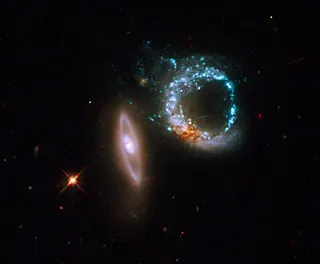
Just a couple of days after being back online, the Hubble orbital observatory pointed its Wide Field and Planetary Camera (WFPC2) towards a pair of interacting galaxies called Arp 147.
The image demonstrates that the camera is working the same as it was before, scoring a perfect 10 for its performance. And, in fact, the alignment of the galaxies seems to be "drawing a 10".
The galaxy on the left, which appears edge-on to our line of sight, (the one that would be the drawing of the "1") is relatively undisturbed, beyond the ring of starlight. The galaxy on the right (the "0") exhibits a lumpy blue ring of intense star formation.
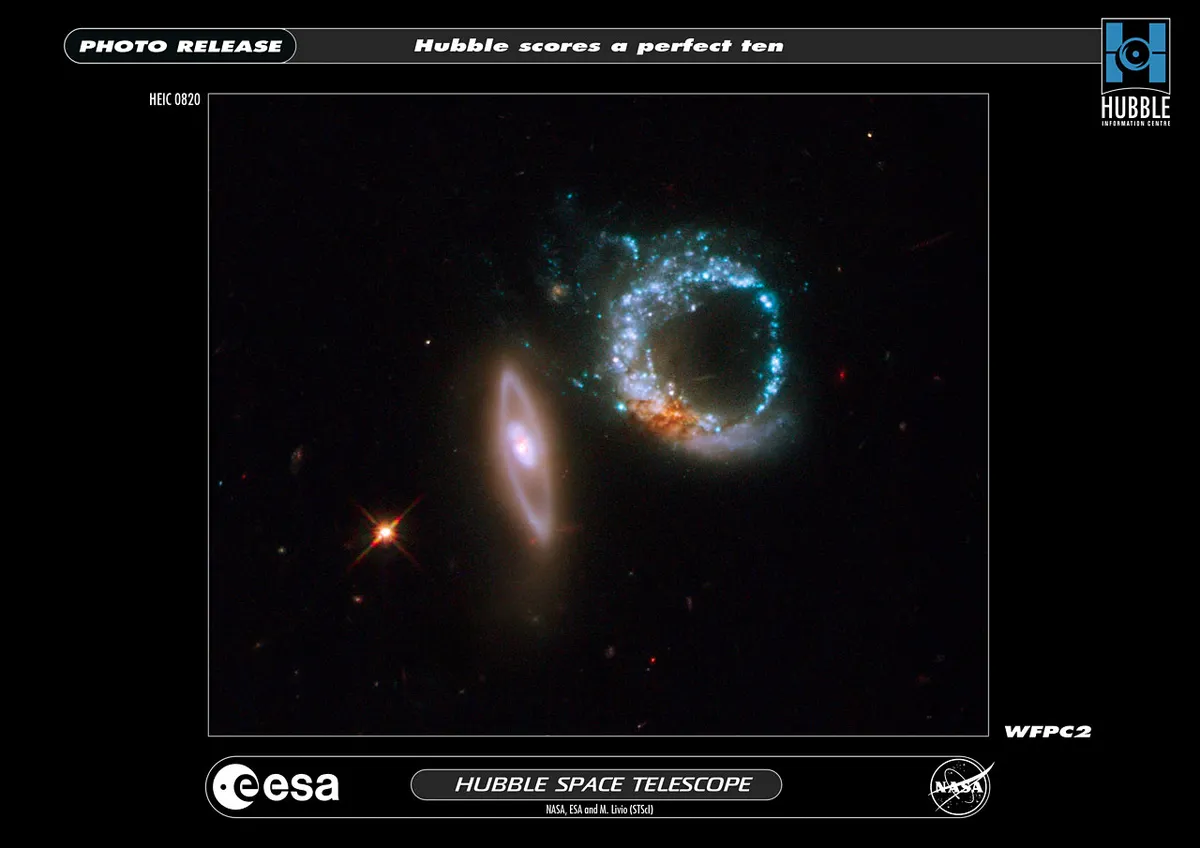
The ring was formed after the galaxy on the left passed through the galaxy on the right. Just as a stone thrown into a pond creates a circular wave moving outward, that is, waves, a propagating ring, of higher density, was created at the point of impact of the two galaxies.
When this excessive density collided with the outer material that was moving inward due to the gravitational pull of the two galaxies, shocks and dense gas were produced that stimulated star formation.
The reddish part in the lower left region of the blue ring probably marks the location of the original nucleus of the struck galaxy.
Arp 147 appears in the Atlas of Peculiar Galaxies by Arp, compiled by Halton Arp in 1960 and published in 1966.
We had talked about the catalog in "A fabulous collection of wild galaxies".
The pair lies in the constellation Cetus, more than 400 million light-years from Earth.
The image was composed from WFPC2 camera images taken with three separate filters. The blue, green and red colors represent the blue, visible light and infrared filters, respectively.
The galactic pair was photographed between October 27 and 28.
Missions STS-125 and STS-126
Meanwhile, it was learned that Servicing Mission 4 (STS-125), which had been postponed until at least February, would be delayed until May 2009. This is because for that mission they will not have, until then, the spare component for the data handling system that recently failed.
On the other hand, Endeavour's STS-126 mission to the International Space Station is set for November 14.
Sources and related links
- Space Telescope:The NASA/ESA Hubble Space Telescope is back in business
- HubbleSite:Hubble Scores a Perfect Ten
About the images
Credit:NASA, ESA and M. Livio (STScI)