This week, Astronomy & Astrophysics is publishing two studies based on high-resolution observations of intermediate-mass infant stars. Astronomers obtained a very precise view of the process in the surrounding disks that feeds stars as they form. This mechanism includes material falling toward the star, as well as gas being ejected.
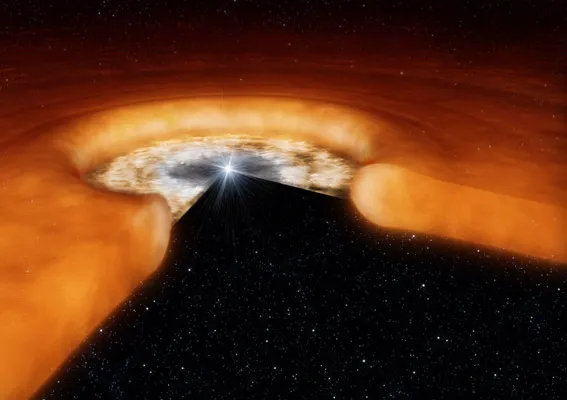
Stars form from a disk of gas and dust that could later provide material for a planetary system. Since the star-forming regions closest to us lie about 500 light-years away, these disks appear very small in the sky and their study requires special techniques to be able to investigate them in fine detail.
This is achieved with interferometry, a technique that combines light from two or more telescopes and, thus, the level of detail revealed corresponds to that of a telescope whose diameter is equal to the separation between the elements, typically from 40 to 200 meters. The Very Large Telescope Interferometer (VLTI) of ESO allowed astronomers to achieve a resolution of one milli-arcsecond, an angle equivalent to the size of a dot seen from 50 kilometers away! Observing the Moon with such a resolution should reveal details about 2 meters in size!
"Until now interferometry has been used mainly to investigate the dust closely surrounding young stars," says Eric Tatulli, who co-led the international project. "But dust is only one percent of the total mass of the disks. Their main component is gas, and its distribution could define the final architecture of the planetary systems that are still forming."
High-resolution observations of the gas emission lines are required. Several processes have been proposed as the source of these emission lines. For example, they could come from an inner disk of gas or could be due to stellar winds or magnetospheric accretion processes. Most of these processes would take place very close to the star (less than 1 Astronomical Unit) and are, therefore, inaccessible with direct observation facilities.
The ability of the VLTI and the AMBER instrument to take spectra while probing objects at high resolution allowed astronomers to map the gas. Thus, the scientists studied the inner gaseous environments of six young stars belonging to the family of Herbig Ae/Be objects. These objects have masses a few times greater than our Sun and are still forming, increasing their mass by swallowing material from the surrounding disk.
"The origin of the gas emissions from these young stars has been under debate until now, because in previous investigations of the gas component, the spatial resolution was not high enough to study the distribution of gas close to the star," indicates Stefan Kraus, co-leader of the project. "Astronomers have very different ideas about the physical processes involved. By combining spectroscopy and interferometry, the VLTI has given us the opportunity to distinguish between the physical mechanisms responsible for the observed gas emission."
The astronomers found evidence of matter falling onto the star in two cases and masses being ejected in four other stars, either in an extended stellar wind or in a disk wind.
It also seems that for one of the stars, dust could be present closer to the star than generally expected. The dust is so close that the temperature should be high enough to evaporate it, but since this was not observed, it must mean that the gas protects the dust from the starlight.
These new observations demonstrate that it is possible to study the gas in the disks around young stars. This opens new perspectives on the understanding of this important phase in a star's life.
"Future observations using VLTI will allow us to determine the spatial distribution and motion of the gas and could reveal whether the observed emission line is caused by a jet launched from the disk or by a stellar wind," adds Kraus.
Sources and related links
- Spatially resolving the hot CO around the young Be star 51 Ophiuchi
E. Tatulli, F. Malbet, F. Menard, C. Gil, L. Testi, A. Natta, S. Kraus, P. Stee, and S. Robbe-Dubois.
A&A 489, 1151-1155 (2008)
DOI:10.1051/0004-6361:200809627 - The origin of hydrogen line emission for five Herbig Ae/Be stars spatially resolved by VLTI/AMBER spectro-interferometry
S. Kraus, K.-H. Hofmann, M. Benisty, J.-P. Berger, O. Chesneau, A. Isella, F. Malbet, A. Meilland, A. Nardetto, A. Natta, Th. Preibisch, D. Schertl, M. Smith, P. Stee, E. Tatulli, L. Testi, and G. Weigelt.
A&A 489, 1157-1173 (2008)
DOI:10.1051/0004-6361:200809946 - Young stellar objects: the source of gas emission around Herbig Ae/Be stars
- ESO:Astronomers get best view yet of infant stars at feeding time
About the images
ESO PR Photo 35/08
Artist's impression of the environment of a young star, showing the geometry of the dust disk in the outer region and the gas disk close to the central star.
Credit:ESO/L. Calçada