The 10th anniversary of the Hubble Heritage Project is being celebrated with a new image of the cosmos. The intricate "valleys and hills" of gas and dust of an incredible nearby star-forming region.
The Hubble Heritage Project, which began in October 1998, has released nearly 130 images from the Space Telescope's archives as well as a number of observations taken specifically by the project. By releasing a new, unknown image each month, the team tries to showcase some of the most attractive images taken by the telescope and share them with a wide audience. The team continues to create aesthetic images that present the universe from an artistic perspective.
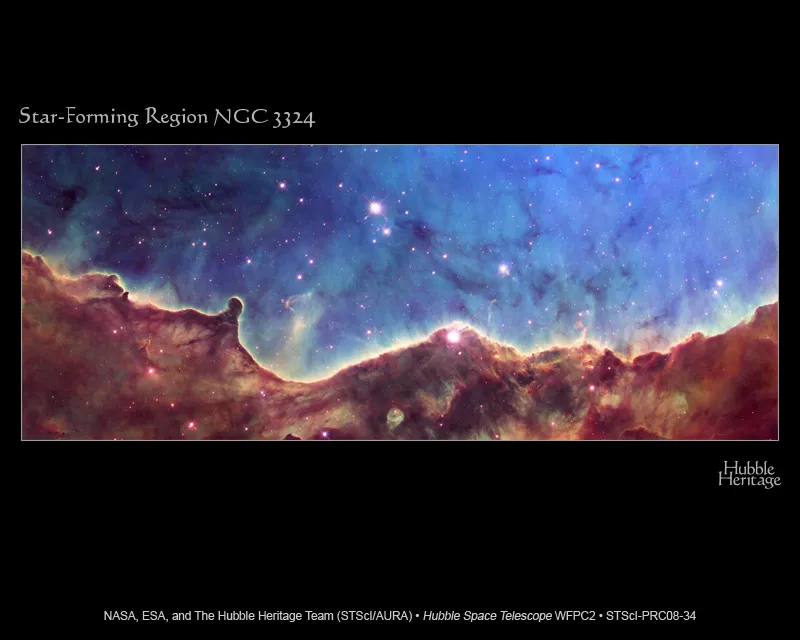
This month a three-dimensional image shows the edge of a giant cavity of gas in the star-forming region called NGC 3324. The bright nebula has been excavated by the intense violet radiation and stellar winds from many young, hot stars. A cluster of very massive stars, located outside the image at the center of the nebula, is responsible for ionizing the nebula and eroding the cavity.
The image also reveals the dark towers of cold gas and dust that rise above the bright wall of gas. The dense gas at the top resists the radiation from the central stars and creates a tower pointing in the direction of the energy flow. The high-energy radiation from the young stars in NGC 3324 is sculpting the nebula's wall by slowly eroding it and thus creating the magnificent silhouette we see.
Located in the southern hemisphere, NGC 3324 is 7,200 light-years (2.2 kiloparsecs) away, at the northern corner of the Carina Nebula (NGC 3372), home to the Keyhole Nebula (Keyhole Nebula) and the active, explosive star Eta Carinae.
The image is a composite of data taken by two of Hubble's scientific instruments. Data taken by the Advanced Camera for Surveys (ACS) in 2006 isolates light emitted by hydrogen. More recent data, taken this year with the Wide Field and Planetary Camera 2 (WFPC2), isolates light emitted by sulfur and oxygen. To create the color composite, the data from the sulfur filter are represented in red, those from oxygen in blue, and those from the hydrogen filter in green.
Where is NGC 3324?
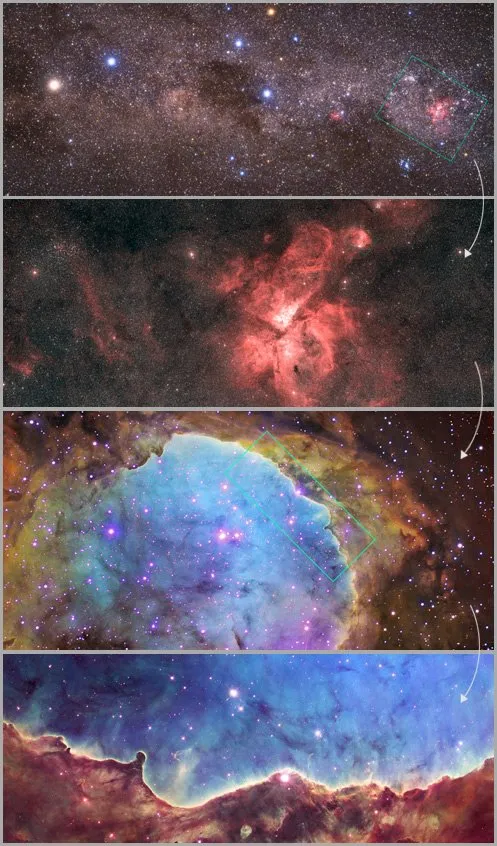
Ground image of the constellation Carina. The Carina Nebula complex is marked with a square.
Photo courtesy: A. Fujii
Red and blue composite of the Carina Nebula complex, home of NGC 3324
Photo courtesy of NASA, ESA, Digitized Sky Survey, and Z. Levay (STScI)
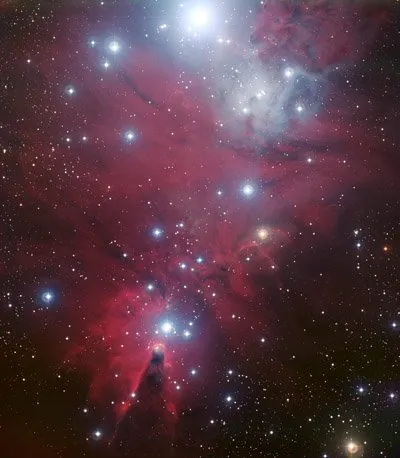
Emission nebula NGC 3324
Photo courtesy of Brad Moore
Section of NGC 3324 from Hubble Heritage
NASA, ESA, the Hubble Heritage Team (STScI/AURA), and N. Smith (University of California, Berkeley)
Sources and related links
- A Celestial Landscape in Celebration of 10 Years of Stunning Hubble Heritage Images
- Hubble Heritage Project
About the images
Credit: NASA, ESA, and The Hubble Heritage Team (STScI/AURA)
Acknowledgement: N. Smith (University of California, Berkeley)