The image combines data from X-rays, infrared, and visible light, captured by ESA's XMM-Newton observatory, NASA's Spitzer, and ESO's New Technology Telescope.
The incredible image offers a new look at the NGC 346 region, revealing new information about how stars form.
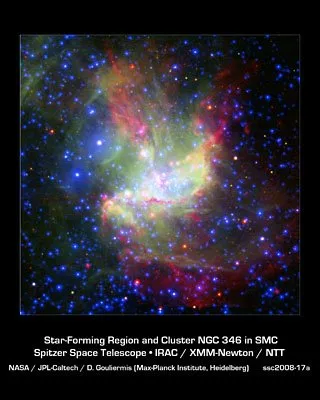
NGC 346 is the brightest star-forming region in the Small Magellanic Cloud, a dwarf galaxy orbiting the Milky Way at a distance of 210,000 light-years.
"When we combine data from several wavelengths, we are able to separate what is happening in different parts of the cloud," says Dimitrios Gouliermis of the Max Planck Institute in Germany, author of a report describing the observations in an upcoming issue of Astrophysical Journal.
Previously, astronomers knew that most of the smaller stars in NGC 346 were created at the same time as the massive stars located in the center of the region, all from a single parent cloud. The intense radiation from the most massive stars eroded the surrounding dust, causing the gas to expand and compress to form new stars. The red-orange filaments around the center of the image show where this triggered star formation process occurred.
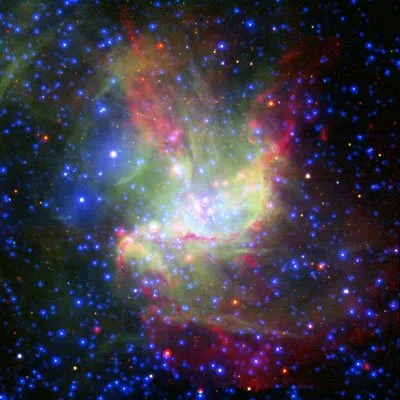
However, a set of younger and smaller stars in the region seen at the top of the image could not be explained by this mechanism. What triggered the formation of this seemingly isolated group of stars?
By combining data from many wavelengths of NGC 346, Gouliermis and his team were able to trace the generation of these young stars to a very massive star that exploded as a supernova about 50,000 years ago. According to the team, this massive star generated a different type of star formation compared to what occurs around the central region. Fierce winds from the massive star, and not radiation, compressed the remaining dust in the cloud, thus forming new stars.
The finding demonstrates that both formation mechanisms, by radiation and stellar winds, are at play in the same cloud. "The result shows us that star formation is a much more complicated process than thought, involving different mechanisms," says Gouliermis.
The new image also reveals a bubble, seen as a blue halo on the left, caused by the supernova explosion of the massive star. Analyses show that the bubble is located within a larger gaseous shell, possibly generated by the explosion and the winds of other bright stars in the vicinity.
In the image, infrared light (in red) shows cold dust; visible light (in green) denotes irradiated gas and X-rays (in blue) represent hot gas.
Sources and related links
- ESA: Splashy portrait paints picture of how stars form
- Spitzer: Splashy Portrait Helps Explain How Stars Form
- ESO: Born from the Wind - Unique Multi-wavelength Portrait of Star Birth
- NGC 346 in The Small Magellanic Cloud. IV. Triggered Star Formation in the HII Region N66
Dimitrios A. Gouliermis, Thomas Henning, Wolfgang Brandner, You-Hua Chu, Eva Hennekemper, Felix Hormuth
arXiv:0710.1352v3
Accepted for publication in The Astrophysical Journal
About the images
NASA/JPL-Caltech/ESA/ XMM-Newton/NTT/MPIA