Unique observations of the flickering light from the surroundings of two black holes provide new insights into the colossal energy flowing from their cores. By mapping how variations in visible light match those in X-rays, astronomers have shown that magnetic fields must play a crucial role in the way black holes swallow matter.
Like the light of a candle, the light coming from the surroundings of a black hole is not constant. "The rapid flickering of light from a black hole is observed mainly in X-ray wavelengths," says Poshak Gandhi, who led the international team reporting the results. "This new study is only one of a few to date that also explores the rapid variations in visible light, and, more importantly, how these fluctuations relate to those in X-rays."
The observations tracked the glow of the black holes simultaneously using two different instruments, one on the ground and one in space. The X-ray data were taken with the Rossi Satellite. The visible light was collected with the ultra-fast camera ULTRACAM, on the VLT, which records up to 20 images per second. ULTRACAM was developed by team members Vik Dhillon and Tom Marsh. "These observations are among the fastest of a black hole obtained with a large optical telescope," notes Dhillon.
To their surprise, the astronomers discovered that the brightness fluctuations in visible light were even faster than those in X-rays. Furthermore, the variations are not simultaneous, but follow a repetitive and remarkable pattern: just before an X-ray flare, the visible light dims, then increases to a bright glow for a tiny fraction of a second before rapidly decreasing again.
None of these radiations emerge directly from the black hole, but from the intense energy flow of electrically charged matter in its vicinity. The environment of a black hole is constantly reshaped by an uncontrolled struggle of forces such as gravity, magnetism, and explosive pressure. As a result, the light emitted by hot streams of matter varies in brightness in a confusing and capricious way. "But the pattern found in this new study has a stable structure that stands out in a chaotic variability and thus can provide vital clues about the underlying physical processes in action," explains team member Andy Fabian.
The visible light emission from the surroundings of black holes was thought to be a side effect, with a primary X-ray burst illuminating the surrounding gas that subsequently glowed in the visible range. But if that were the case, the visible light variations would occur after the X-ray variations and would be much slower to peak and fade. "The rapid flickering of visible light now discovered immediately rules out this scenario for both systems studied," states Gandhi. "Instead, the variations in X-rays and visible light must have a common origin, and one very close to the black hole itself."
Powerful magnetic fields represent the best candidates for the dominant physical process. Acting as reservoirs, they can absorb the energy released near a black hole, storing it until it can be discharged either as hot X-ray plasma or as streams of charged particles traveling at near-light speed. The division of energy into these two components may result in the characteristic pattern of X-ray and visible light variability.
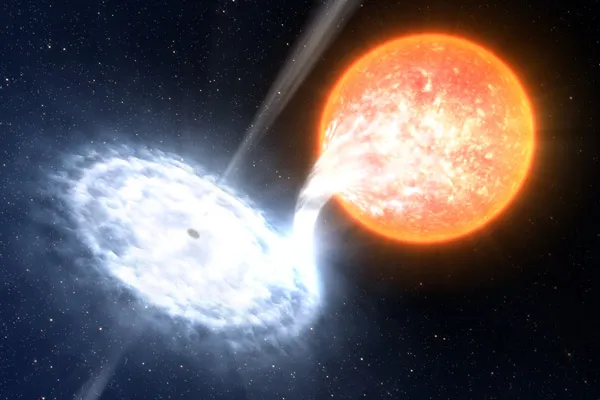
The two black holes studied here, GX 339-4 and SWIFT J1753.5-0127, are the remnants of dead massive stars in the Milky Way. They are embedded in separate binary systems, where the black hole is paired with a normal star that is ceding matter to its dark companion. Both black holes have masses about 10 times that of our Sun, although the size of their orbits is only a few million kilometers, much more compact than Mercury's orbit around the Sun.
Sources and related links
- VLT and Rossi XTE satellite probe violently variable black holes
- SWIFT J1753.5-0127: a surprising optical/X-ray cross-correlation function
Martin Durant, Poshak Gandhi, Tariq Shahbaz, Andy Fabian, Jon Miller, V. S. Dhillon, Tom R. Marsh
The Astrophysical Journal Letters, 682:L45–L48, July 20, 2008
DOI:10.1086/590906
arXiv:0806.2530v1 - Rapid optical and X-ray timing observations of GX 339-4: flux correlations at the onset of a low/hard state
P. Gandhi, K. Makishima, M. Durant, A.C. Fabian, V.S. Dhillon, T.R. Marsh, J.M. Miller, T. Shahbaz, H.C. Spruit
Monthly Notices of the Royal Astronomical Society
Volume 390 Issue 1, Pages L29 - L33
DOI:10.1111/j.1745-3933.2008.00529.x
arXiv:0807.1529v1
About the images
Artist's impression of the black holes studied by the astronomers. The systems, designated as Swift J1753.5-0127 and GX 339-4, each contain a black hole and a normal star, separated by a few million kilometers. That is less than 10% of the distance between Mercury and our Sun. As the two objects are so close, a stream of matter flows from the star toward the black hole and forms a disk of hot gas around it. As matter collides in this accretion disk, it heats up to millions of degrees. Near the black hole, intense magnetic fields accelerate some of the gas into jets that flow in opposite directions. The orbital period of Swift J1753.5-0127, only 3.2 hours, is the fastest found for a black hole. The orbital period of GX 339-4, in contrast, is 1.7 days.
Credit:ESO/L. Calçada
ESO PR Photo 36/08
Star-Forming Region NGC 366
Note: In the ESO press release, an animation of the black hole GX 339-4 made with ULTRACAM is also available.