An international team of astronomers obtained the most detailed observations of what is thought to be the supermassive black hole at the center of the Milky Way.
The astronomers linked radio antennas in Hawaii, Arizona and California to create a virtual telescope over 4,500 kilometers across that is capable of seeing details more than 1,000 times finer than the Hubble Space Telescope. This technique is called Very Long Baseline Interferometry (VLBI). With this technique, signals from multiple telescopes are combined to create the equivalent of a much larger telescope, as wide as the separation between the observatories. The result is a very sharp resolution of objects. The cosmic target was the source known as Sagittarius A* (Sgr A*), which has long been thought to mark the position of a black hole whose mass is 4 million times the mass of our Sun. Although Sgr A* was discovered three decades ago, the new observations have, for the first time, an angular resolution or ability to detect small details.
The team clearly distinguished a structure with an angular scale of 37 micro-arcseconds, which corresponds to a size of about 50 million kilometers at the galactic center, which would correspond to the event horizon of the black hole. The new observations have a resolution equivalent to being able to see, from Earth, a baseball on the surface of the Moon," says Sheperd Doeleman of MIT, lead author of a study to be published in the September 4 issue of Nature.
The observations were made using very short radio waves, 1.3 millimeters, which can penetrate the fog of interstellar gas that "clouds" observations at longer wavelengths. Like distant lights seen through a dense fog, longer-wavelength observations of the Galactic Center are diffuse and blurry. "The short wavelengths combined with the large distances between the radio observatories is what makes this virtual telescope unique for studying the black hole," adds Lucy Ziurys, of the Arizona Radio Observatory.
Although it takes more than 25,000 years for light from the center of the Milky Way to reach us, the team measured the size of Sgr A* at only one third of the Earth-Sun distance, or about 50 million km, a journey that light would make in just three minutes. The astronomers concluded that the source of radiation probably originates in a disk of matter spiraling into the black hole, or a jet of high-speed matter ejected by the black hole. "Future observations with larger virtual telescopes will be able to determine exactly what makes Sgr A* shine," says Doeleman. "Most galaxies are thought to have black holes at their centers, but because Sgr A* is in our own galaxy, it is our best chance to observe what is happening at an event horizon."
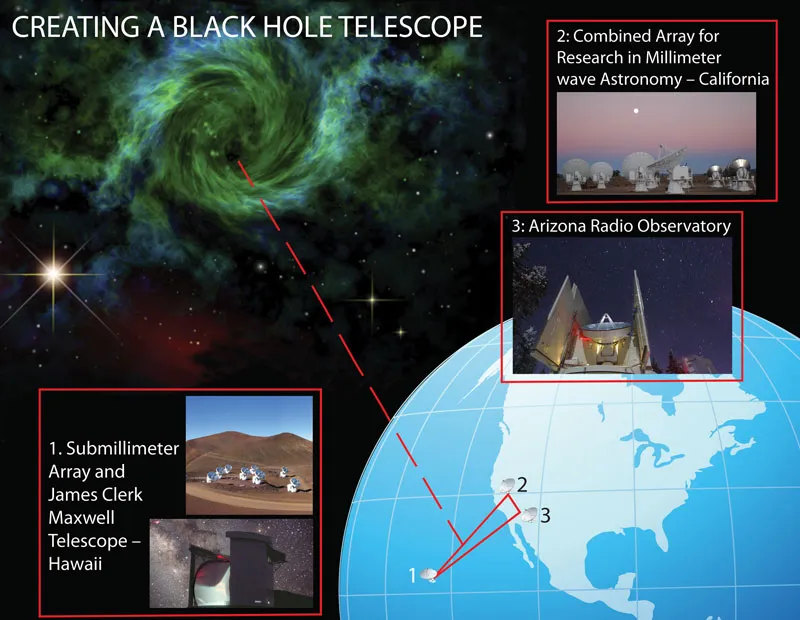
To create this continental telescope, the team developed and installed special equipment at four observatories: The Arizona Radio Observatory Submillimeter Telescope (ARO-SMT), the Combined Array for Research in Millimeter-wave Astronomy (CARMA) in California, and the James Clerk Maxwell Telescope (JCMT) and the Submillimeter Array (SMA) in Hawaii.
The results represent the first time that observations have a scale that matches the size of the black hole itself, which has a "Schwarzschild radius" of 16 million kilometers.
Similar observations had already been made, using the VLBI technique to study Sgr A*, as we reported in "The galaxy's black hole, closer"
Sources and related links
- MIT: New Virtual Telescope Zooms In On Milky Way's Super-massive Black Hole
- EurekAlert: Closest look ever at the edge of a black hole
- Event-horizon-scale structure in the supermassive black hole candidate at the Galactic Centre
Sheperd S. Doeleman et al.
Nature 455, 78-80 (4 September 2008) | DOI:10.1038/nature07245
About the images
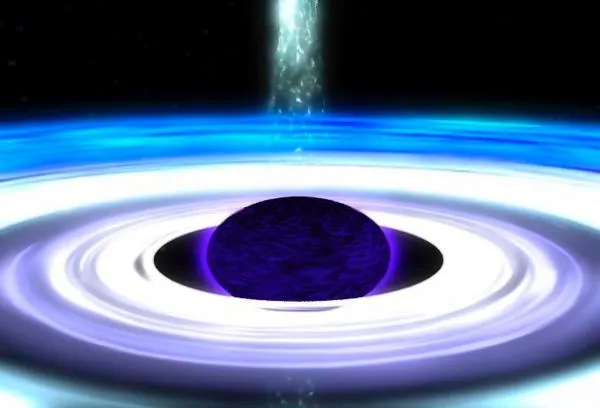
Image from a computer animation of a rotating black hole
Credit: NASA
The 4 radio telescopes used and their location:
1-Submillimeter Array and the James Clerk Maxwell Telescope in Hawaii
2-Combined array for research in millimeter wave astronomy, California
3-Arizona Radio Observatory
Courtesy: Sheperd Doeleman, MIT
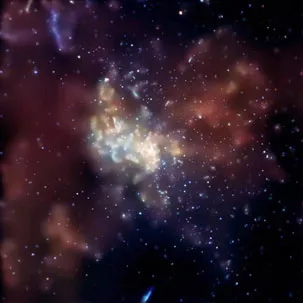
The supermassive black hole of the Milky Way, Sgr A*.
Credit: NASA, CXC, MIT, F.K.Baganoff et al