Astronomers used two different telescopes simultaneously to study the violent outbursts from the supermassive black hole at the center of the Milky Way. They detected eruptions from this region, known as Sagittarius A*, which reveal material being torn apart as it approaches the intense gravity of the central black hole.
The team of European and American astronomers used the Very Large Telescope (VLT) and the Atacama Pathfinder Experiment (APEX) in Chile to study light from Sagittarius A* at near-infrared and submillimeter wavelengths. This is the first time astronomers have detected an eruption with these telescopes simultaneously.
"Observations like this, over a range of wavelengths, are really the only way to understand what's happening near the black hole," says Andreas Eckart of the University of Cologne and leader of the team.
Sagittarius A* is located at the center of our Milky Way at a distance of 26,000 light-years from Earth. It is a supermassive black hole with a mass of about 4 million times the mass of the Sun. It is thought that most galaxies possess a supermassive black hole at their centers.
"Sagittarius A* is unique, because it is the closest of these monstrous black holes, within our own galaxy," explains Frederick K. Baganoff of the Massachusetts Institute of Technology.
The emission from Sagittarius A* is thought to come from gas ejected from stars, which then orbits and falls into the black hole.
Carrying out simultaneous observations requires careful planning between the teams at the two telescopes. Then, it's a matter of waiting for the right moment.
When the VLT astronomers observed that Sag A* was active and becoming brighter each minute, they alerted their colleagues at APEX. Over the next six hours, the team detected violent, variable infrared emission with four major eruptions from Sagittarius A*. The results at submillimeter wavelengths also show eruptions but which occurred an hour and a half after the infrared ones.
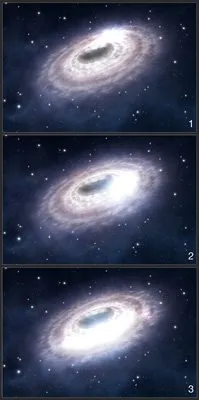
The researchers explain that this time delay is likely caused by the rapid expansion, at speeds of about 5 million kilometers per hour, of the gas clouds emitting the eruptions.
Sources and related links
- Astronomers detect matter torn apart by black hole
- Simultaneous NIR/sub-mm observation of flare emission from SgrA*
A. Eckart et al.
arXiv:0811.2753v1
Forthcoming in Astronomy and Astrophysics
DOI:10.1051/0004-6361:200810924
About the images
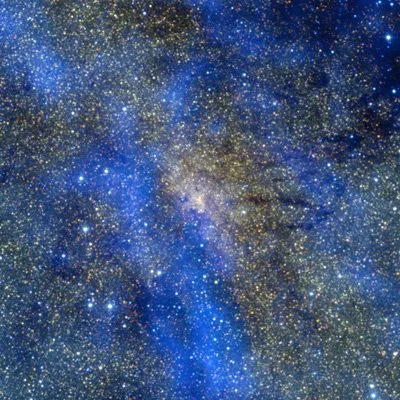
Color composite of the central region of the Milky Way. Giant clouds of gas and dust are shown in blue, detected by the LABOCA instrument on the Atacama Pathfinder Experiment (APEX) telescope at submillimeter wavelength. The image also contains near-infrared data from the 2MASS project, in red, green, and blue. The image shows a region approximately 100 light-years in diameter.
Credit: ESO/APEX/2MASS/A. Eckart et al.
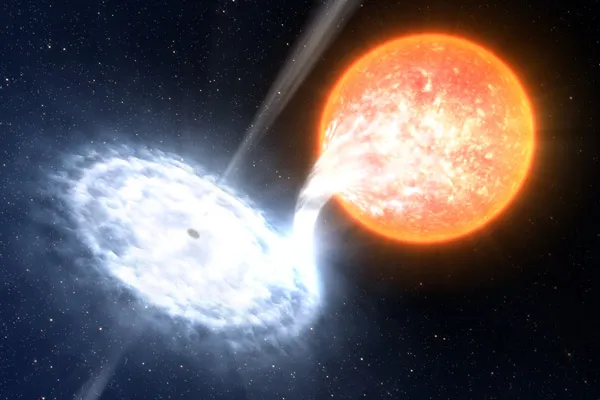
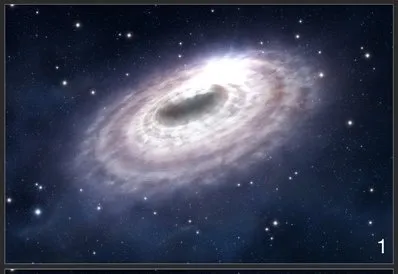
This series of images shows an artist's impression of a bright bubble of gas in the disk of material surrounding the black hole at the center of our galaxy, Sagittarius A*. This bubble of material is responsible for the eruptions detected by the researchers. As it orbits the black hole, it is stretched and this expansion over time causes the delay between the eruptions detected at the different wavelengths.
Credit: ESO/L. Calçada