NASA supercomputer simulations of dust disks around a star like our Sun show that planets as small as Mars can create patterns that future telescopes may be able to detect. The research opens a new avenue in the search for habitable planets.
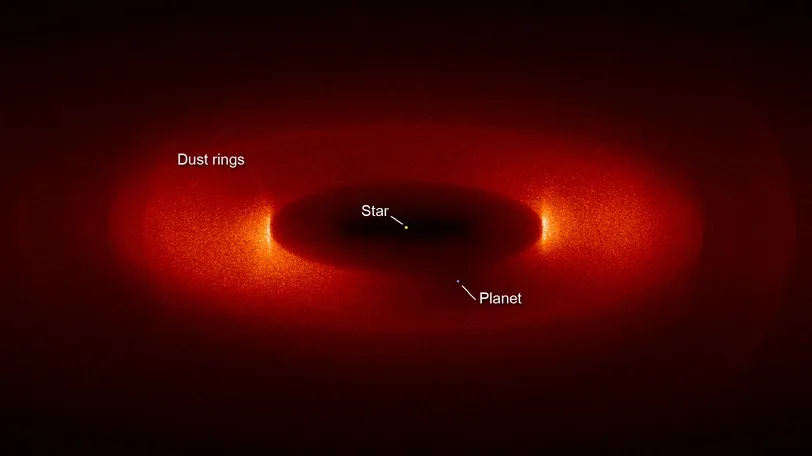
"It may be a while before we can directly image Earth-like planets around other stars, but, before then, we'll be able to detect the ornate and beautiful rings they carve in interplanetary dust," says Christopher Stark, the researcher who led the study at the University of Maryland.
Working with Marc Kuchner of the Goddard Space Flight Center, Stark modeled how 25,000 dust particles responded to the presence of a single planet—with masses ranging from that of Mars to five times the mass of our planet—orbiting a star like our Sun. Using NASA's Thunderhead supercomputer, the scientists ran 120 different simulations varying in dust particle size and the planet's mass and orbital distance.
"Our model uses ten times more particles than previous simulations. This allowed us to study the contrast and shapes of the ring structures," notes Kuchner. From this data, the researchers mapped the resulting density, brightness, and heat for each set of parameters.
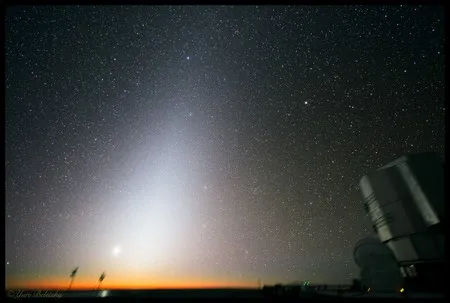
Much of the dust in our solar system forms inside Jupiter's orbit, from comets breaking up near the Sun and from asteroids of all sizes colliding. The dust reflects sunlight and can sometimes be seen as a glow in the sky, called Zodiacal Light, before sunrise or after sunset.
The computational models account for the dust's response to gravity and other forces, including the star's light. Starlight exerts a small pull on the tiny particles that causes them to lose orbital energy and bunch up closer to the star.
The particles, the experts explain, can become trapped in "resonances" with the planet. A resonance occurs when the orbital period of the particles is a small fraction, like two-thirds or five-sixths, of the planet's.
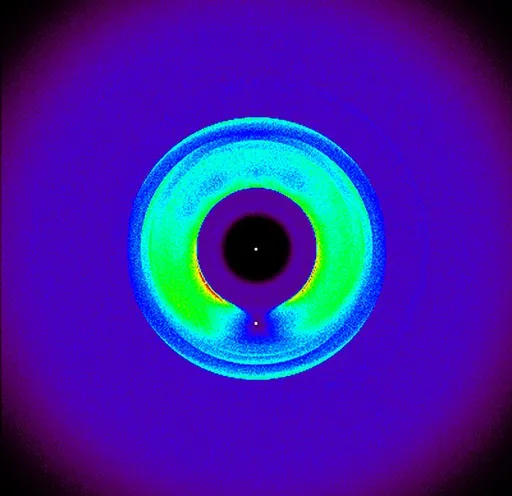
For example, if a dust particle makes three orbits around its star every time the planet completes one, the particle will repeatedly feel an extra gravitational pull at the same point in its orbit. This extra pull can offset, for a time, the drag from starlight and the dust can settle into ring-like structures.
"The particles spiral toward the star, get trapped in a resonance, fall out of it, continue their spiral, get trapped again in another resonance, and so on," explains Kuchner.
Some scientists note that the presence of large amounts of dust presents an obstacle to directly imaging planets like ours around other stars. Future space missions, such as NASA's James Webb Space Telescope, now under construction and scheduled for launch in 2013, and the proposed "Terrestrial Planet Finder" will study nearby stars with dust disks. The models created by Stark and Kuchner give astronomers a preview of the dust structures that indicate the presence of otherwise hidden worlds.
"Our catalog will help others infer a planet's mass and orbital distance, as well as the predominant particle sizes in the rings," adds Stark.
Stark created an "atlas" of the exo-zodiacal dust simulations, available online: Exozodi Simulation Catalog.
Thunderhead
The computational model requires a large supercomputer to perform the calculations for the 25,000 dust particles in question.
For this, a cluster called Thunderhead was used. A cluster is a set of computers connected by a high-speed network, which behave as if they were a single system.
Thunderhead is a 512-processor cluster located at the Goddard Space Flight Center. It features 2.4 Ghz Pentium 4 Xeon processors, 256 Gb of DDR memory, 20 Tb of disk, and a 2.2 Gbps Myrinet network.
Sources and related links
- NASA Supercomputer Shows How Dust Rings Point to Exo-Earths
- The Detectability of Exo-Earths and Super-Earths Via Resonant Signatures in Exozodiacal Clouds
Christopher C. Stark and Marc J. Kuchner
The Astrophysical Journal, 686:637–648, October 10, 2008
DOI:10.1086/591442
About the images
A planet twice the mass of ours forms a ring-like dust structure in this simulation.
Credit: NASA/Christopher Stark, GSFC
A glow called zodiacal light can be seen in the sky before sunrise or after sunset. It is formed by sunlight scattered from dust near the plane of Earth's orbit.
Credit: Yuri Beletsky/ESO Paranal
Colors indicate density in this front view of dust sculpted by an Earth-mass planet. Purple regions are of lower density and red ones, of higher.
Credit: ASA/Christopher Stark, GSFC