New observations from the Spitzer Telescope indicate that the planetary system closest to Earth has two asteroid belts. The host star of the system, Epsilon Eridani, is a younger and cooler version of our Sun. Previously, astronomers discovered evidence of two possible planets in the system and of a ring of icy comets similar to our Kuiper Belt.
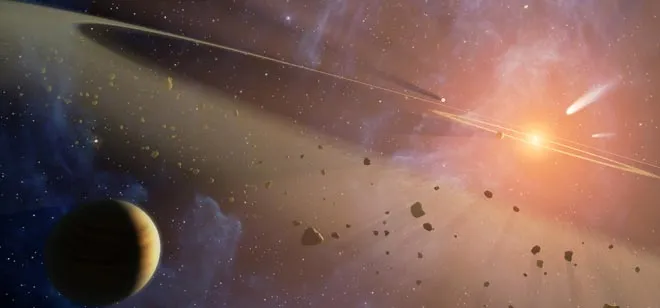
Now, the Spitzer Space Telescope discovers that the system has two belts. One lies at approximately the same distance as the asteroid belt in our solar system. The second, denser one, likely also populated mostly by asteroids, lies between the first belt and the comet ring. The presence of the belts would imply additional planets in this system.
"The system probably looks very similar to ours when life took root on Earth," says Dana Backman, an astronomer at the SETI Institute in California and director of the Sofia mission.
"The main difference we know so far is that it has an additional ring," indicates the author of a report with the results that will appear in Astrophysical Journal on January 10.
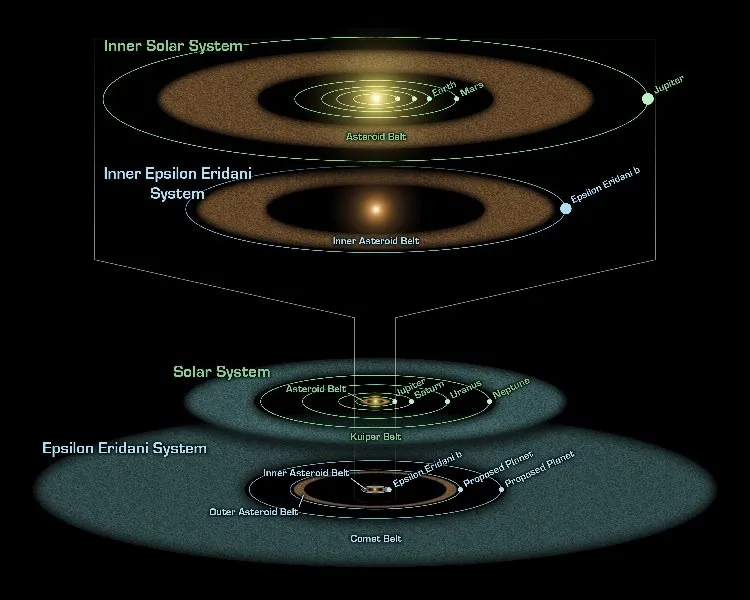
Asteroid belts are debris of rocks from the early phases of planetary formation. Their presence around other stars indicates that rocky planets like ours may be orbiting in the inner regions of the system, while massive gaseous planets do so near the boundaries of the belts. In our solar system, for example, there is evidence that Jupiter, which lies just beyond our asteroid belt, caused the formation of the belt by stirring the material, which otherwise would have merged into a planet. Today, Jupiter helps keep our asteroid belt confined in a ring.
Astronomers have detected stars with signs of multiple belts of material before, but Epsilon Eridani is much closer to our planet and more similar to our Sun. It is located only 10 light-years away, is just a little less massive than the Sun, and is about 800 million years old (one-fifth the age of our star).
Because the star is so close and similar to the Sun, it is popular in science fiction. The television series Star Trek and Babylon 5 refer to Epsilon Eridani, and it has been mentioned in novels by Isaac Asimov and Frank Herbert, among others.
The popular star was also one of the first in which signs of other civilizations were sought using radio telescopes in 1960.
Spitzer observed Epsilon Eridani with its two infrared cameras and its infrared spectrometer. When asteroids and comets collide or evaporate, they release small dust particles that emit heat that Spitzer can detect. "Because the system is so close Spitzer can pick up details of the dust, giving us a good look at the architecture of the system," indicates co-author Karl Stapelfeldt of JPL.
The detected belts orbit at approximate distances of 3 to 20 astronomical units (AU) from the star. Our belt lies at about 3 AU from the Sun and Uranus is at about 19 AU.
One of the two planets previously identified around the star, called Epsilon Eridani b, was discovered in 2000. The planet is thought to orbit at an average distance of 3.4 AU from the star, just outside the innermost belt identified by Jupiter. This is the first time an asteroid belt and a planet, beyond our solar system, are found in an arrangement similar to that of our belt and Jupiter.
Some researchers reported that Epsilon Eridani b orbits in an exaggerated ellipse between 1 and 5 AU, but this would mean the planet would cross and disturb the belt. Instead, Backman and her colleagues say this planet must have a more circular orbit that keeps it outside the belt.
The other candidate planet was proposed in 1998 to explain the observed irregularity in the star's outer comet ring. It is thought to lie near the inner edge of the ring, which orbits between 35 and 90 AU from the star.
The intermediate belt detected by Spitzer suggests that a third planet could be responsible for creating that material. This planet could orbit at about 20 AU and lie between the other two planets. "Detailed studies of the dust belts in other planetary systems tell us a lot about their complex structure," notes Michael Werner, co-author of the report.
Sources and related links
- Closest Planetary System Hosts Two Asteroid Belts
- JPL:Closest Planetary System Hosts Two Asteroid Belts
- Solar System's Young Twin Has Two Asteroid Belts
- Epsilon Eridani's Planetary Debris Disk: Structure and Dynamics Based on Spitzer and CSO Observations
D. Backman, M. Marengo et al.
Submitted to The Astrophysical Journal
About the images
The diagram compares the Epsilon Eridani system with our solar system. Both systems are structured similarly and both host asteroids (brown), comets (blue), and planets (white dots).
Credit:NASA/JPL-Caltech